


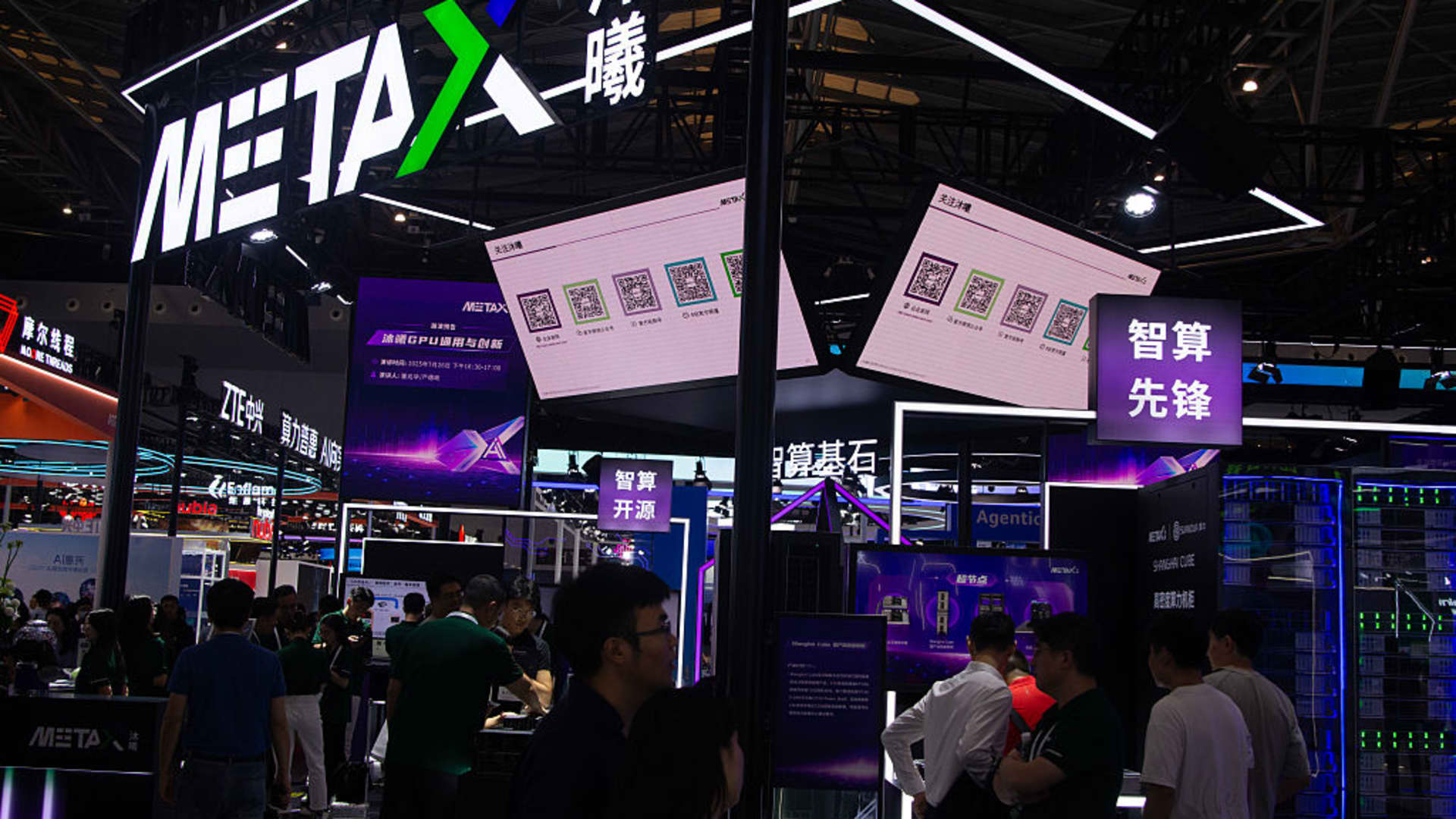
MetaX booth at the Shanghai New Expo Center in Shanghai, China, on July 26, 2025. (Photo by Ying Tang/NurPhoto via Getty Images)
Nurphoto | Nurphoto | Getty Images
It felt like déjà vu when shares of chipmaker MetaX Integrated Circuits soared 700% in its Shanghai market debut on Wednesday. Moore Threads surged over 400% on its first day of trading just two weeks earlier.
They’re the latest Chinese AI chip companies the country’s investors are ploughing money into, as it races to develop its own semiconductors and challenge Nvidia’s dominance in the face of U.S. export curbs.
Both are developing graphics processing units (GPUs), the type of chip manufactured by Nvidia and used for advanced AI.
Investor enthusiasm around Chinese AI-chip IPOs is partly shaped by longer-term expectations that China will build a self-sufficient semiconductor ecosystem as tensions with the U.S. continue, Macquarie’s equity analyst Eugene Hsiao told CNBC.

Washington has barred sales of Nvidia’s most advanced semiconductors to the country. While U.S. President Donald Trump relaxed export curbs for some Nvidia chips, regulators in the country were planning to limit access to the company’s processors, the Financial Times reported earlier this month, as it looks to wean itself off overseas tech in the AI race.
None of China’s AI chipmakers — which include a cohort of tech giants like Huawei, Alibaba and Baidu — have been able to develop processors comparable to Nvidia’s most advanced so far.
But while significant barriers remain in overcoming export control restrictions in some areas of its chip supply chain, like equipment, it’s made significant strides in others, such as memory.
Here’s how the market of China’s AI chip Nvidia rivals is shaping up.
Huawei
Privately-owned tech giant Huawei develops the Ascend series of chips, with its next-generation model, the 950, to be launched in 2026. Nvidia told CNBC that “competition has undeniably arrived” when the new systems were announced.
While its previous Ascend models have not been considered competitive with Nvidia’s on a chip-by-chip basis, Huawei has been able to build high-performance “clusters” to rival the US chipmaker’s most advanced systems by linking more of its processors.
“This strategy relies on high-speed, potentially optical interconnects to move data quickly across large clusters – a setup that doesn’t require top-end chips and therefore suits China’s current strengths,” Brady Wang, associate director at Counterpoint Research, told CNBC in November.

Baidu
China’s biggest search platform, Baidu, has increasingly funneled more resources into AI and is a majority shareholder in chip designer Kunlunxin. In November, the company unveiled a five-year roadmap for its Kunlun AI chips, unveiling new processors in 2026 and 2027.
Baidu, which is traded on the Nasdaq, uses a combination of self-developed chips and Nvidia products in its data centers to run its in-house AI models. The company has looked to position itself as a “full-stack” provider, producing chips, servers, data centers, and AI models and applications.
“Kunlunxin has emerged as a leading domestic AI chip developer, focusing on high-performance AI chips for large language model (LLM) training and inference, cloud computing, and telecom and enterprise workloads,” analysts at Deutsche Bank said in a note in November.
JPMorgan said in a November note that it viewed the Kunlun AI chip as one of the “best-positioned” as Chinese hyperscalers increasingly source from local solution providers.
Alibaba
E-commerce giant Alibaba — which is sometimes compared with Amazon as it is one of the biggest cloud providers locally — began developing AI chips in the late 2010s. It was developing a new AI chip in August, CNBC reported, specifically designed for inference rather than training.
Alibaba’s share rose in September after reports that the company had secured a major customer for its AI chips.
“Improved performance of its self-developed chip” was one of the factors that supported revenue growth in the cloud division at Alibaba, Morningstar analyst Chelsey Tam said in September.
Cambricon
Cambricon, which is developing chips for AI training and inference, posted record profits in the first half of 2025 as revenue surged. The chipmaker, founded in 2016, said revenue rose more than 4,000% year-on-year to 2.88 billion Chinese yuan ($402.7 million) and net profit hit a record 1.04 billion yuan.
“We view Cambricon as the most plausible winner in China’s AI accelerator market, which is still at its early stage when compared to the US market on chip accessibility issue,” Jamie Mills O’Brien, investment director at investment group Aberdeen, told CNBC by email.
“We see multiple roadblocks being digested in next 1-2 years, including fab maturity, client acceptance, and ecosystem formation, which is likely to set Cambricon a ‘good enough’ alternative to Nvidia’s downgraded chips in China.”
An illustration photo shows Moore Threads logo in a smartphone in Suqian, Jiangsu Province, China on October 30, 2025.
Cfoto | Future Publishing | Getty Images
Other AI chip companies
MetaX raised nearly $600 million in its initial public offering on Wednesday, five years on from its founding by former AMD executive Chen Weiliang.
Founded in 2020 by a former general manager of Nvidia’s Chinese arm, Moore Threads is sometimes referred to as “China’s Nvidia.”
It’s set to launch its latest GPU architecture at a Beijing developer conference later this week, according to a report in the South China Morning Post.
The company said in its listing that IPO proceeds were needed to accelerate core research and development initiatives, including producing new self-developed AI training and inference GPU chips.
Enflame was founded by former AMD employees in 2018 and designs chips for data centers focused on AI training and processes.
Biren Technology, founded in 2019, is designing high-performance GPUs and was approved for an IPO by the Chinese regulator on Tuesday, according to reports from Reuters and the South China Morning Post.
