


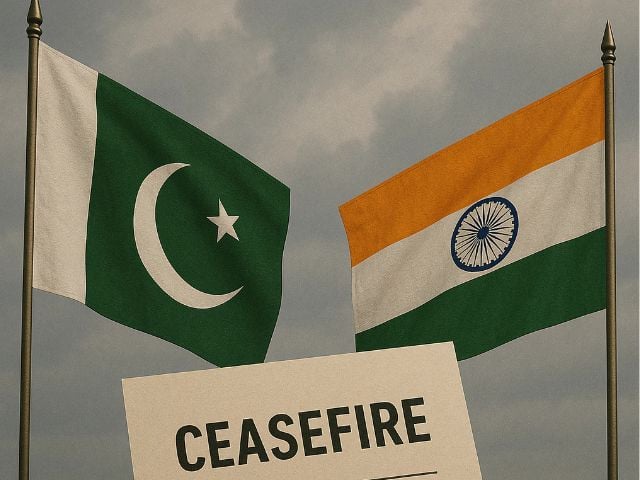
As the Modi-led regime’s war bravado crumbles under the weight of inconvenient truths emerging from the fog of war with Pakistan, a different kind of battle is now underway – one for the narrative, and perhaps, the so-called strongman’s political survival.
The ghosts of the 2017 Rafale deal have come knocking, with critics dredging up the old controversy to shame the government for what many are calling a historic failure.
Journalists and analysts alike argue that India has forfeited decades of carefully cultivated international standing, squandered at the altar of jingoism and over-the-top theatrics.
While the government has tried to muzzle dissent, social media platform X has become a pressure valve for public outrage. A once-unified commentariat now splinters into infighting, wounded pride, and even turning on its own, including the foreign secretary and Colonel Sophia Qureshi of India’s Army Signal Corps.
The veneer of control is cracking. India’s image as a regional hegemon and self-styled Vishwaguru is in free fall.
The fallout has spiralled to such an extent that India has been forced to beef up security for both the foreign minister and the foreign secretary, after a vicious online pile-on targeted the latter and his daughter.
“The police are also reviewing their security cover for Foreign Secretary Vikram Misri, and at least 25 leaders from the BJP, including Union Ministers, MPs and Delhi Chief Minister Rekha Gupta,” The Indian Express reported on Wednesday.
Tacit admission by the Indian Air Force (IAF)
It all began as international media and independent reports trickled in, steadily chipping away at the frenzied Indian media narrative, bursting one propaganda balloon after another.
The government’s response swung between deafening silence and evasive half-answers, doing little to stem the tide.
The final blow came when even the military couldn’t feed the war drumbeat or satisfy the Zionist-style fervour at home to wipe Pakistan off the map, leaving nationalist hawks with sabres rattled, but no battle to show for it.
“The Modi government is welcome to spin this any way it likes – i.e. that it is the Pakistanis who went running to the US saying ‘save us’, that India accomplished all that it set out to – but the reality is that Modi did something that has produced an unsavoury but quite predictable end result. Pakistan now believes J&K is back in play as an international issue and the US is also saying this,” said Siddharth Varadarajan, founding editor of The Wire.
“The Indian side has suffered military losses that it is reluctant to quantify because doing so will be to the ‘advantage of the adversary’ – an admission that these losses are non-trivial,” he added.
Varadarajan also observed that Modi’s right-wing zealots are disillusioned, accusing him of lacking the backbone to carry out his own rhetoric.
“The truth is that Modi knew all along that there is no military solution. Driven by his own political calculations, he recklessly embarked on a dangerous, ‘Balakot x 9’ course of action hoping that the consequences could be easily managed. But events proved him wrong.”
Even as an IAF officer tried to downplay the damage — “losses are a part of combat” — the remark was seen as a tacit nod to the widely reported downing of a Rafale jet.
For many Indians, a burning question remains: what, exactly, did Operation Sindoor achieve?
If deterrence was the aim, this looks more like a strategic misfire.
In his commentary, Varadarajan continued to cut deep. On the IAF’s vague accounting of its losses, he noted: “This is a significant admission, and the sad fact is that the IAF’s refusal to provide specifics will continue to lend credence to Pakistan’s claims of having shot down multiple Indian aircraft.”
“Everybody knows ‘all our pilots are back home’ is not the same as ‘all our planes are back home’. The refusal to acknowledge losses stems from the Modi government’s political compulsions because the resulting cost-benefit analysis may alter public perceptions about the utility of Op. Sindoor.”
Myth of Indian superiority shattered
The fog of war has cleared to reveal another unsettling truth: a handful of militants just pushed a nuclear power of billions to the brink of crisis.
Military analyst and journalist Pravin Sawhney argued that Operation Sindoor has dismantled the longstanding myth of Indian military superiority over Pakistan, a myth deeply tied to national self-worth.
As Washington pushes for de-escalation and hyphenates India with Pakistan once more, the symbolism is not lost.
“India worry of hyphenation with Pakistan is evidence that India does not believe in Global South nations thinking which it wants to lead,” Sawhney said.
“Their [Global South] thinking is about win-win, equality of nations big & small & development for all. This explains why Modi govt does not want to be close to BRICS & SCO. India’s security & foreign policy need course change after this operation!”
‘India weak link in BRICS’
Echoing this, in a separate post on why international media is “turning hostile” to India, Arnaud Bertrand, a commentator on economics and geopolitics, opined that much of it stemmed from India’s recent geopolitical positioning.
Its strategy of multi-alignment – engaging both the Global South and the West – is intended to appeal to both sides, but the outcome, as seen in global reactions to its altercation with Pakistan, has been quite the opposite: India is increasingly perceived as hedging its bets rather than standing on principle, ultimately breeding distrust from all quarters instead of the support it seeks to cultivate.
“Let’s be real: in the Global South people almost universally see India as the weak link in the BRICS, the country trying to undermine collective South-South cooperation whenever it conflicts with its parallel ambitions of being embraced by Western powers.”
He added that India’s Islamophobia alienates much of the Muslim-majority Global South, while in the West, Modi’s domestic record and ties with Russia make India seem like a misaligned, hard-to-identify-with player.
He pointed out that India’s economic stage, culture and historical context differ sharply from the West, fuelling a persistent undercurrent of othering, marked by colonial condescension mixed with strategic interest.
Add to that India’s toxic media climate and the combative nationalism seen online, and it becomes clear there’s a stark disconnect between how India views itself and how others perceive it.
He stopped short of being prescriptive, but noted: when people say “the international media is viciously against Bharat,” they might consider whether this is the natural consequence of a multi-alignment strategy that serves no one’s interests but India’s, and whether the reflexive victimhood narrative is blocking honest self-reflection.
‘Hugely disappointing’
In his scathing review of the Indian DGMOs’ press briefing, Sawhney said it was “hugely disappointing”. “Worse, it betrayed a sense of own war appreciation gone wrong.”
“NO mention of air war on night 6/7. And making the incredible remark that IAF hits inside Pakistan sovereign space were meant to kill terrorists & not fight Pakistan military – showed little thought had gone even in organising this media interaction whose proceeding the world would have watched with utter disbelief!”
He questioned the disproportionate focus on Indian air defences: “For sure, it was clear that Pakistan military employed unexpectedly large numbers of drones, loitering munitions & so on along the whole border with India.”
Meanwhile, columnist Brahma Chellaney — seen as aligned with the mainstream — raised sharp concerns: “Why did India, under US pressure, abruptly halt a military campaign against Pakistan just as its armed forces had seized the upper hand?”
He noted how New Delhi terminated the operation within three days, just after a phone call from JD Vance to Modi.
“The root cause of the conflict was left unaddressed, even as Washington shielded Pakistan from the consequences of its actions. The result? Donald Trump — the real estate mogul who has fancied acquiring Greenland, the Panama Canal and even Gaza — has now turned his gaze to Kashmir, while remaining conspicuously silent on the cross-border terrorism that India continues to face.”
The remarks were particularly striking coming from Chellaney, a known hawk who usually toes the establishment line.
Calls for resignation
Journalist Raju Parulekar minced no words, blaming Modi’s “irresponsible, jingoistic pseudo-nationalism” for squandering India’s diplomatic gains.
“Modi hasn’t learned from his past mistakes. Like Demonetisation, Pulwama, the current military response (“free-hand”) seems to be a MONUMENTAL MISMANAGEMENT, a BLUNDER.”
He suggested Modi walked straight into a trap set by those seeking to provoke a nationalist overreaction — one that brought no diplomatic advantage.
“Modi has always evaded responsibility in 11 years of his being the PM on any matter of governance. How can a PM repeatedly fail to submit himself to account in Lok Sabha and continue in Office of the 1.4 billion strong Democratic Republic like India.”
Before 2014, India pursued a clear Pakistan strategy — quiet diplomacy, strategic retaliation, and isolation of Islamabad on the global stage. But Modi’s politicisation of Pakistan and Kashmir, Parulekar argued, has upended that playbook.
He warned that the Pulwama airstrikes may have helped the BJP electorally, but they damaged India’s international credibility.
“Modi should be removed from his Office and made to face the detailed scrutiny of Law for denting India’s image and posing a serious threat to its sovereignty.”
‘More lessons to come’
Regarding the vicious trolling of Indian Foreign Secretary Vikram Misri, Faran Jeffery, deputy director and head of the South Asia desk on terrorism at ITCT, wrote a detailed post on X. “If they do that to their own Foreign Secretary, you can imagine the rest,” he noted.
He observed that while the focus so far had been on the military dynamics of this Indo-Pak round, the real fallout for India would emerge in other domains.
The world had been watching—and what it saw, he said, was a complete horror show. Perceptions have shifted dramatically: the media’s credibility is in the gutter, the supposedly independent journalists turned out to be little more than government propagandists and a diplomatic mess unfolded with Iran, driven by a media narrative run amok.
There was mass censorship, websites were blocked and social media accounts were restricted. Government messages bombarded the public, urging them to trust only official propaganda, while both TV and social media teemed with fake news and wild claims.
In a twist, it became easier to get more accurate information from the Pakistani side. Pakistan even lifted the ban on X during the conflict, which surprised many.
“Forget others,” he wrote, “many foreigners who praise India publicly have been joking about it privately”.
He concluded that this was a major reality check for India, one that should, in theory, help bring its arrogance down a notch or two. But, he added, that seems unlikely. More lessons, it appears, are yet to come.
