


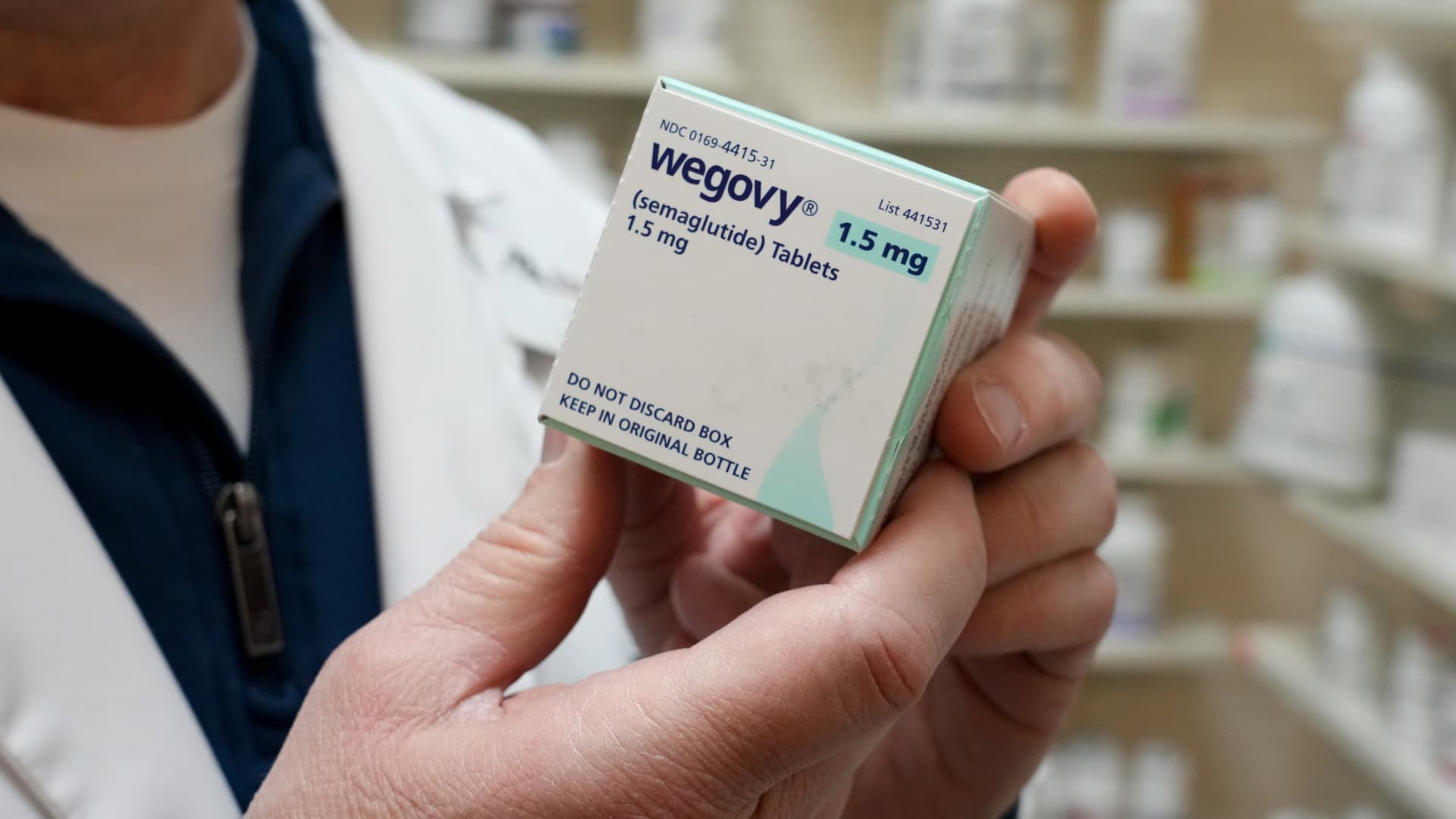
A pharmacist displays a box of Wegovy pills at a pharmacy in Provo, Utah, Jan. 15, 2026.
George Frey | Bloomberg | Getty Images
The future of the booming obesity drug market won’t hinge on drugs that deliver greater weight loss alone.
Top executives from drugmakers big and small told CNBC that the next phase of the space will be defined by a broader range of treatment options and improved access for patients. Those were among the themes that emerged at the annual JPMorgan Healthcare Conference in San Francisco during interviews with top brass from Eli Lilly, Novo Nordisk, Pfizer and other drugmakers.
“We really see the obesity market going from, in this year, a one-size-fits-all kind of idea to different medicines for different patients. We don’t have a crystal ball to know how that all sorts out,” Dan Skovronsky, Eli Lilly’s chief scientific officer, told CNBC in an interview at the conference.
“But I think by presenting people with options, they’ll pick for themselves with their doctors, and I think we want to have something for everyone,” he continued. “And we’re not done yet.”
Over the coming years, executives expect an expanding menu of obesity treatments that can be tailored to an individual patient’s needs — from pills and less-frequent injections to combination regimens and drugs designed to preserve muscle mass while promoting weight loss. Some also expect the direct-to-consumer market to become an even larger slice of the market, while hoping that hurdles preventing patients from getting treatment continue to fall.
Novo Nordisk and Eli Lilly are widely credited with establishing the market through their weekly GLP-1 injections for obesity and diabetes, which have surged in popularity in recent years. The next chapter is already taking shape, with Novo launching the first GLP-1 pill for obesity earlier this month and Lilly preparing to bring an oral option of its own to market later this year.
While those companies will play a critical role in how the space evolves, other players from pharma titan Pfizer to little-known upstarts could also enter the market — both threatening the two rivals’ sales dominance and offering more treatment alternatives for consumers.
While access remains a challenge for many patients, the ability to get GLP-1s has improved notably over the past year. Both Novo and Lilly have slashed cash prices for their injections and struck deals with President Donald Trump in November that will, for the first time, introduce Medicare coverage for obesity drugs later this year.
More treatment options and wider access could boost the case for analyst projections that say the weight loss and diabetes drug market could be worth almost $100 billion annually by the end of the decade.
In an interview at the conference, Novo Nordisk CEO Mike Doustdar said the company and Lilly currently have around 15 million people combined who have obesity taking GLP-1s. There is still a “long tail” to reaching the 110 million that are reportedly suffering from the condition, along with those who are overweight, he added.
In a May report, McKinsey said it expects a range of 25 to 50 million U.S. patients to use GLP-1s by 2030.
Here’s what executives say the future of the space could look like.
The pill potential
Pills have not yet proven more effective than injections.
Still, the consensus among executives is that oral options could expand the market, reaching entirely new patients. That may include people who are afraid of needles, as well as people who could benefit from existing injections but don’t view their condition as severe enough to warrant a weekly shot.
In an interview at the conference, Doustdar said it could also include people who travel frequently and can’t easily refrigerate injections.
“There is so much aligned exactly with this market expansion story … because there is a huge number of patients that are simply not interested in losing weight at the cost of injecting themselves,” Doustdar said.
The “real growth” and uptake of the pills is going to come from primary care physicians, who write the majority of prescriptions for Americans and typically prefer pills to injections, said Ray Stevens, the CEO of obesity market hopeful Structure Therapeutics.
He said he believes his company’s GLP-1 pill, aleniglipron, will be the third to enter the market after Eli Lilly’s and Novo Nordisk’s. Structure’s oral drug will enter Phase 3 trials this year.
Daily pills can offer more flexibility to patients. For example, Stevens said a patient could cut a pill in half to mitigate side effects on a day when they have an important meeting to attend.
Lilly’s Skovronsky said pills will also serve as a way for patients to “deescalate their therapy” after taking injections. The company in December released data showing that patients who initially took Wegovy or Zepbound shots maintained the majority of their weight loss after switching to Lilly’s pill.
“They say, ‘I’ve lost the weight, I’ve got this, so I can maintain this on my own with something less strong,'” Skovronsky said.
Structure is also developing an oral drugs that targets amylin, an emerging form of weight loss treatment that mimics a hormone co-secreted with insulin in the pancreas to suppress appetite and reduce food intake. Novo is developing a medicine called amycretin, which targets both GLP-1 and amylin to offer potentially enhanced weight loss.
Mixing and matching drugs
Stevens said combination regimens are “going to be the next phase of the field.”
For example, Structure hopes to combine its oral GLP-1 and amylin drugs to achieve even greater weight loss than one alone would, which he said will likely be “one of the best combos of the future.” It’s too early to say which patients would be the best fit for that regimen, but Stevens said it could achieve “good tolerability, really good patient experience and good efficacy.”
He said the company is already working on manufacturing the two ingredients together in a single pill, which is similar to what Novo’s amycretin achieves.
But he said combination regimens can also help treat certain obesity-related conditions better than one product alone. That could look like combining a GLP-1 with one of the existing treatments for fatty liver disease.
“I feel like the winners are now starting to emerge for the monotherapy” treatments, he said. But Stevens said the treatment patients take will segment according to the other health conditions a person has on top of obesity, such as fatty liver disease, chronic kidney disease and cardiovascular disease.
Lilly’s upcoming pill is an oral GLP-1, but Skovronsky said the company can see the potential for a pill that targets that hormone along with another called GIP, since that’s a “preferred formulation.”
That’s how tirzepatide, the active ingredient in Lilly’s blockbuster obesity and diabetes injections, works. That drug has proven to be more effective than semaglutide, the active ingredient in Novo Nordisk’s rival injections, which only targets GLP-1.
Skovronsky said, “we’re working hard to create those medicines” in an oral form, but aren’t ready to disclose any details.
Pfizer inherited several experimental injections and pills with combination potential from its roughly $10 billion acquisition of the obesity biotech Metsera last year.
But Pfizer CEO Albert Bourla said the company is also developing an in-house oral drug that blocks the GIP receptor, which can significantly reduce side effects when combined with GLP-1.
“I have very high hopes that it will also differentiate,” Bourla said.
One biotech, Wave Life Sciences, also sees combinations as part of its broader strategy, its CEO Paul Bolno said in an interview at the conference.
Different weight loss methods
Wave is taking a different approach to weight loss, targeting how the body burns fat rather than suppressing appetite. The goal is to achieve comparable weight loss to GLP-1s, without the associated muscle loss, and with less frequent dosing of once or twice a year rather than weekly.
That push comes amid growing focus on the quality of weight loss with next-generation obesity drugs, as GLP-1 treatments have raised concerns around muscle loss, side effects and patient drop-offs.
Wave has an experimental injection that uses RNA technology to lower levels of a protein called activin E – a liver-produced protein that slows fat burning. By reducing that protein, Wave believes the drug can increase fat loss, particularly harmful visceral fat, while preserving lean muscle mass.
Bolno said the company is developing the injection, called WVE-007, as a monotherapy or a potential maintenance treatment that patients can switch to and take far less frequently after being on GLP-1s.
But he also sees the opportunity to combine the company’s injection with GLP-1s to “continue to drive benefits.”
“We can double the weight loss on GLP-1s in combination,” Bolno said, referring to what the company is seeing in preclinical research.
He said adding Wave’s injection on top of a GLP-1 won’t make it more difficult for patients to tolerate the treatment regimen, so it makes the company’s drug “very amenable to combination” options.
As for who can use Wave’s injection, Bolno said it will work for any patient since “this happens to be a target that’s actually in human genetics.”
The future of the industry will likely also include drugs that can achieve even greater weight loss than the current treatments on the market.
Lilly in December released the first late-stage data on an injectable drug called retatrutide, the highest dose of which achieved more than 28% weight loss at 68 weeks among patients who stayed on the treatment. Lilly will read out data on seven other Phase 3 trials on the drug this year.
Dubbed the “triple G” drug, retatrutide works by mimicking three hunger-regulating hormones — GLP-1, GIP and glucagon — rather than just one or two. That appears to have more potent effects on a person’s appetite and satisfaction with food than other treatments.
Skovronsky said the drug could serve patients who need additional weight loss or have other severe health conditions on top of obesity, such as arthritis knee pain.
Novo Nordisk is racing to catch up: In March, it agreed to pay up to $2 billion for the rights to an early experimental drug from Chinese drugmaker United Laboratories International. The newly acquired treatment is a clear potential competitor to retatrutide because it similarly uses a three-pronged approach to promoting weight loss and regulating blood sugar.
Patient access to drugs
The industry has made strides toward improving drug access for patients, and executives expect that will continue. The cash price of Novo’s pill is already the lowest seen on the market, at $149 for the starting dose and up to $299 for the higher doses.
GLP-1 injections are roughly $1,000 per month before insurance and without recent cash discounts.
Both Pfizer’s Bourla and Lilly’s Skovronsky said upcoming Medicare coverage of obesity drugs should also move the needle with coverage.
“Once the government starts covering it in Medicare, it probably will become more and more uncomfortable for employers to not — it’s that societal pressure,” Skovronsky said.
He also pointed to an “activation of consumers,” where patients are starting to call their employers and ask why their benefits don’t cover obesity drugs.
Drugmakers, researchers and scientists are also generating more data about the benefits of obesity drugs for health-care spending, which could help spur more employer coverage, Skovronsky said.
“So for employers, is there less absenteeism? Is there better productivity? Is there better medical costs?” he said. “The data’s coming in, and we’re seeing more and more of that.”
In terms of the direct-to-consumer channel, Skovronsky said it may become the “fastest-growing segment” of the space given the recent push for drugmakers to launch cash offerings.
Lilly was among the first companies to launch a direct-to-consumer platform in 2024 offering its obesity drug Zepbound at a discount, and Novo followed more than a year later.
Bourla estimated that the direct-to-consumer channel already makes up 30% of the obesity and diabetes drug market in the U.S. It could become closer to 90% or more of that market abroad, he added.
When asked about what the broader market will look like by 2030, Structure’s Stevens said he hopes access and affordability are no longer issues.
“I’m okay with the cost dropping because, to me, this has always been about volume and really trying to address a very large unmet need globally itself,” he said.
