


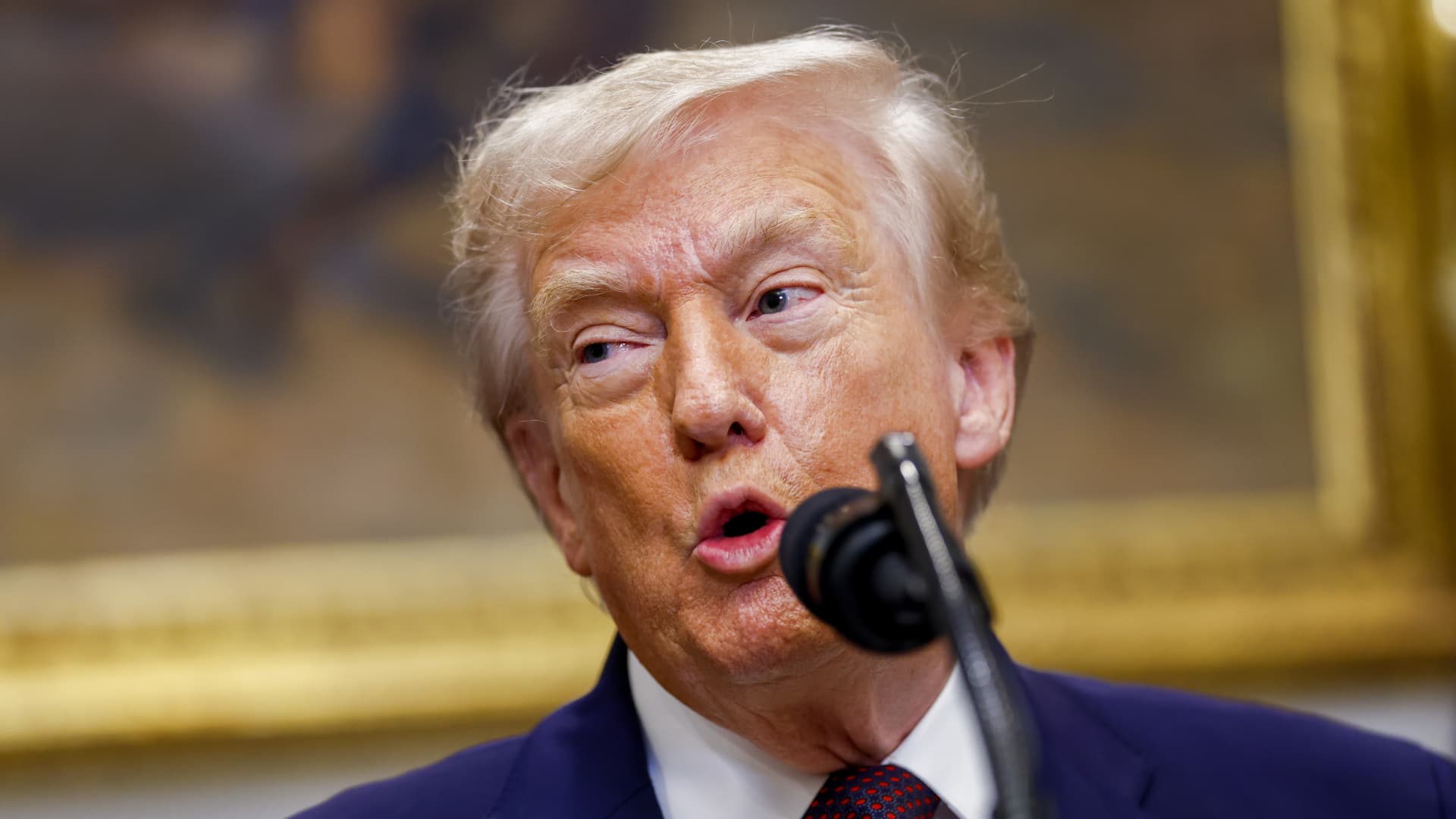
US President Donald Trump during an announcement in the Roosevelt Room of the White House in Washington, DC, US, on Friday, Dec. 19, 2025.
Will Oliver | Bloomberg | Getty Images
Several of the largest U.S. and European-based drugmakers inked deals with President Donald Trump on Friday to voluntarily sell their medications for less, as his administration pushes to link the nation’s drug prices to cheaper ones abroad.
That includes Merck, Bristol Myers Squibb, Amgen, Gilead, GSK, Sanofi, Roche’s Genentech, privately-held Boehringer Ingelheim and Novartis. In exchange, the companies agreed to a three-year grace period during which their products won’t face Trump’s planned pharmaceutical-specific tariffs – as long as the drugmakers further invest in U.S. manufacturing.
Among the most notable pledges on Friday is that Bristol Myers Squibb will offer Eliquis, its blockbuster blood thinner and top-prescribed product, for free to Medicaid.
The companies make up the majority of the 17 drugmakers Trump sent letters to in July, calling on them to lower prices as part of his “most favored nation” policy. Trump signed an executive order in May to revive that policy, calling for prices to be increased outside of the U.S. and to “end global freeloading.”
“As of today, 14 out of the 17 largest pharmaceutical companies … have now agreed to drastically lower drug prices for … the American people and the American patients,” Trump said at an event on Friday. “This represents the greatest victory for patient affordability in the history of American health care, by far, and every single American will benefit.”
Johnson & Johnson, AbbVie and Regeneron are the remaining companies among the largest that haven’t signed drug pricing deals. But Trump noted that Johnson & Johnson “will be here next week.”
How the drug pricing deals will work
The full terms of the deals were not immediately released, which makes it unclear how broad their impact will be.
The nine drugmakers agreed to take measures to reduce U.S. drug prices, including selling their existing treatments to Medicaid patients at the lowest “most favored nation” prices, and guaranteeing that pricing for new medicines. Trump said the drugmakers also agreed to list their most popular drugs on his upcoming direct-to-consumer website, TrumpRx, which is launching in January.
Some companies also launched new or expanded existing direct-to-consumer offerings for certain drugs. For example, Gilead said in a release that it will launch a program that will allow patients to access its Hepatitis C treatment and cure, Epclusa, at a discounted price.
Sanofi said it will offer discounts of nearly 70% on certain medicines to treat infections and cardiovascular and diabetic conditions on TrumpRx and other direct-to-consumer platforms.
Merck said it will offer three diabetes medications, Januvia, Janumet and Janumet XR, at a roughly 70% discount to cash-paying patients through a direct-to-patient program. That program will be extended to the company’s experimental daily cholesterol pill if it gets approved in the U.S., according to the company.
“I reflect on your goal of driving affordability and access to Americans, but equally, getting prices up outside the United States,” Merck CEO Robert Davis said during the press conference. “And we’re 100% supportive of your actions.”
Meanwhile, Amgen will expand its existing direct-to-patient program to include preventative migraine medication Aimovig and autoimmune treatment Amjevita, at 60% and 80% discounted monthly prices, respectively.
Earlier this year, Trump announced agreements with Eli Lilly, Novo Nordisk, Pfizer, AstraZeneca and EMD Serono to sell certain drugs directly to patients at a discount, in exchange for exemptions from his planned pharmaceutical tariffs and other benefits, such as fast-tracked reviews of new drugs.
U.S. prescription drug prices on average are nearly three times higher than overseas, according to a 2024 study by RAND Corporation. Prices for branded drugs were more than four times higher, the report found.
Trump signed an executive order in May to revive the most favored nation policy, calling for prices to be increased outside of the U.S. and to “end global freeloading.”
Trade association PhRMA, which represents many major pharma companies, has said that most-favored nation pricing isn’t the best way to lower drug costs for Americans, and instead blamed pharmacy benefit managers for the price disparity.
The U.S. is the single most important market for many drugmakers, regardless of their home country. Despite being based across the Atlantic, European pharma companies are heavily exposed to the U.S. market, with half of the 10 largest companies on the continent generating a majority of their sales in the U.S.
