


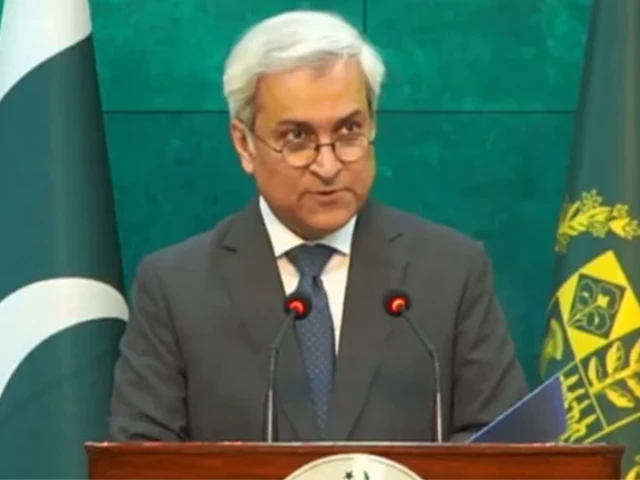
Says he cannot call many news items or sets of information as ‘blanket fake or a blanket misinformation’
Pakistan’s Foreign Office has denied any knowledge of reported negotiations between Pakistan and Afghanistan in Saudi Arabia, stating that Pakistan’s border with Afghanistan would remain closed until Kabul provided firm assurances that cross-border terrorist infiltration would be prevented.
Addressing a weekly news briefing, Foreign Office spokesperson Tahir Hassan Andrabi said, “I can check specific news and call it fake or otherwise. However, I cannot call many news items or sets of information as a blanket fake or a blanket misinformation.”
The Foreign Office’s remarks came in the backdrop of a Reuters report claiming that Pakistan and Afghanistan recently participated in a third round of peace talks in Saudi Arabia, hosted jointly by Saudi Arabia, Turkiye, and Qatar. The report said no major breakthrough was achieved, though both sides agreed to maintain the ceasefire.
Andrabi said the matter was not limited to the TTP or TTA alone, as several Afghan nationals had also been involved in serious crimes inside Pakistan. He emphasised that the border closure must be viewed in its proper security context.
Pakistan has no dispute with the Afghan people and has always facilitated humanitarian corridors, but its border policy was tied directly to practical cooperation from Afghanistan in eliminating terrorism emanating from its soil, said the spokesperson.
He added that the border would reopen only when Afghanistan ensured that terrorists and their facilitators would not enter Pakistan.
The spokesperson referred to Turkish President Recep Tayyip Erdoğan’s earlier announcement about a high-level delegation visiting Islamabad, saying the change in schedule could be due to logistical issues or a lack of cooperation from the Taliban. He said Pakistan had closed the border for its own protection and did not want its citizens to fall victim to terrorism.
Responding to questions about Russian President Vladimir Putin’s visit to India and possible bilateral defence agreements, Andrabi said Pakistan had no specific position on the matter, as sovereign states were free to strengthen their relations independently.
He, however, expressed concern over discriminatory policies targeting Muslims in India, saying state patronage had emboldened extremist groups. He noted that the 33rd anniversary of the demolition of the Babri Mosque would be observed on Saturday, calling the event a continuing source of sorrow.
He emphasised the need for transparent accountability of damage caused to Muslim religious symbols and heritage, saying that desecration of any sacred site violated principles of religious equality.
Andrabi also highlighted the recent visit of the Kyrgyz president to Pakistan, during which delegation-level meetings were held with Prime Minister Shehbaz Sharif. Both countries agreed to strengthen bilateral ties and enhance trade to $200 million by 2027–28.
The FO spokesperson said, 15 MoUs were signed during the visit and that the Kyrgyz president addressed a business forum, attended by more than 20 Kyrgyz companies and over 80 Pakistani businessmen.
He added that Foreign Minister Ishaq Dar had also met the Kyrgyz leadership and also received Egypt’s foreign minister during his visit to Islamabad, where Dar inaugurated the Islamabad Conclave.
