


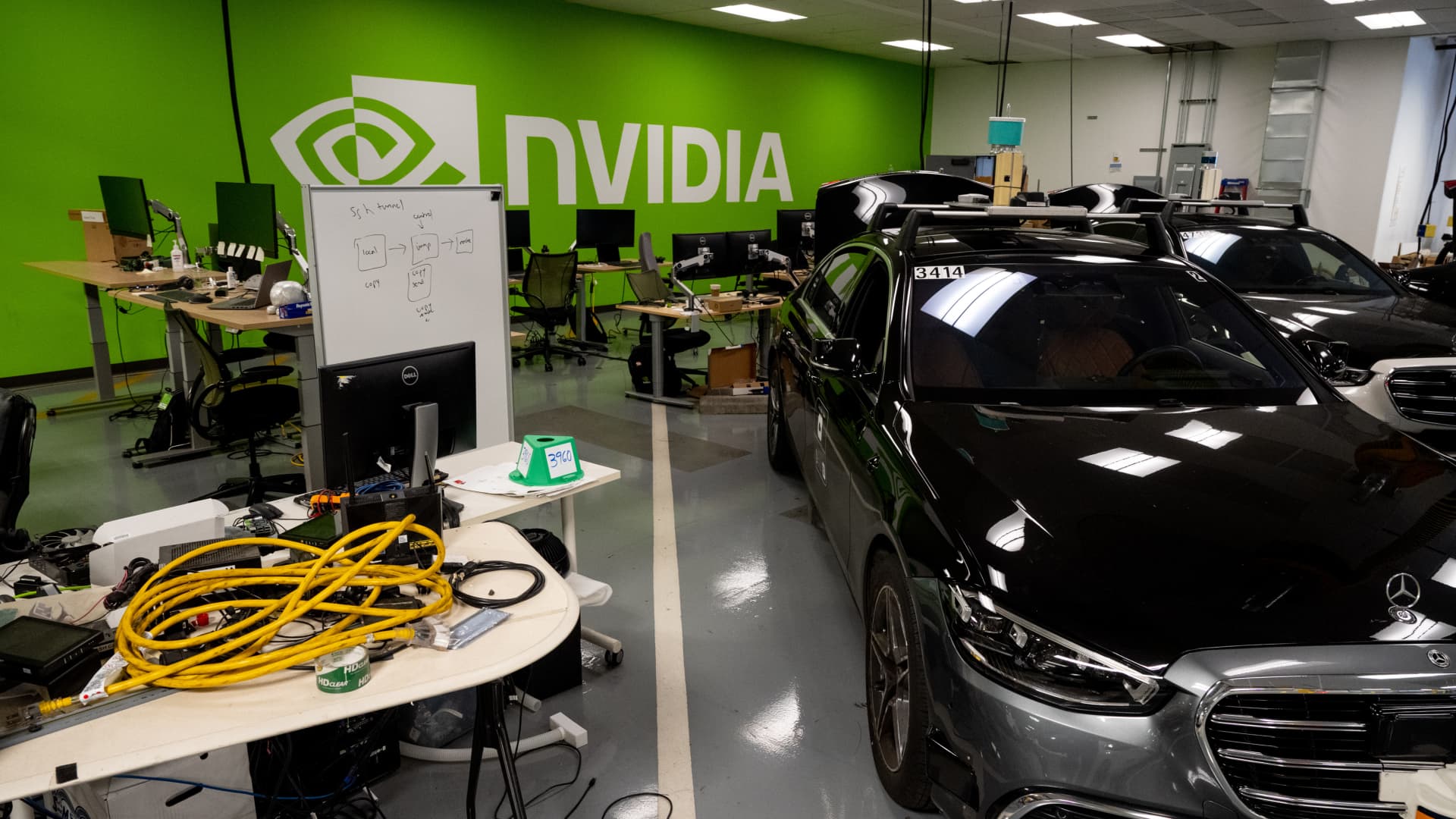
Nvidia is building out an automotive tech business. Pictured here are its autonomous vehicle test cars at the company’s auto garage in Santa Clara, California, June 5, 2023.
Bloomberg | Bloomberg | Getty Images
Nvidia on Monday unveiled plans to test a robotaxi service with a partner as soon as 2027, highlighting the chipmaker’s ambition to become a major player in the world of self-driving cars.
The service would be offered with a partner, and would employ cars with “Level 4” driving, meaning they will be capable of driving without human intervention in pre-defined regions, Nvidia officials said at a self-driving demonstration in San Francisco last month. The company declined to name where it would operate and who its partner will be.
“We will probably start with a limited availability but work with the partner for us to get our footing,” Xinzhou Wu, Nvidia’s vice president of automotive, said at the event.
Since 2015, Nvidia has offered chips and other technology for cars under the brand name Drive, but that remains a small part of the company’s business. Automotive and robotics chips accounted for just $592 million in sales in the quarter ended in October, or about 1% of Nvidia’s total revenue. Nvidia announced a robotaxi partnership with Uber in October.
The chipmaker said in December that it had developed software that can power a self-driving car and that Mercedes-Benz models to be released in late 2026 will be able to use Nvidia’s technology to navigate cities like San Francisco.
Self-driving cars remain one of the primary areas where Nvidia can show growth outside of AI infrastructure. CEO Jensen Huang has said that robotics — including self-driving cars — is the company’s second most important growth category after artificial intelligence.
“We imagine that someday, a billion cars on the road will all be autonomous,” Huang said at a launch event on Monday at the CES conference in Las Vegas. “You could either have it be a robotaxi that you’re orchestrating and renting from somebody, or you could own it.”
In addition to chips that go inside self-driving cars, Nvidia sells access to its famed AI chips as well as its simulation software to automotive companies so they can train self-driving models and develop technology.
Nvidia says that car makers can use its Drive AGX Thor automotive computer, which costs about $3,500 per chip, to save on research and development costs and get self-driving features to market faster. Nvidia said it works with car makers to tune its technology, such as determining how hard the car should accelerate, for specific vehicles.
“Some say, ‘Hey, I need your help on training and optimizing my software on your chip, but I’ll take care of simulation myself,'” said Ali Kani, general manager of Nvidia’s automotive platform.
Car companies, like Mercedes-Benz, want to tune Nvidia’s technology, market it as part of its in-car experience and sell it as part of or alongside a new car.
Robotaxis have caught on in the past year, led by Alphabet’s Waymo, which is operating a commercial taxi service without drivers in five U.S. markets, including San Francisco.
Nvidia’s robotaxi announcement signals that it is targeting self-driving fleets in addition to personal cars that consumers can buy.

Riding an Nvidia robotaxi
In December, Nvidia offered reporters and analysts an hourlong ride through San Francisco in a 2026 Mercedes-Benz CLA sedan.
While my car had a safety driver employed by Mercedes-Benz behind the wheel, the driver said that the car was driving itself for 90% of the ride.
The drive was uneventful. San Francisco is a tricky city to drive in, with big hills, frequent red lights and trucks unloading in the middle of streets, but I never felt stressed and could focus on holding a conversation.
But there was one major snag: The driver took control during a thorny situation where two buses and a self-driving Waymo were trying to pass in a four-lane road with street parking that also had trucks on both sides unloading goods. The driver had to back the car up and wait for the jam to clear.
Nvidia said my drive was “Level 2 Plus Plus,” which means that its technology has features similar to Tesla’s Full Self-Driving mode. Nvidia-powered cars like the Mercedes-Benz will have increasing self-driving capabilities, but the responsibility of keeping everyone safe still falls to the driver, who must pay attention at all times.
The chipmaker said the system would eventually be able to do “park-to-park,” meaning it can drive from a starting parking space to another, but the Mercedes-Benz CLA cars won’t come with that feature to start.
“Any parking situation that you feel is intimidating, that car will solve for you,” said Mercedes-Benz Group CEO Ola Källenius at an Nvidia event on Monday.
The Mercedes-Benz model that Nvidia demonstrated was launched last year in Europe, but it’s launching in the U.S. this year, Kani said.
The Mercedes-Benz cars were rolled out with lane keep and driver assistance features to help drivers stay in their lanes, Kani said. The vehicles received a lane-switching feature through a software update and will get hands-free highway driving, urban driving and park-to-park features this year.
Nvidia said that it is using two AI systems in Drive-powered cars to ensure safety. The car mostly drives with an “end-to-end” system, called a vision-language model, that uses AI to decipher visual sensors and chart a path.
The chipmaker said it also built a second, safety-oriented “stack” that uses strict rules — such as stopping at a stop sign — to take over when the AI is unsure about what to do.
Still, Nvidia hopes that recent advances in generative AI — driven by the company’s graphics processing units — will allow self-driving algorithms to become more capable. Nvidia is targeting 2028 for point-to-point self-driving features in consumer cars. Eventually, Nvidia said it wants to make the car itself feel like an actual driver that the users can simply speak to.
“With transformers and generative AI, we can do much more,” Wu said.
