


Call move ‘dangerous and unprecedented’, urge global action to halt implementation
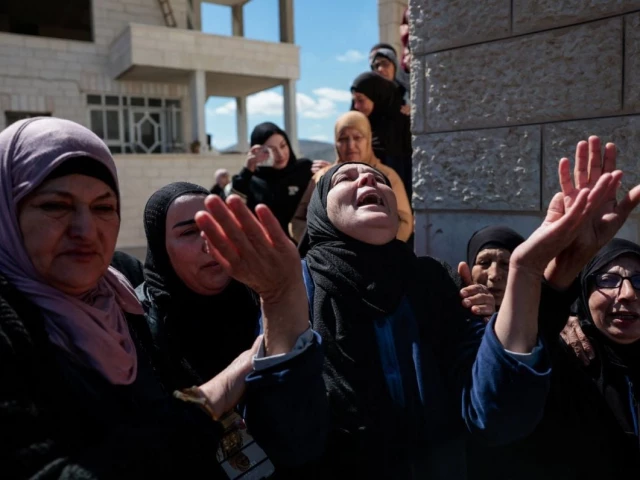
Mourners react during the funeral of three Palestinians who were killed in an Israeli settler attack, in the village of Abu Falah near Ramallah, in the Israeli-occupied West Bank, March 8, 2026. PHOTO: REUTERS
Amnesty International, the United Nations and the Organisation of Islamic Cooperation (OIC) on Tuesday strongly condemned the approval of a law by the Israeli parliament allowing the execution of Palestinian prisoners, calling it a “dangerous and unprecedented step” that violates international law.
The Knesset passed the law on Monday in a 62-48 vote. Prime Minister Benjamin Netanyahu voted in support.
In a statement issued from Jeddah, the OIC general secretariat said the legislation “grants a licence for murder and political execution against the Palestinian people”, warning that it contravened international humanitarian law, including the Fourth Geneva Convention and the International Covenant on Civil and Political Rights.
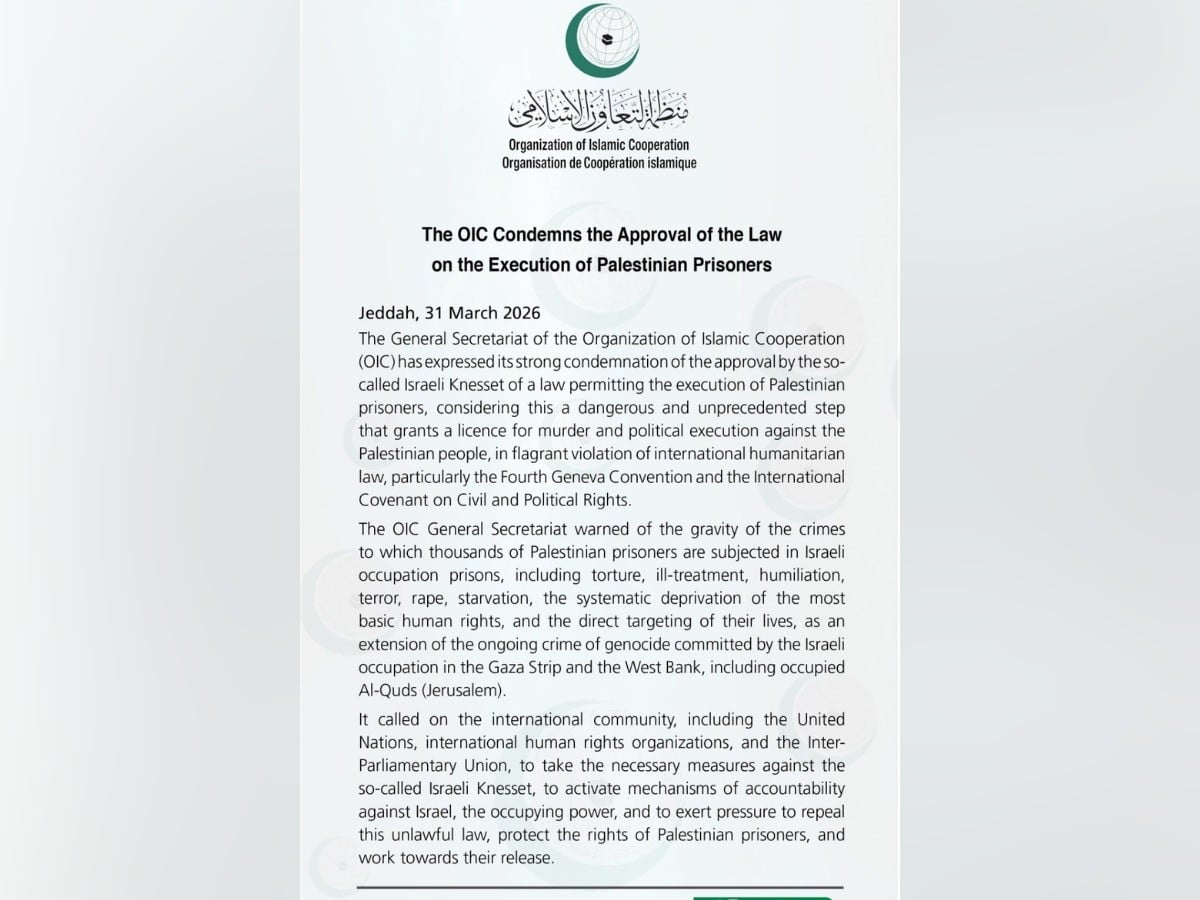
The organisation also raised alarm over the conditions faced by Palestinian detainees in Israeli prisons, stating they are subjected to “torture, ill-treatment, humiliation, terror, rape and starvation,” alongside systematic deprivation of basic human rights.
It described the measure as part of a broader pattern of violations linked to what it termed ongoing “genocide” in Gaza and the West Bank, including occupied Jerusalem.
The OIC called on the international community, including the UN, human rights bodies, and the Inter-Parliamentary Union, to take “necessary measures” to hold Israel accountable and pressure it to repeal the law. It further urged immediate steps to ensure the protection of Palestinian prisoners and work towards their release.
Amnesty International said the Israeli authorities must urgently repeal the legislative amendments expanding Israel’s use of the death penalty, adopted with support from 62 Knesset members.
“Israel’s parliament adopted the first in a series of laws facilitating the death penalty, showing cruelty, discrimination and contempt for human rights,” said Erika Guevara-Rosas, Amnesty International senior director of Research, Advocacy, Policy and Campaigns.
She noted that military courts, “with conviction rates over 99% for Palestinian defendants, can impose almost mandatory death sentences within 90 days, removing basic fair-trial safeguards”.
“This law comes the same month the Israeli military dropped all charges against soldiers accused of sexually assaulting a Palestinian detainee, a move celebrated by the prime minister,” she added.
The UN strongly opposed the new Israeli law, calling it “particularly cruel and discriminatory.”
UN spokesperson Stephane Dujarric told reporters at a news conference that the UN and Secretary-General Antonio Guterres had a “very clear” stance on Israel’s legislation imposing the death penalty on Palestinian prisoners.
“We stand against the death penalty in all its forms,” he said, adding that “the nature of this particular law makes it particularly cruel and discriminatory.”
Earlier today, Israeli police forcibly dispersed a protest outside the Knesset in West Jerusalem for demonstrating against the passage of the law, according to Israeli sources.
Police said two people were arrested as officers cleared demonstrators from outside the parliament building. Hundreds took part in the protest, according to Israel’s public broadcaster KAN.
Video published by the outlet showed police using foul-smelling water to disperse protesters.
The law mandates executions by hanging to be carried out by prison guards appointed by the Israeli Prison Service, while granting those involved anonymity and legal immunity.
It also requires transferring those sentenced to death to special detention facilities and restricting visits to authorised parties, with lawyer meetings limited to video communication.
The legislation has sparked outrage. About 1,200 Israeli figures, including Nobel laureates, former military officials and former Supreme Court judges, voiced strong opposition in February, calling it a “moral stain”.
More than 9,500 Palestinians are held in Israeli prisons, including 350 children and 73 women. Palestinian and Israeli human rights groups have said detainees face torture, starvation and medical neglect, leading to dozens of deaths.
Since October 2023, Israel has intensified measures against Palestinian prisoners alongside its military offensive in the Gaza Strip, which it is conducting with US support. The conflict has killed more than 72,000 people and wounded 172,000, most of them women and children.
