


PUBLISHED
May 11, 2025
KARACHI:
Did you know that India opposed a United Nations plan in 1947 which proposed the creation of a Jewish state in the Middle East? It voted against the UN Partition Plan for Palestine, citing concerns over religious nationalism and in solidarity with Arab nations.
Although it recognised Israel in 1950, New Delhi refrained from establishing full diplomatic relations for decades. This was because India had adopted a secular polity rather than a religious one, and did not wish to alienate its large Muslim population or its Arab allies.
What’s more, India became the first non-Arab country to recognise Yasser Arafat’s Palestine Liberation Organisation (PLO) as the legitimate representative of the Palestinian people, even allowing it to open an office in New Delhi.
According to reports published in Time and The Indian Express, the end of the Cold War and the onset of the Oslo Peace Accords prompted India to formalise diplomatic ties with Israel in 1992. Since then, bilateral relations have steadily improved. Today, it is hard to imagine that the two countries once stood on opposing sides at the UN.
The relationship progressed slowly at first, particularly under successive Congress governments in India, but gained momentum after the Bharatiya Janata Party (BJP) came to power.
It has flourished especially under Israeli Prime Minister Benjamin Netanyahu and Indian Prime Minister Narendra Modi. Their warm personal rapport was on full display during Modi’s historic visit to Israel in July 2017 — the first by an Indian prime minister.
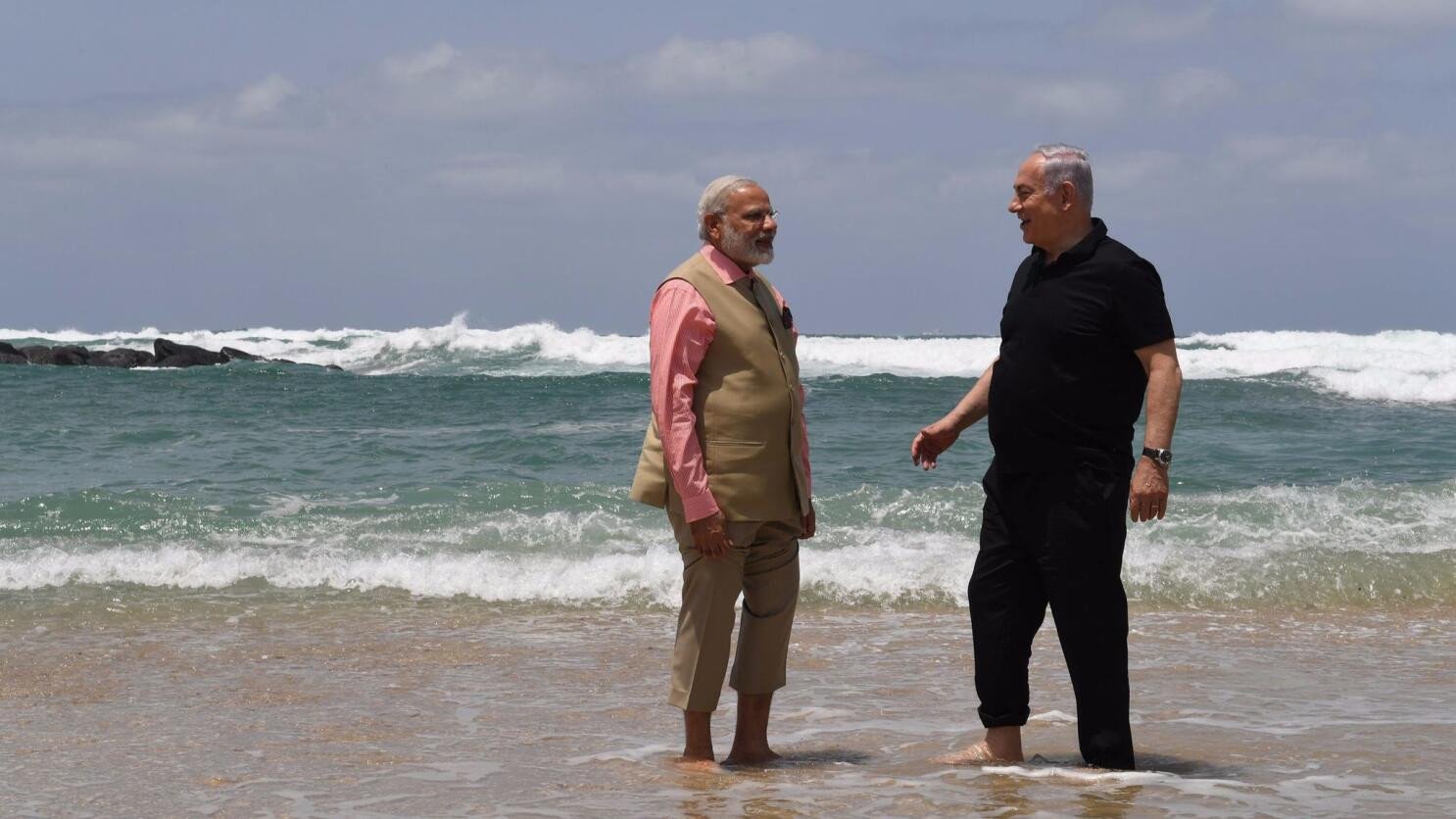
A particularly memorable moment came on 6 July, when the two leaders walked along Dor Beach. Netanyahu, dressed casually in a black T-shirt, strolled beside Modi, smiling and chatting like old friends. Photographs from that day captured a rare informality in diplomacy — two world leaders visibly at ease in each other’s company.
The visit was rich in symbolism. Netanyahu personally accompanied Modi throughout, repeatedly referring to him as “my friend Narendra”, while Modi broke diplomatic protocol by embracing Netanyahu upon arrival at the airport. Yet it was the beach outing that stood out for its intimacy, hinting at a bond that appeared more personal than purely strategic.
Their friendship has since been reinforced by shared interests in defence, technology, and agriculture. Some analysts argue that their closeness also stems from a shared ideological outlook. Both leaders seem to embrace the adage: “The enemy of my enemy is my friend.” In both countries, large Muslim populations have long been viewed with suspicion — a perceived challenge that may have drawn them closer.
Zionism and Hindutva
Following Israeli airstrikes on Gaza in October 2023, Israeli Ambassador to India Naor Gilon remarked: “Everyone is telling me, ‘I want to volunteer, I want to fight for Israel’.” He claimed the response from Indians was so overwhelming that he could raise another Israeli army comprising Indians alone.
Though startling, Gilon’s comment underscored a growing reality — that Israel and India, under Netanyahu and Modi, are more than strategic partners. They are increasingly becoming ideological allies, pursuing parallel paths of ethno-nationalism.
In recent years, the alliance between Zionist Israel and Hindutva-led India has extended beyond arms deals and intelligence sharing. Both states are reshaping their political and legal orders to benefit religious majorities — Jews in Israel, and Hindus in India — while marginalising minority populations.
As mentioned earlier, India was once a staunch supporter of the Palestinian cause. However, that moral clarity has eroded, particularly since the rise of the BJP. While it was a Congress-led government that initiated full diplomatic ties with Israel, Modi’s tenure since 2014 has seen India become an ardent supporter of Israeli policies.
Israel has, in turn, become a model for India — militarily, ideologically, and procedurally. In Occupied Kashmir, Israeli-style tactics have been adopted: fencing, drones, surveillance systems, “surgical strikes”, and the rhetoric of counterinsurgency.
Following the 2019 abrogation of Occupied Kashmir’s limited autonomy, an Indian diplomat openly advocated for Israeli-style settlements in the region: “We already have a model. If the Israeli people can do it, we can also do it.”
At the heart of this deepening alliance lies a shared ideological vision. Zionism, in its current form, seeks to define Israel exclusively as a homeland for the Jewish people. The 2018 Jewish Nation-State Law codified this principle, stating that “the right to exercise national self-determination in the State of Israel is unique to the Jewish people”, effectively denying Palestinians equal status.
In India, ideologues within the BJP, Rashtriya Swayamsevak Sangh (RSS), and Vishwa Hindu Parishad (VHP) have long expressed a desire to transform secular India into a Hindu Rashtra (or state). As early as 1923, Hindutva ideologue Vinayak Damodar Savarkar praised Zionism as a model, writing: “If the Zionists’ dreams are ever realised — it will gladden us almost as much as our Jewish friends.”
The admiration is both strategic and ideological. For India’s Hindu nationalists, Israel’s methods of demographic control, settlement expansion, and legal apartheid offer a template for dealing with Indian Muslims, particularly in Occupied Kashmir.
Demolition and dehumanisation
Israel has long been accused of attempting to erase Palestinian history and presence — from the destruction of 530 villages during the 1948 Nakba to the ongoing demolition of homes in the West Bank and East Jerusalem. Museums often omit Palestinian narratives; place names are changed; and historical sites are replaced with modern symbols of Israeli sovereignty.
India exhibits similar tendencies. In 2023, over 300 Muslim homes and businesses in Nuh — the only Muslim-majority district in Haryana — were bulldozed by the state following communal violence incited by a VHP-led procession.
Hindu nationalist groups not only participated in the violence but later called for an economic boycott of Muslims. The intent was clear: to erase Muslim presence and economic activity — echoing the symbolic demolition of the Babri Masjid in 1992, which has since been replaced by a grand Ram temple with state backing.
India’s legal framework is also being reshaped in ways reminiscent of Israel’s apartheid system. The Citizenship Amendment Act (CAA) of 2019 provides a path to citizenship for refugees from neighbouring countries — unless they are Muslim. Combined with the proposed National Register of Citizens (NRC), the policy risks disenfranchising millions of Indian Muslims.
Surveillance technologies — many of them Israeli in origin — are disproportionately deployed against Muslims. In Occupied Kashmir, Israeli spyware and facial recognition systems have reportedly been used to monitor dissent.
While Israel’s devastating airstrikes on Gaza have drawn global condemnation, India’s response has largely been supportive. Right-wing Indian media outlets celebrated the bombings, politicians expressed solidarity with Netanyahu, and Hindu nationalist groups even offered to fight for Israel. Reports have surfaced alleging the involvement of Indian nationals in acts of violence in Gaza. UCLA professor Khaled Abou El Fadl has claimed that “some of the worst massacres committed against Palestinians in Gaza are by Indian soldiers serving in the Israeli army.”
Within India, expressions of solidarity with Palestine are increasingly criminalised. In Uttar Pradesh, Muslim scholars and students have been arrested for posting “I stand with Palestine” on WhatsApp or for participating in peaceful protests. By contrast, no action has been taken against Hindu right-wing groups staging pro-Israel rallies, even when they chanted “Down with Palestine”.
Parallels in political rhetoric
Political discourse in both countries increasingly mirrors one another in its dehumanisation of minorities. In 1982, Israeli Prime Minister Menachem Begin called Palestinians “two-legged beasts”. In 2023, Israeli Defence Minister Yoav Gallant declared, “We are fighting human animals,” during the Gaza siege.
Such language is echoed in education and media. A 2003 Hebrew University study found that Israeli textbooks frequently portrayed Arabs as “vile and deviant,” depicting them primarily as “refugees, primitive farmers, and terrorists.”
In India, the parallels are stark. Home Minister Amit Shah once referred to undocumented Muslim immigrants as “termites” who are “eating the grain that should go to the poor.” He vowed to “throw them into the Bay of Bengal.” This rhetoric coincided with the NRC’s implementation in Assam, which disproportionately affected Muslims.
The CAA further marginalises Muslim communities by offering citizenship to others while excluding them. CNN has reported that the law, combined with the NRC, effectively brands Indian Muslims as “infiltrators” — a term frequently invoked in political discourse.
Words have been followed by action. In Israel, IDF psychological warfare has included videos portraying Palestinians as “roaches” and “rats.” In India, homes of Muslims accused of protesting against derogatory remarks about Prophet Muhammad (peace be upon him) were bulldozed — a form of collective punishment.
Implications and international concerns
The dehumanisation of minority communities through political rhetoric and state action carries grave consequences. It fosters a climate of impunity, normalises violence, and erodes democratic values and international human rights norms.
The parallels between Israeli and Indian policies are no longer incidental — they are part of a deliberate alignment. Both states have weaponised religion, enacted exclusionary laws, and embraced ideological nationalism as tools of governance.
While Netanyahu and Modi may never openly admit to building parallel apartheid regimes, the evidence is mounting. The world must pay heed — not only for the sake of Palestinians and Indian Muslims, but for the preservation of democracy and justice in both regions. Ends
