


Say that military won’t be used to disarm Hamas or Palestine, matter is ‘red line’ for army
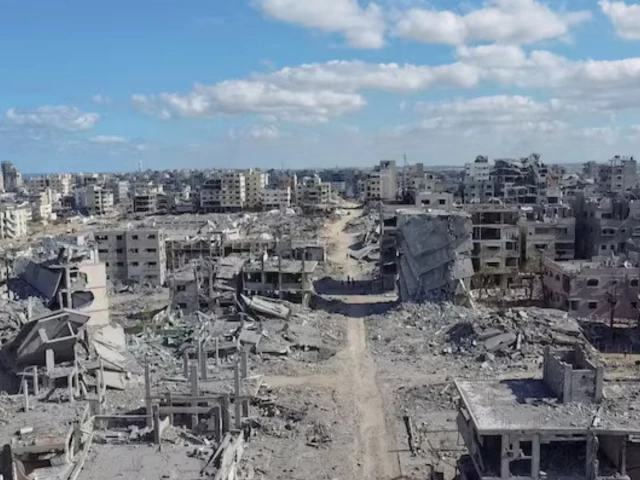
A drone view shows the destruction in a residential neighbourhood, following the withdrawal of the Israeli forces from the area, amid a ceasefire between Israel and Hamas in Gaza, in Gaza City, October 18, 2025. Photo: REUTERS
ISLAMABAD:
Security sources on Friday clarified that any deployment of Pakistani forces in Gaza is the exclusive prerogative of Parliament and the federal government, stressing that no unilateral or extra-constitutional decision would be taken.
It is the prerogative of the Parliament to decide whether Pakistan will send troops to become part of the proposed International Stabilisation Force (ISF) for Gaza, a senior security official said while speaking on the matter during an interactive session with YouTubers and other social media influencers.
The official said no decision has been taken regarding the formation, mandate or deployment of any force. The Gaza Peace Board, he said, is solely intended for reconstruction and rehabilitation, and its objectives are entirely distinct from those of any international stabilisation force.
“The Pakistani army will not be used against Hamas or the Palestinians under any circumstances,” the security official said, adding that questions regarding whether troops would be sent, how they would be deployed and who the stakeholders would be remained unclear and were matters solely within the government’s domain.
“Our red line is clear: Pakistan will not be part of any effort to disarm Hamas,” the official said. While strongly denying speculation about the deployment of Pakistani troops to an international force, the official reiterated that decisions taken in the public interest were made by the federal government, not the armed forces.
Read: Officials deny Pakistani troops will be deployed to Gaza
Pakistan formally joined the Board of Peace, alongside around 20 other countries, at a signing ceremony held in Davos on the sidelines of the World Economic Forum in the presence of United States President Donald Trump.
But the move drew criticism and objections from opposition parties, which warned of potential implications for joining the US-led body. Officials had moved to counter what they described as a “misleading narrative” surrounding Islamabad’s decision to associate with the Board of Peace, stressing that the move did not involve, nor could it lead to, the deployment of Pakistani troops to Gaza under any arrangement aimed at disarming Hamas.
The officials had insisted that the confusion had been deliberately created by conflating the Board of Peace, a political and diplomatic forum, with a hypothetical ISF, which, they noted, does not exist and would require an entirely separate mandate if ever proposed.
They had underscored that Pakistan’s position on troop deployment was categorical and non-negotiable. No Pakistani forces would be sent to Gaza under any ISF or similar framework, particularly for coercive military tasks.
Read more: Pakistan ready to join Gaza peace force if mandate excludes disarming Hamas: Dar
As part of the US plan for Gaza’s reconstruction, security will be handled by an ISF, commanded by US Major General Jasper Jeffers, currently head of the US special forces. The ISF will lead security operations, support “comprehensive demilitarisation” and ensure the safe delivery of humanitarian aid and reconstruction materials.
The security official stated that Pakistan’s decision to join the Gaza Peace Board was made after extensive consultations and thorough deliberations with eight major Islamic countries, reflecting Pakistan’s consistent commitment to a multilateral foreign policy approach.
Addressing the broader regional context, the briefing noted that only the United States has the capacity to restrain Israel, and that an end to the genocide of Palestinians can only be achieved through political processes and dialogue.
Reiterating Pakistan’s core national principles, the official said Pakistan will safeguard its national interests under all circumstances and that no one can create a rift between the armed forces and the nation, calling the bond deep and resilient.
‘Military neither for nor against any political party’
The security official also addressed domestic political matters and said that if the Khyber-Pakhtunkhwa government wished to receive a briefing, it should approach the federal government. The official added that it was up to the centre to decide whether such a briefing would be arranged through the Ministry of Interior or the Ministry of Defence.
“We are bound by the directives of the federal government,” the official said. It was stressed that the military was neither for nor against any political party. “Political parties say many things about us, but no political party or leader is important to us. Our relationship is with the federal government,” the security official said.
The official emphasised that the National Action Plan is a consensus document endorsed by all political parties, and its full implementation by all stakeholders is essential to completely eradicate terrorism. They said terrorism would only end when intent is sincere.
On the issue of prison meetings, the official said the law and Constitution clearly defined who could meet whom and when. The security official added that political parties could only make requests in this regard and stressed the need for improved governance.
It was also clarified that former intelligence chief Faiz Hameed was a notified prisoner of the Punjab government. “A political party wanted him to work for them, and then his court martial took place,” the security official added.
He highlighted that the Pakistan Armed Forces and law enforcement agencies are making round-the-clock sacrifices in the fight against terrorism, but lasting success requires unified national action. Improved security in Balochistan, they said, is the result of better governance, job creation, grassroots empowerment, and institutional strengthening.
It was added that without a strong army, a country’s fate would resemble that of Gaza or Libya. However, the official added that Pakistan’s future lay in democracy and that Chief of Defence Force and Chief of the Army Staff Field Marshal Asim Munir believed in democratic principles.
The briefing also addressed foreign relations, stating that Pakistan–China relations remain strong and continue to deepen while safeguarding mutual interests. Pakistan’s position on Afghanistan and India, the officials said, is unequivocally clear, adding that their nexus has contributed to an increase in terrorism inside Pakistan.
On Kashmir, the official reiterated Pakistan’s commitment to securing the Kashmiri people’s right to self-determination in line with UN resolutions, stressing that “Kashmir will become Pakistan” remains a national resolve.
Referring to the Pakistan-India conflict last year, the official said civilian leadership was present when decisions were made between May 7 and 10. He said all decisions related to Marka-e-Haq were taken by the government under the prime minister’s leadership, with professional advice from the armed forces, and that Pakistan’s politicians and diplomats demonstrated effective diplomacy in its aftermath.
Commenting on relations between states, including Saudi Arabia and the United Arab Emirates, the security official urged restraint and advised that discussions be limited to official statements issued by the Foreign Office. “We must be cautious while talking about relations between states,” the official added.
