


PUBLISHED
December 21, 2025
I didn’t set out to build anything.
In the late 2000s, in Houston, I was doing what I was employed for, pediatric emergency medicine: long shifts, clinical and academic/research competence, the steady rhythm of a life that made sense on paper. And yet, something was off. Not broken. Not dramatic. Just… hollow in places I couldn’t quite name. I was busy, productive, advancing, while quietly feeling that the work was losing its soul. Or maybe I was.
Around that time, without fully understanding why, I started writing stories for children. Not to teach. Not to intervene. Just to speak plainly and gently about things that had become too loud and technical in adult language. Fear. Illness. Change. Courage. Curiosity. The small, interior weather of a child’s mind that often gets flattened in clinical encounters.
That’s where Biloongra – the kitten, the child, the me — came from.
It began with a simple instruction. While I was in Houston, wandering through questions of purpose and meaning, I reached out to Sami Mustafa of Bookgroup in Karachi. There was no philosophy offered, no long explanation. He simply said, write a story. And so, I did. That first story was Biloongra. That word in Urdu means kitten, but it is also used colloquially to describe a child who is playful, a little mischievous, unguarded — still testing the world with curiosity rather than caution. Over time, it became more than a character or a story for me; it became a state of being. A reminder that learning, healing, and meaning-making often begin when we allow ourselves to remain open, unfinished, and a little bit biloongra. It was co-written in English and Urdu with Alezeh Rauf — a high school student, and later joined by Mayank Aranke, a college student, for the Hindi edition. It was collaborative from the beginning. Rakhshee Niazi also of Bookgroup served as a critical gatekeeper in those early days, helping decide which stories were ready for publication, which needed more time, and which were no-go ahead. That discernment shaped the work.
Not as a project. Not as a plan. As a response.
We made children’s stories, simple, metaphor-rich, unburdened by outcomes. There were no frameworks hovering over us, no talk of scale or impact. The stories existed because they needed to. Because they felt right. Looking back, I see that phase for what it was: making something to survive a sense of misalignment. Storytelling as repair. Storytelling as listening, before I had language for either.
When the stories began to travel, from Houston to Karachi, from private drafts to printed books, they found readers. Children responded. Parents did too. Educators, quietly. Still, I resisted naming any larger purpose. I wasn’t trying to “do” health literacy. I wasn’t trying to innovate. I was translating complexity into something kinder and more intelligible, because that felt like the honest thing to do.
There was an unexpected moment of recognition during this early Houston phase, when the work received a Congressional Certificate of Recognition presented by Representative Sheila Jackson Lee. It was never a goal, but it was a proud moment nonetheless, an acknowledgment that the significance of the work was being recognised beyond its immediate setting.
The question that began to surface then, tentative, unformed, was whether storytelling could do more than comfort. Whether it could help children understand the world they were being asked to navigate.
That question followed me to Karachi, to Aga Khan University, where instinct finally met evidence.
At AKU, the stories were no longer protected from scrutiny. They were tested, in schools, in classrooms, in community settings, against the demands of public health and academic rigor. Road safety. Injury prevention. Vaccination literacy. We measured what children learned. We compared formats. We analysed retention and understanding.
What mattered to me was not that the work “worked,” but that it survived the encounter with evidence. Research didn’t invent Biloongra. It verified something that had already been alive. Storytelling proved to be a legitimate way to support child health literacy, not because it was novel, but because it respected how children make meaning.
Still, something felt incomplete.
The classroom was safer than the hospital. In schools, children had time. In hospitals, they had fear.
It was only later, in clinical settings, that storytelling crossed another threshold. At the bedside, in pediatric encounters thick with anxiety, I saw again how poorly we listen to children. How often we speak around them or over them, even when our intentions are good. Narrative medicine stopped being a concept and became a practice: presence, witnessing, choosing words that don’t overwhelm.
By then, it was clear the work couldn’t remain author-driven. I didn’t want to be the storyteller at the centre. I wanted conditions where stories could emerge, locally, culturally, honestly, without me.
Human-Centred Design Thinking arrived not as a revelation, but as vocabulary for something already underway. Generative AI followed, not as a replacement for human insight, but as a tool that accelerated co-creation. The stories began to be made by healthcare teams themselves, nurses, doctors, administrators, drawing on their own encounters with children and families. Language diversified. Characters shifted. Eventually, the original biloongra characters receded, not discarded but outgrown.
That, for me, was a quiet turning point.
When PediTales took shape in 2025, it didn’t feel like a beginning. It felt like a container, temporary, useful, for a practice that had been evolving for years. PediTales gave the work a name inside hospital systems. It allowed storytelling to sit alongside workflows, feedback tools, leadership learning, and quality improvement. It made space for MoodBoards, for reflection, for teams to see child experience as something measurable without being mechanized.
PediTales found its most complete expression within Evercare Group. What had begun years earlier as storytelling and child health literacy work matured here into an implemented, team-led practice. Embedded within pediatric care, it was co-created by clinicians and caregivers across countries, and linked to patient experience, leadership development, and system learning. In many ways, Evercare became the place where stories stopped being ideas and started becoming part of care.
The selection of PediTales for the International Hospital Federation Innovation Hub Geneva 2025 carried a significant meaning. It was not an objective or an endpoint, but another form of validation along the journey. A reminder that work grounded in listening rather than ambition can still find resonance.
By then, the work had moved decisively away from me. It lived in hospital corridors in Lahore, Lagos, and Nairobi, in team workshops, in shared laughter and calmer procedures. Stories were being created in South Asia and Africa, in multiple languages, by people who understood their own contexts far better than I ever could. That was not loss of control. It was the point.
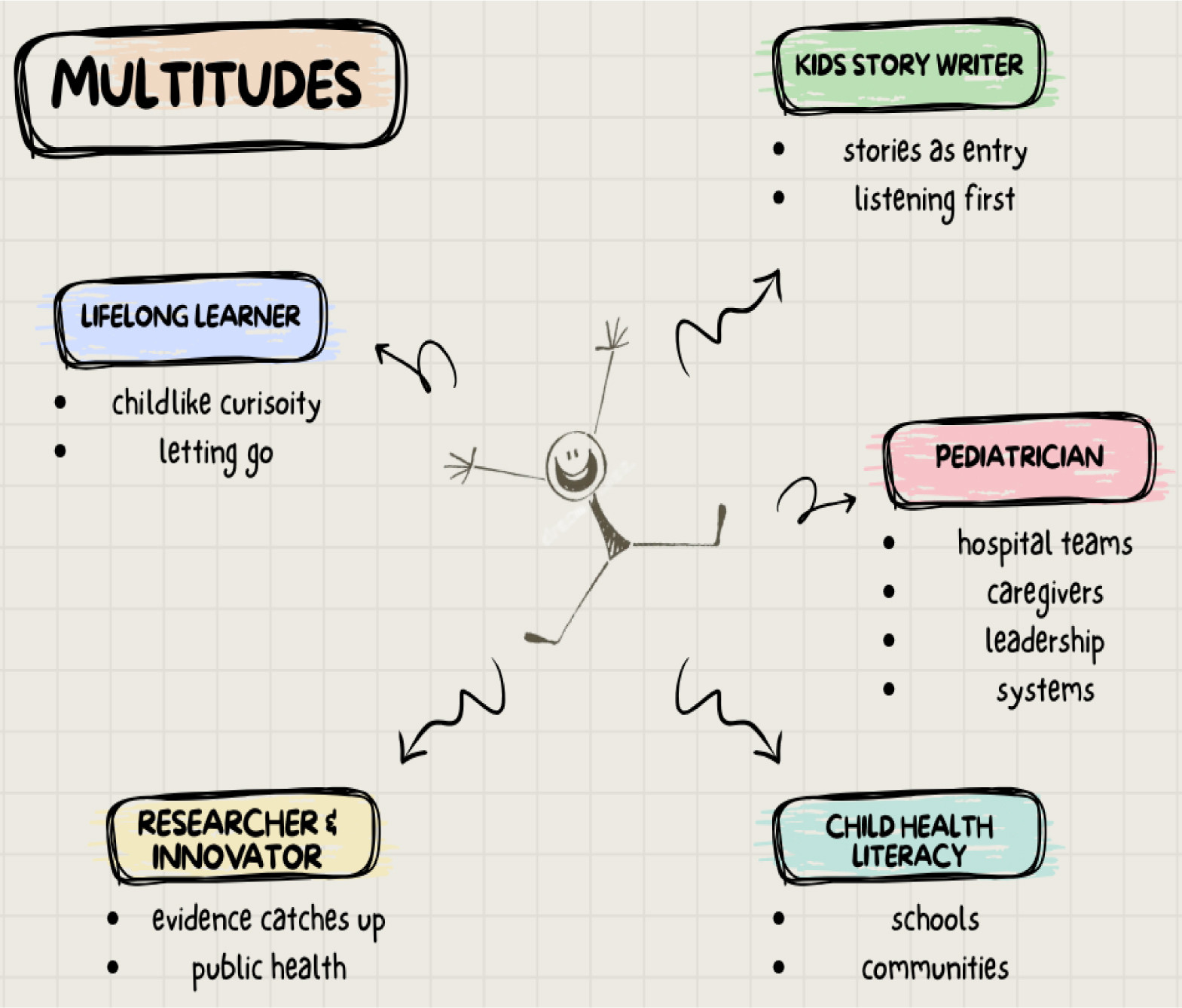
Over these 20 years, the work has revealed parts of me I didn’t set out to discover: the writer who needed simplicity, the clinician uneasy with reductionism, the teacher who learned best by staying a student, the innovator suspicious of innovation for its own sake. It reawakened a childlike curiosity I had learned to suppress, the kind that asks why before how, and listens before it speaks.
If there is leadership here, it is the leadership of stepping back. If there is advocacy, it is for listening, especially to children, who are too often treated as passive recipients of care rather than meaning-makers in their own right.
As PediTales took shape, an inevitable question surfaced: if storytelling can restore agency, emotional safety, and meaning for children in healthcare spaces, what might it offer adults navigating illness, aging, trauma, or professional burnout? Perhaps the work is not only pediatric. Perhaps the deeper invitation is to consider how narrative, when taken seriously, could become part of care across the lifespan — an AdultTales, of sorts — less as a programme and more as a way of practicing medicine with coherence and resilience.
PediTales is not a success story. There is no culmination to point to. It is a vessel for now, not a destination. The work remains unfinished, as it should. It continues to adapt, to belong to others, to ask better questions than it answers.
What I know, finally, is simple: the most important thing I learned over these twenty years was how to listen to children, without rushing to fix, explain, or control what they are trying to tell us. Everything else followed from that.
Asad Mian, MD, PhD, is a physician, researcher, innovator, and freelance writer. With a background in paediatric emergency medicine and a passion for human-centred design thinking, he explores intersections between healthcare, education, innovation, and culture in his writing
All facts are information are the sole responsibility of the writer
