


Analysis of Pakistan’s nuclear weapons program is fraught with uncertainty due to years of secrecy by the Pakistani government. While it is known that Pakistan, like many other nuclear powers, is modernizing its nuclear capabilities and fielding new weapons systems, little official information has been released about these programs or the status of its nuclear arsenal.
One of the many questions researchers have asked concerns the modernization of Pakistan’s nuclear-capable aircraft and associated air-launched cruise missiles (ALCMs). For a long time, the Mirage III and Mirage V fighter-bombers have been assumed to be the two aircraft responsible for delivering nuclear weapons for the Pakistan Air Force (PAF). The Mirage V is believed to fulfill Pakistan’s limited nuclear gravity bomb strike role, while the Mirage III has been used to test-fire Pakistan’s dual-load capable Ra’ad-I (Hatf-8) ALCM and its successor, the Ra’ad-II. The Ra’ad ALCM was first tested in 2007 and has since remained Pakistan’s only nuclear-capable air-launched cruise missile.
The U.S. Air Force’s National Air and Space Intelligence Center (NASIC) reported in 2017 that the Raad cruise missile could be “conventional or nuclear,” a term typically used to describe a dual-capable system.
As Pakistan seeks to retire its aging Mirage III and V fleets and ramp up defense production, it has acquired over 130 operational JF-17 aircraft co-produced with China, with plans to acquire more in the future. During the 2024 Pakistan Day Parade, the Pakistan Air Force also announced the JF-17 PFX (Pakistan Fighter Experimental) project to maximize the operational life and modernize the capabilities of the JF-17 aircraft.
There have been several reports over the past few years that Pakistan may be dual-equipping its JF-17s with Ra’ad ALCMs, with the new aircraft eventually taking over the nuclear strike role from the Mirage III/V. However, little information was revealed about the status of this procurement or whether the JF-17 would replace the Mirage III and V in the nuclear role. Until, in March 2023, an aerial photographer captured images that could help answer some of these questions.
Possible new nuclear mission
During a rehearsal for the 2023 Pakistan Day Parade (which has since been cancelled), images surfaced of a JF-17 Thunder Block II carrying the Ra’ad ALCM. Notably, this This is the first time such an arrangement has been observed in public..
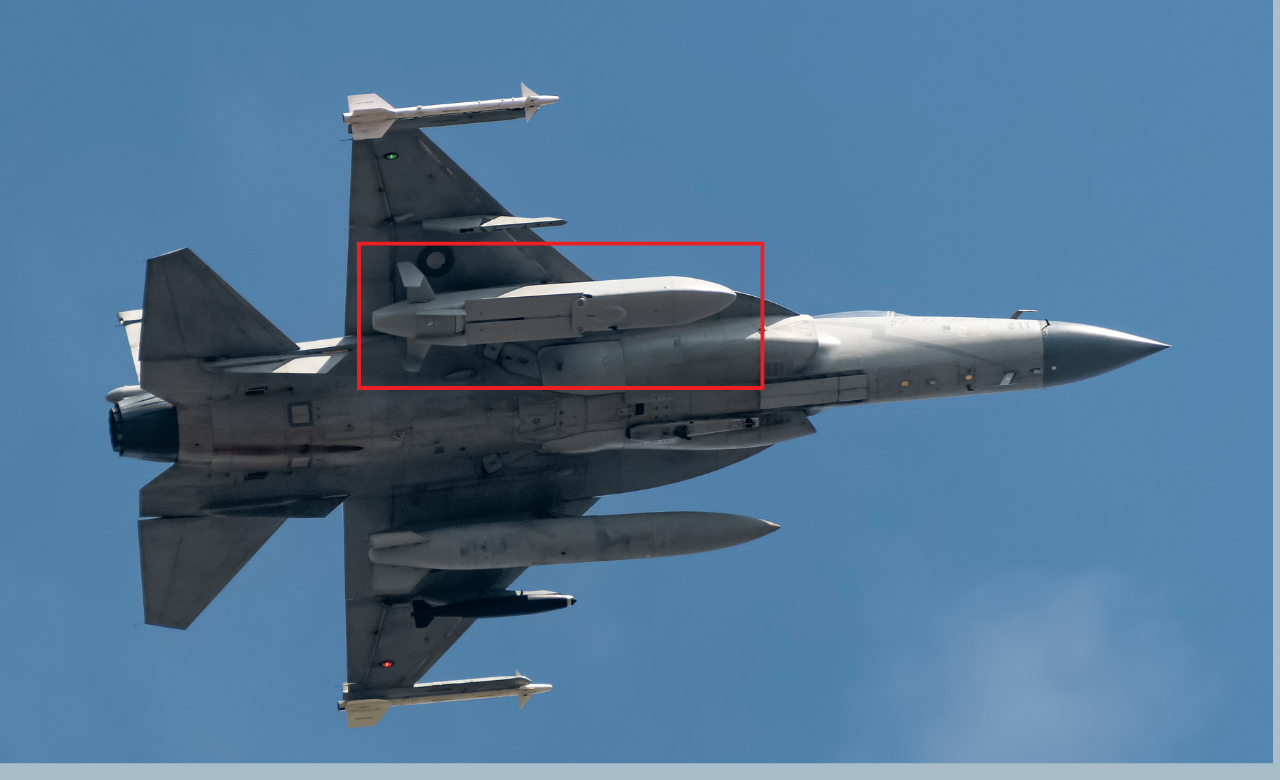
Photo credit: Rana Suhaib/Snappers Crew
FAS was able to purchase the original images. To determine whether the Ra’ad shown in the JF-17 images is the original Ra’ad-I or the extended-range Ra’ad-II, we compared it to other Ra’ad-I and Ra’ad-II missiles displayed at the 2017, 2018, 2019, 2021, 2022 and 2024 Pakistan Day Parades (the 2020 and 2023 parades were cancelled). In these parades, the Ra’ad-I and Ra’ad-II were displayed alongside other nuclear-capable missiles such as the Nasr, Ghauri, Shaheen-IA and -II, and the Babur-1A.
There were few visible differences between the Ra’ad I and II between 2017, when the Ra’ad II was first revealed, and 2022. During this period, both missiles were equipped with new engine air intakes and it was announced that the Ra’ad II would have nearly double the range, although this was not clearly visible from its external characteristics.
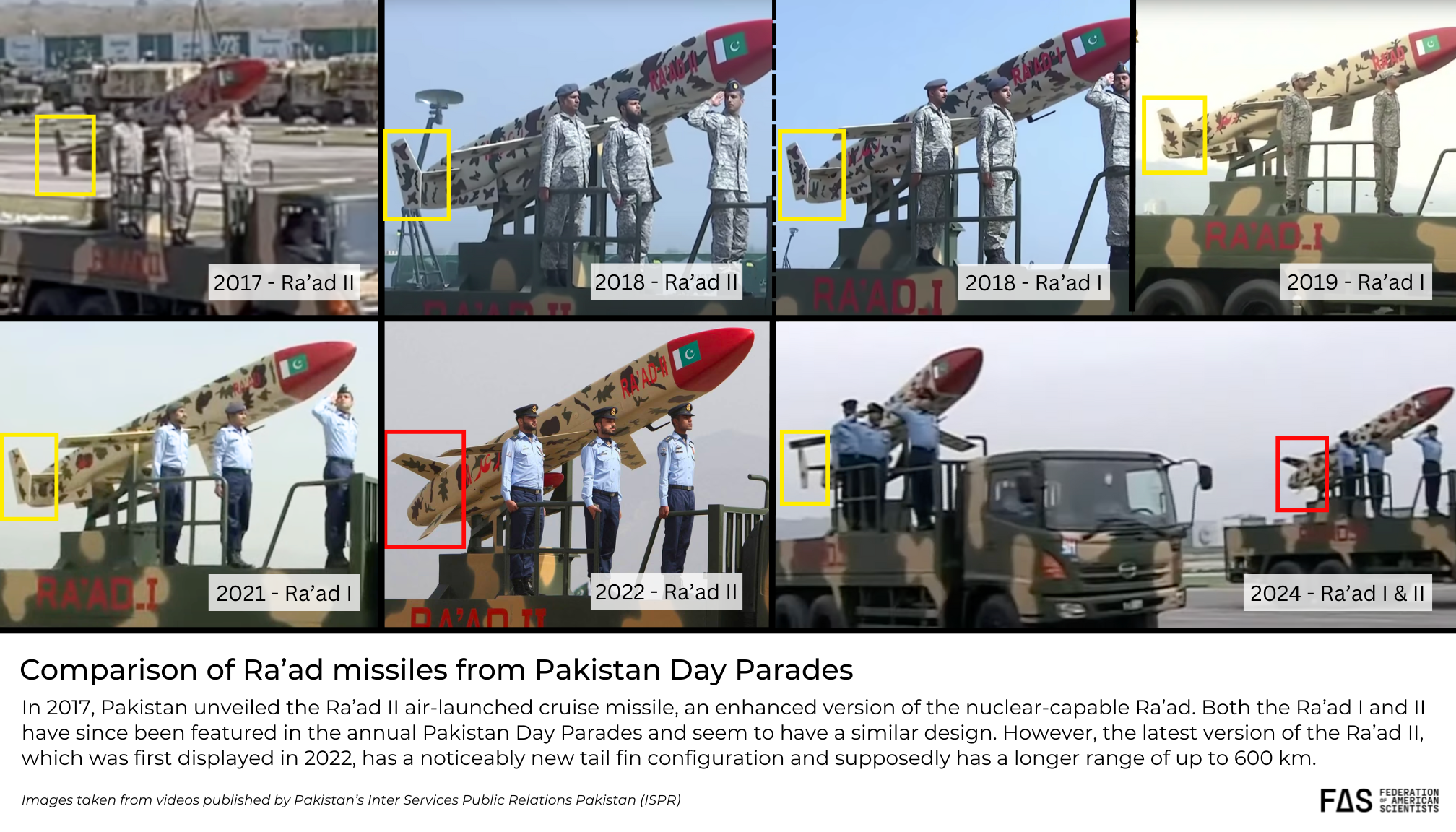
Comparison of Raad missiles at Pakistan Day Parade
Pakistan unveiled the Ra’ad II air-launched cruise missile, an improved version of the nuclear-capable Ra’ad, in 2017. The Ra’ad I and II have since been showcased at the annual Pakistan Day Parade and appear to be similar in design. However, the latest version of the Ra’ad II, first unveiled in 2022, features a significantly new tail shape and is said to have an increased range of up to 600 km.
However, in 2022, a new version of the Ra’ad-II was displayed at the 2022 Pakistan Day Parade. Notably, this new version featured an “X-shaped” tail configuration as opposed to the other “twin-tail” configuration seen on previous versions of the missile. Two different versions of the Ra’ad were also displayed at the subsequent 2024 Pakistan Day Parade, each with their own tail arrangement.
The fin arrangement on the JF-17 missile pictured appears to be closer to the Ra’ad-I’s “twin-tail” configuration rather than the Ra’ad-II’s newer “X-shaped” tail, especially since older versions of the Ra’ad II are unlikely to be used in flight tests to demonstrate cutting-edge capabilities.
Pakistan is also developing the Taymor, a conventional anti-ship variant of the Ra’ad ALCM, which can be launched from the JF-17. Photos of the missile show the two designs are very similar, but the Taymor missile also appears to include an “x-tail” fin configuration, and is reported to be 4.38 metres long. The “x-tail configuration” could mean that the missile photographed with the JF-17 is do not have Taimor, but to clarify further, I measured multiple parade images of both versions of the Ra’ad and compared their length with the length of the missile shown in the photos.
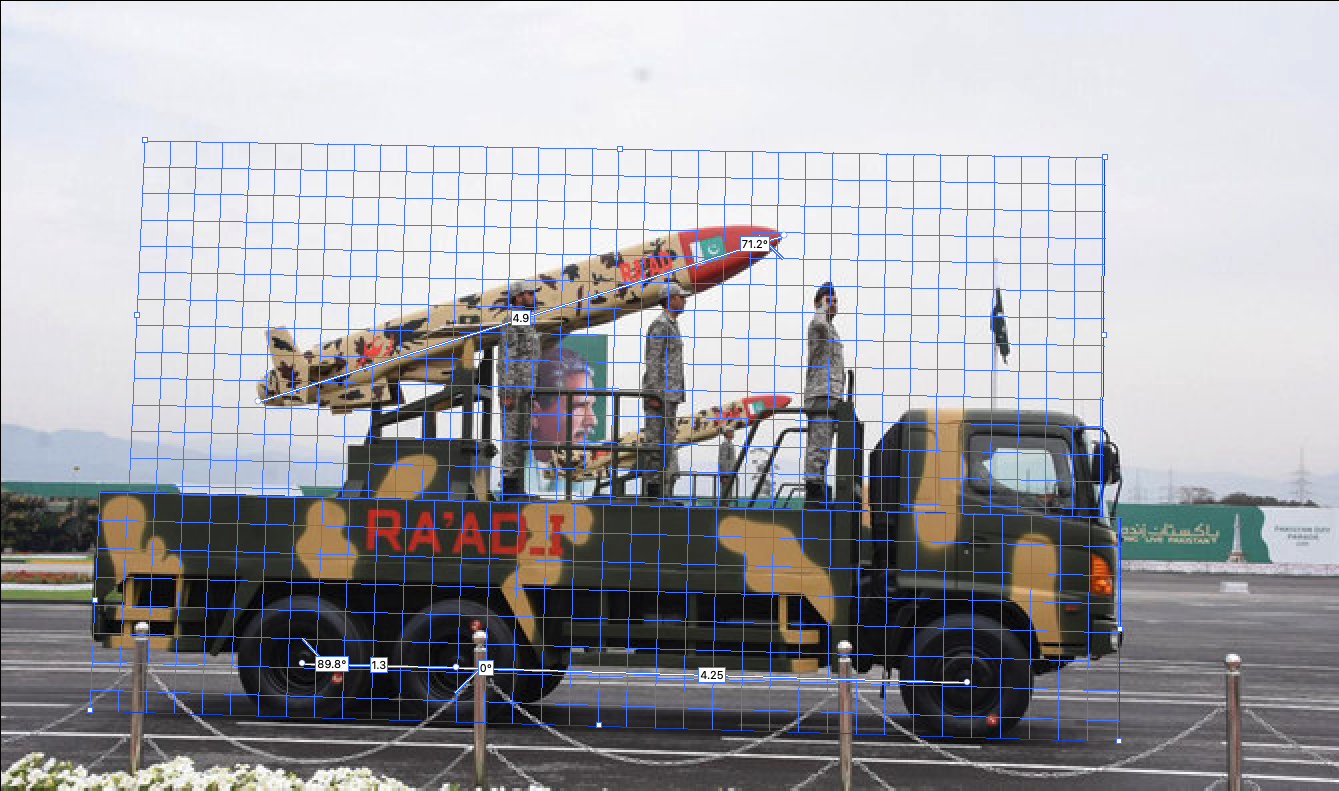
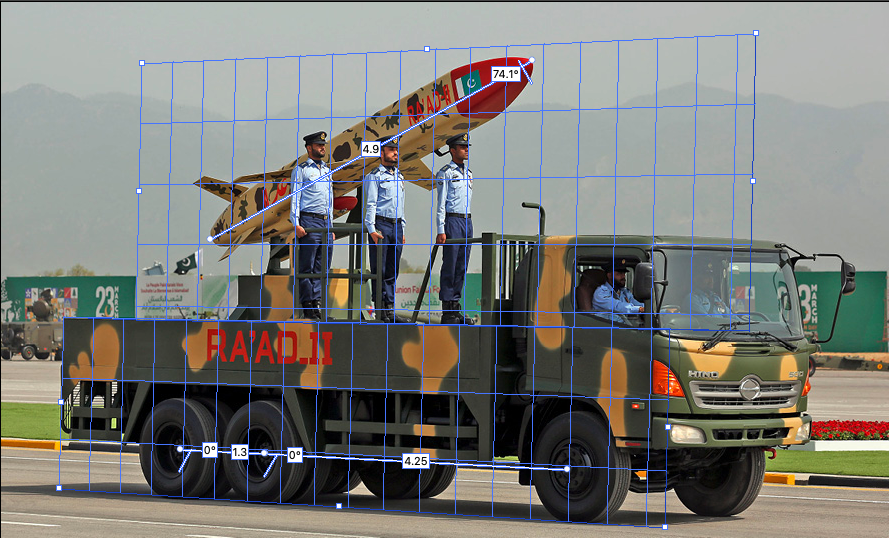
To an image of Ra’ad-I taken at the 2019 Pakistan Day Parade, I used Photoshop’s vanishing point feature to add a grid plane simulating 3D space, taking into account the angle at which the image was taken and the depth of the missile’s position compared to the side of the truck. After identifying the make and model of the vehicle carrying the missile (which appears to be an early version of the Hino 500 Series FM 2630), I used the truck’s trailer axle spread of approximately 1.3 meters and wheelbase of 4.24 meters as reference values and used Photoshop’s measure tool to render its approximate length, which I found to be approximately 4.9 meters.
To estimate the dimensions of the Ra’ad-II, we started with a photo from the Pakistan Day Parade 2022. Using the same technique as Photoshop’s vanishing point tool, we calculated the angle of the photo and the distance from the missile’s position in the center of the vehicle to the front-most grid plane that measures the length of the track, and estimated the missile’s size to be around 4.9 metres.
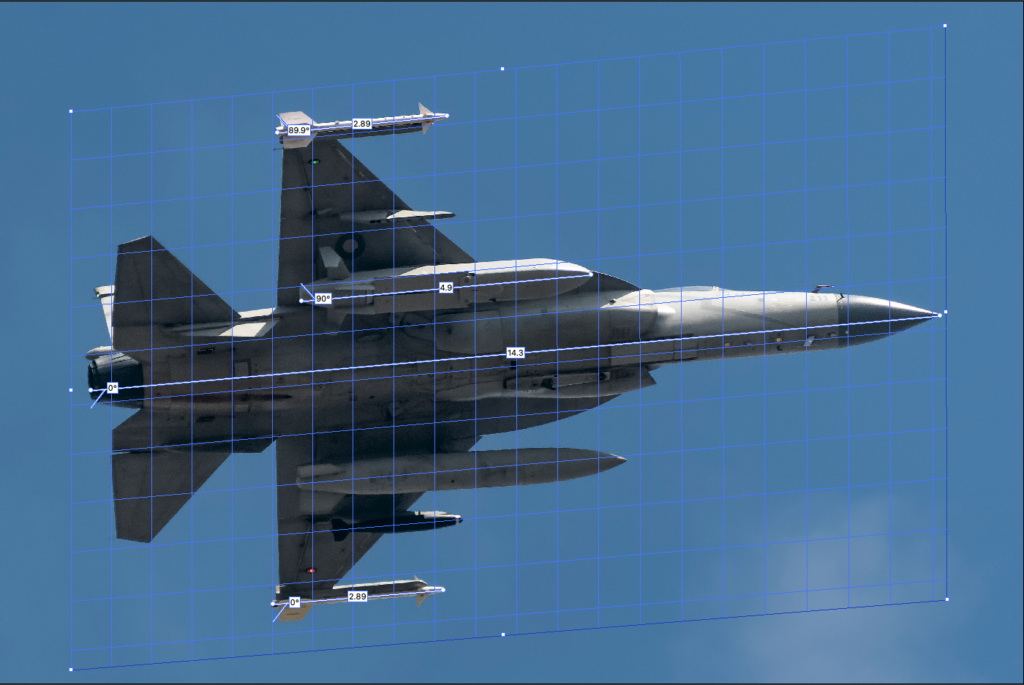
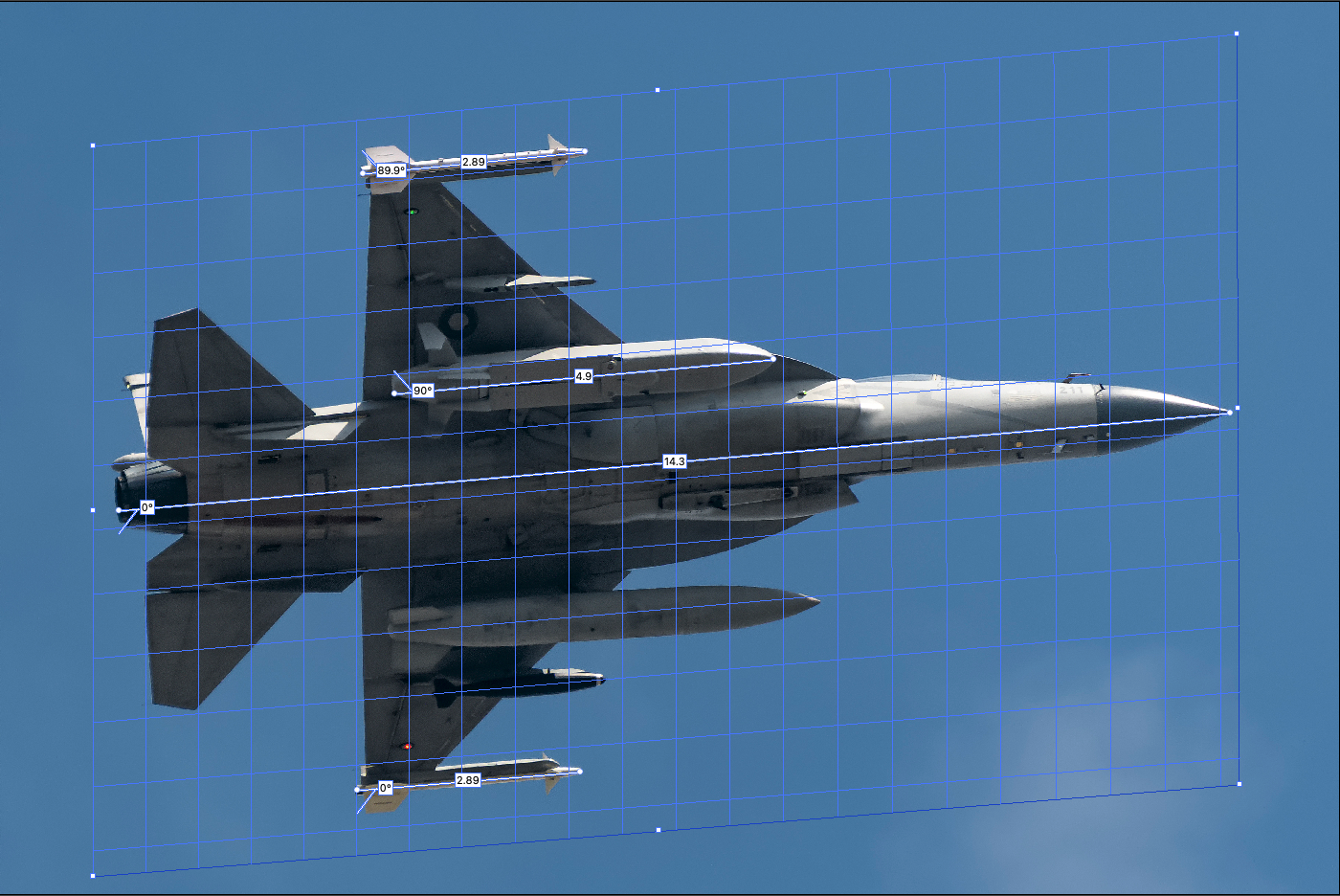
We also double-checked the dimensions of the cruise missile seen in the JF-17 image. We know that the JF-17 is approximately 14.3 meters long, so we used that as a baseline and again used Photoshop’s vanishing point and measurement tools to render the approximate length of the missile in a lowered position relative to the end of the aircraft. The result was 4.9 meters, which is consistent with the reported dimensions of the Ra’ad-I and -II ALCMs, as well as our own estimates. This measurement is longer than the Taimoor’s reported length of 4.38 meters.
It is possible that this missile is an older Ra’ad-II, but given that the 2017 version was also in the “twin-tail” configuration, that version of the Ra’ad-II appears outdated and is unlikely to be used for flight testing. Still, it is possible that we may see further information, images, or statements from the Pakistani government that answer some of these questions.
Observing the differences between the Ra’ad I and Ra’ad II missiles raises several questions: How did Pakistan manage to nearly double the Ra’ad’s range from an estimated 350 km to 550 km and then to 600 km in the latest version without any noticeable changes to the missile’s size to carry more fuel? The answer could be that the Ra’ad II’s engine design is more efficient, structural components are made from lighter materials, or the payload is reduced.
These measurements provide further evidence supporting our conclusion that the missile observed in the JF-17 photographic images is a Ra’ad-I ALCM.
Implications for Pakistan’s nuclear arsenal
Given the lack of public information from the Pakistani government on its nuclear forces, we must rely on such analyses to understand the status of Pakistan’s nuclear arsenal. From these observations, it is likely that Pakistan has made significant progress toward equipping its JF-17s with a capability to eventually complement and possibly replace the nuclear strike role of its aging Mirage III/Vs. Additionally, it is clear that Pakistan has redesigned its Ra’ad-II ALCM, but little information has been confirmed about the purpose or capabilities associated with this new design. It is also unclear whether any of the Ra’ad systems have been deployed, but this may be a matter of if, rather than when. Once deployed, it remains to be seen whether Pakistan will continue to maintain a nuclear gravity bomb capability for its aircraft or transition exclusively to standoff cruise missiles.
All of this is happening within the larger backdrop of an ongoing and escalating nuclear arms race in the region. Pakistan is reportedly pursuing the capability to deliver multiple independently targetable reentry vehicles (MIRVs) on its Ababil ground-launched missiles, while India is also pursuing MIRV technology for its Agni-P and Agni-5 missiles, and China has fielded MIRVs on many of its DF-5B ICBMs and DF-41s. In addition to the Ra’ad ALCM, Pakistan is also developing other shorter-range, lower-yield nuclear-capable systems, such as the NASR (Hatf-9) ballistic missile, designed to counter conventional military threats from India below the strategic nuclear level.
These developments, along with rising tensions in the region, have raised concerns about new risks of an accelerating arms race and a potential escalation of conflict between India and Pakistan, particularly as India continues to grow the size and capabilities of its nuclear arsenal. This creates a greater need for transparency and understanding of the quality and intent of countries’ nuclear programs to avoid misinterpretations, misinterpretations, and, at worst, a military-intensity response.
The authors would like to thank David La Boon and Decker Eveleth for their valuable guidance and feedback on the use of Photoshop’s Vanishing Point feature.
