


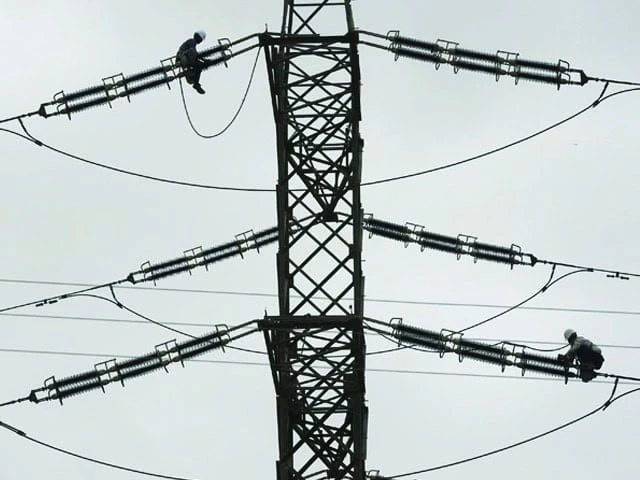
To cover losses, successive governments have increased electricity prices and imposed a Rs3.23 per unit surcharge to service debts taken for power distribution companies, pushing energy prices to the highest levels in the region. Photo: file
ISLAMABAD:
The power sector equity turned negative by Rs800 billion in the last fiscal year due to a reduction in sales and six power distribution companies remaining in losses because of under-recoveries and electricity theft, an official annual performance report has revealed.
At least four power distribution companies still managed to post profits ranging between Rs1 billion and Rs13.6 billion in the fiscal year 2024-25, which ended in June last year.
According to the state-owned enterprises (SOEs) report, total liabilities of the power sector amounted to Rs9.2 trillion compared to total assets of Rs8.4 trillion in the last fiscal year. The negative equity of Rs800 billion was attributed to distribution companies (DISCO) losses, theft of units, generation companies (GENCO) re-pricing, the circular debt burden and an unsustainable business model, stated the report prepared by the Ministry of Finance.
To keep the power sector functioning, the government injected over Rs1 trillion in subsidies during the last fiscal year, including Rs552 billion for distribution companies alone.
The report showed that out of 10 power distribution companies, six remained in losses in the fiscal year 2024-25, which was the first full year of the government of Prime Minister Shehbaz Sharif.
However, four power distribution companies that were in losses in the preceding year showed a cumulative profit of Rs39 billion, according to the report prepared by the Central Monitoring Unit of the Ministry of Finance.
The entities that posted profits included Gujranwala Electric Power Company, which earned Rs13.6 billion, and the Tribal Electricity Supply Company, which recorded Rs9.4 billion, largely due to the injection of subsidies.
Faisalabad Electric Supply Company showed strong improvement in collections and booked a profit of Rs9.6 billion. Multan Electric Power Company also posted a profit of Rs4.5 billion in the last fiscal year as its recoveries improved, although the company still needs to focus on controlling theft.
The remaining six entities incurred losses of Rs258 billion, which were about one-fifth lower than the preceding year. However, their cumulative losses stood at a staggering Rs3 trillion, close to half of the total combined losses of Pakistan’s top 25 enterprises.
With losses of Rs113 billion last year, the Quetta Electricity Supply Company was the second-largest loss-making entity after the National Highway Authority. Its cumulative losses reached Rs825 billion due to weak recoveries and high theft, according to the Ministry of Finance. Quetta has deep structural losses that successive governments have struggled to address.
The report stated that power sector revenues declined to Rs3.9 trillion, reflecting a 4% reduction or Rs181 billion, due to tariff lag and the impact of circular debt on DISCO cash recoveries, according to the Central Monitoring Unit of the Ministry of Finance.
The financial health of SOEs further deteriorated in the first full fiscal year of the current government, as net losses surged by 300% and these entities received Rs2.1 trillion in annual fiscal support, according to results announced by the Ministry of Finance on Friday.
Peshawar Electricity Supply Company was the third most loss-making entity, incurring Rs93 billion in losses. Its cumulative losses surged to Rs764 billion, with the Finance Ministry citing systemic theft in PESCO’s jurisdiction.
The government has announced plans to privatise power distribution companies this year. It has already sold a 75% stake in Pakistan International Airlines after carving out Rs670 billion in debt, setting a precedent that prospective buyers of DISCOs may also seek similar concessions before bidding.
The Sukkur Electric Power Company, the ninth highest loss-making public sector entity, incurred fresh losses of Rs25.4 billion, pushing its cumulative losses to nearly Rs500 billion, according to the report.
Hyderabad Electric Supply Company incurred losses of Rs13 billion, becoming the 12th highest loss-making entity, with total losses reaching Rs460 billion. The Finance Ministry noted that Hyderabad suffers from very high technical and commercial losses.
Lahore Electric Supply Company incurred Rs12.7 billion in losses, ranking as the 13th most loss-making entity, with cumulative losses rising to Rs306 billion, according to the Ministry of Finance.
Islamabad Electric Supply Company ranked as the 19th highest loss-making entity after incurring losses of Rs1.4 billion last year. Its cumulative losses increased to Rs133 billion.
To cover these losses, successive governments increased electricity prices and imposed a Rs3.23 per unit surcharge to service debts taken for power distribution companies, pushing energy prices to the highest levels in the region.
Finance Minister Muhammad Aurangzeb said this week that high energy prices and high taxes were among the reasons foreign companies were leaving Pakistan, although he added that some firms still wanted to do business in the country.
Residential, commercial and industrial consumers have increasingly shifted to rooftop solar panels and other cheaper energy solutions, and despite the government’s efforts to discourage off-grid options, consumers remain reluctant to stay on the grid.
