


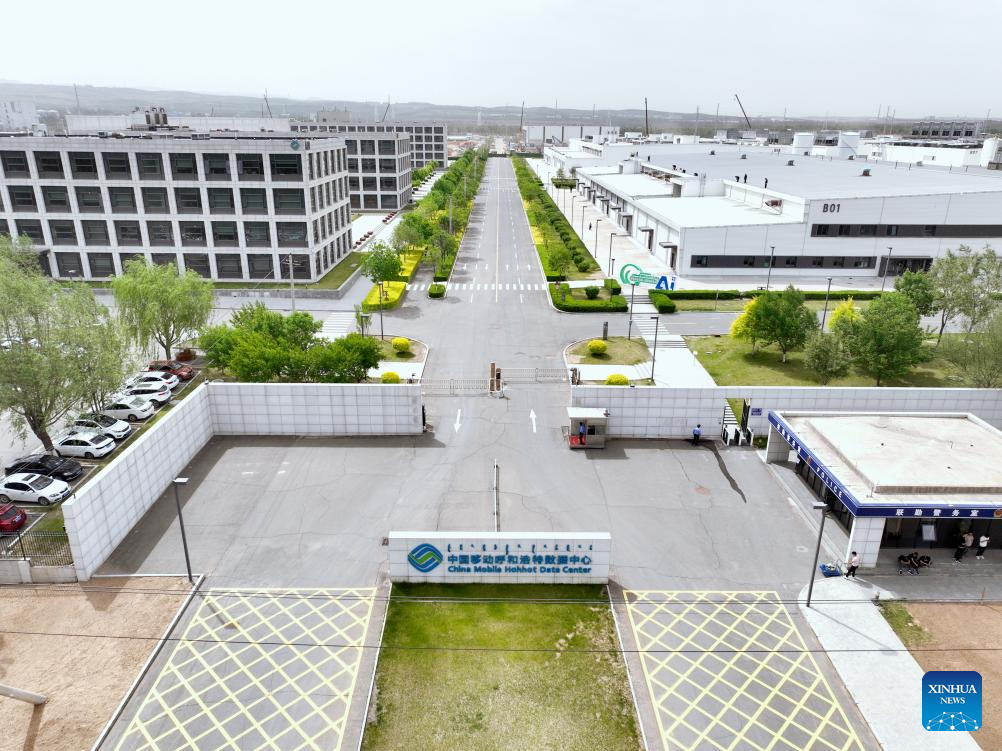
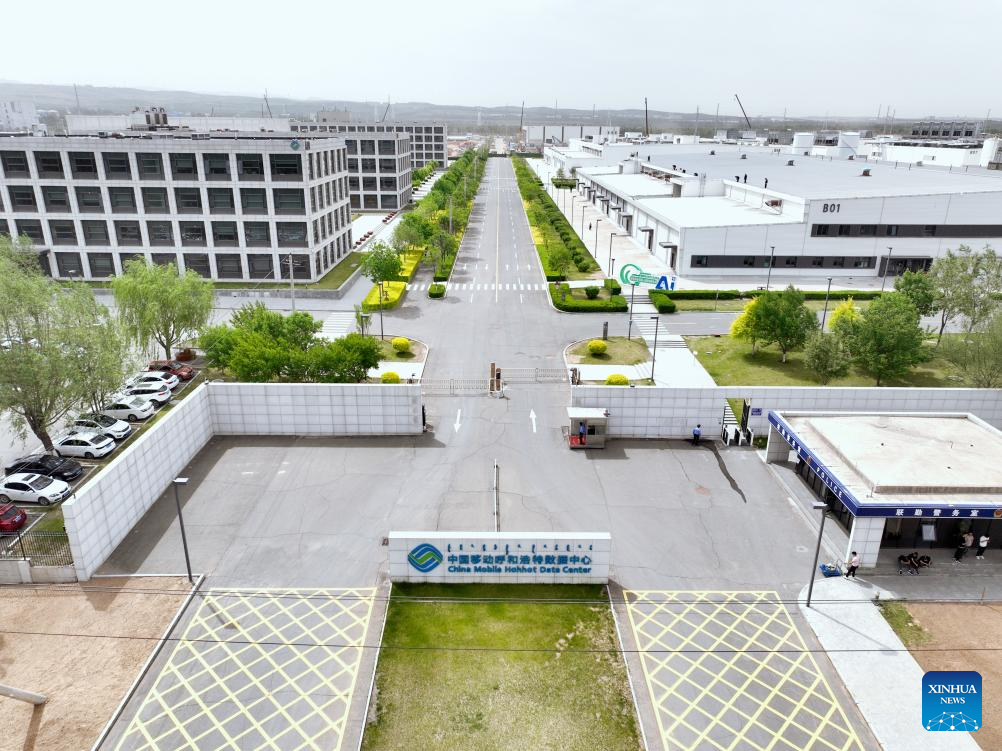
This photo taken on May 20, 2025 shows the China Mobile Hohhot Data Center in Hohhot, north China’s Inner Mongolia Autonomous Region. (Photo by Chen Qian/Xinhua)
HOHHOT, Jan. 24 (Xinhua) — On the prairie of Hohhot, capital of north China’s Inner Mongolia Autonomous Region, the wind that has swept the grasslands for millennia now turns massive turbines to generate green electricity that powers thousands of servers in the Horinger New Area, where data centers process information at millisecond speeds.
Inner Mongolia has emerged as one of eight national computing hubs under China’s “East Data, West Computing” strategy. This initiative aims to have less-developed inland regions store and process data sent from the country’s economically dynamic eastern areas, accelerating the development of an integrated national computing network.
As the global digital economy drives data center energy use and the associated carbon emissions to new heights, China is anchoring this high-power industry in regions rich in wind and solar energy, laying a sustainable foundation from the ground up.
The economic logic is compelling. “About half of the operational cost for computing industries comes from electricity consumption. Electricity costs determine competitiveness,” explained Li Xiang, head of the intelligent new energy production management platform at China Huadian Corporation Ltd.
Hohhot enjoys a decisive advantage. Green power flows directly from wind farms to data centers through dedicated lines, slashing grid fees. Meanwhile, the city’s cool climate, with an average annual temperature of 7.7 degrees Celsius, provides natural cooling for up to six months a year, drastically reducing air-conditioning costs.
“Compared to data center projects in Beijing, our electricity costs here are reduced by about two-thirds,” said Bai Yang, head of the Jingmeng intelligent computing center in Horinger New Area.
This powerful combination has fueled staggering growth. Hohhot’s total computing power now exceeds 122,000 petaflops, with 96 percent dedicated to intelligent computing. This scale has, in turn, attracted an equipment manufacturing ecosystem. Forty-five companies producing servers, cabinets and sensors have set up locally, forming a complete industrial supply chain.
Making this raw power usable requires smart networks. Sun Wenda, who oversees a local computing resource platform, says acquiring computing power here is now “as convenient as online shopping.” The platform integrates resources for streamlined scheduling and billing, and connects to hubs in Beijing and elsewhere.
The speed is breathtaking. “In the blink of an eye, our data makes 50 round-trips between Beijing and Hohhot,” said Xiao Liangpeng, a client of the platform, referring to a round-trip latency of under 5 milliseconds. This enables real-time applications from scientific research to training the next generation of AI models.
The value of this green computing power shines in its everyday impact. The raw computational power fuels advanced scientific inquiry through supercomputing platforms that are currently supporting more than 3,600 active research projects. It also serves as a critical training ground for the next generation of AI models, developed by leading technology firms.
Beyond the digital world, this intelligence breathes new life into traditional sectors such as dairy farming. Here, smart systems monitor herds by tracking each cow’s activity levels, milk yield and sleep patterns in clear, real-time detail. Automation takes the lead in safety and standardization, with unmanned milking equipment carrying out the entire process, from disinfection to attachment and milking, consistently and precisely.
In the city itself, this computing power enables smart parking systems, smooths traffic flow and powers AI-assisted medical screenings, making urban life more efficient and responsive for residents.
Hohhot’s story stands as a tangible testament to China’s broader pursuit of a balanced path, where vigorous economic development walks hand in hand with a commitment to green transition. Hohhot is not just building a regional data hub; it is actively fueling a cleaner, more powerful engine for the global industrial revolution. ■
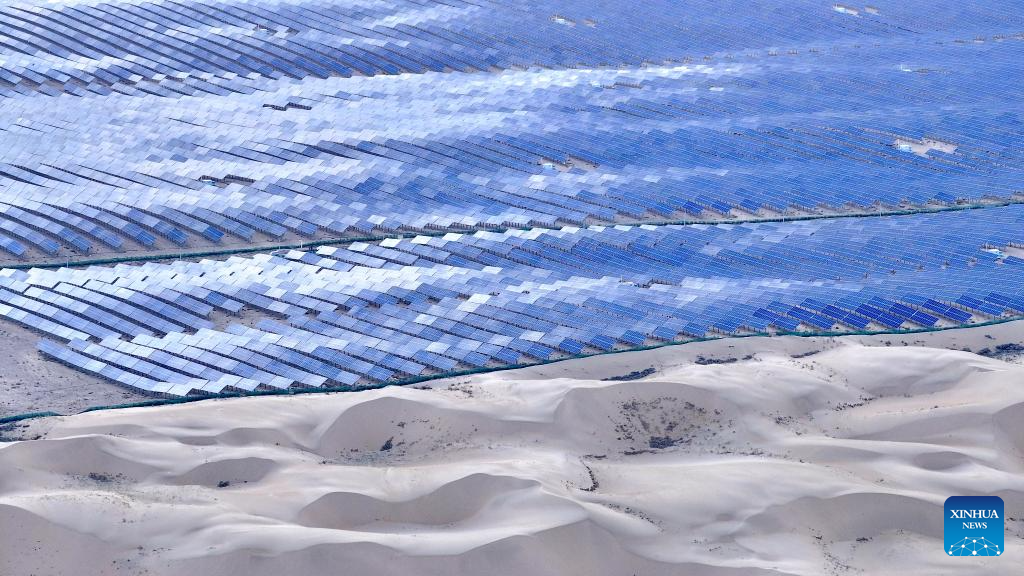
An aerial drone photo taken on May 17, 2025 shows a photovoltaic base with a capacity of one million kilowatts in Dalad Banner of Erdos, north China’s Inner Mongolia Autonomous Region. (Photo by Yang Yaozhong/Xinhua)
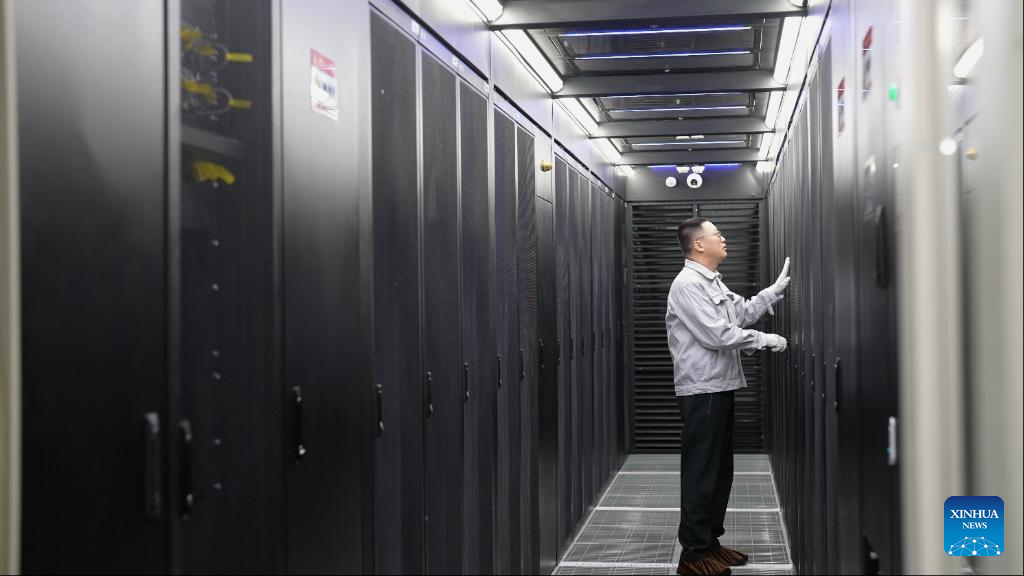
An employee conducts maintenance at a server room of the China Mobile Hohhot Data Center in Hohhot, north China’s Inner Mongolia Autonomous Region, on May 20, 2025. (Photo by Su Yali/Xinhua)
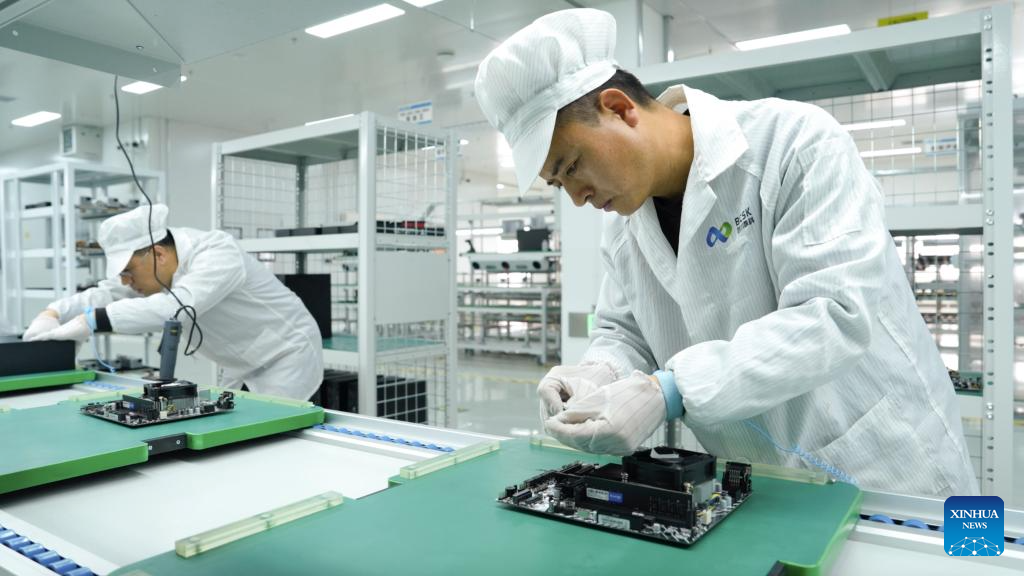
Employees assemble computer servers at a digital technology company in Hohhot, north China’s Inner Mongolia Autonomous Region, on Jan. 20, 2025. (Photo by Zhang Jiahui/Xinhua)
