


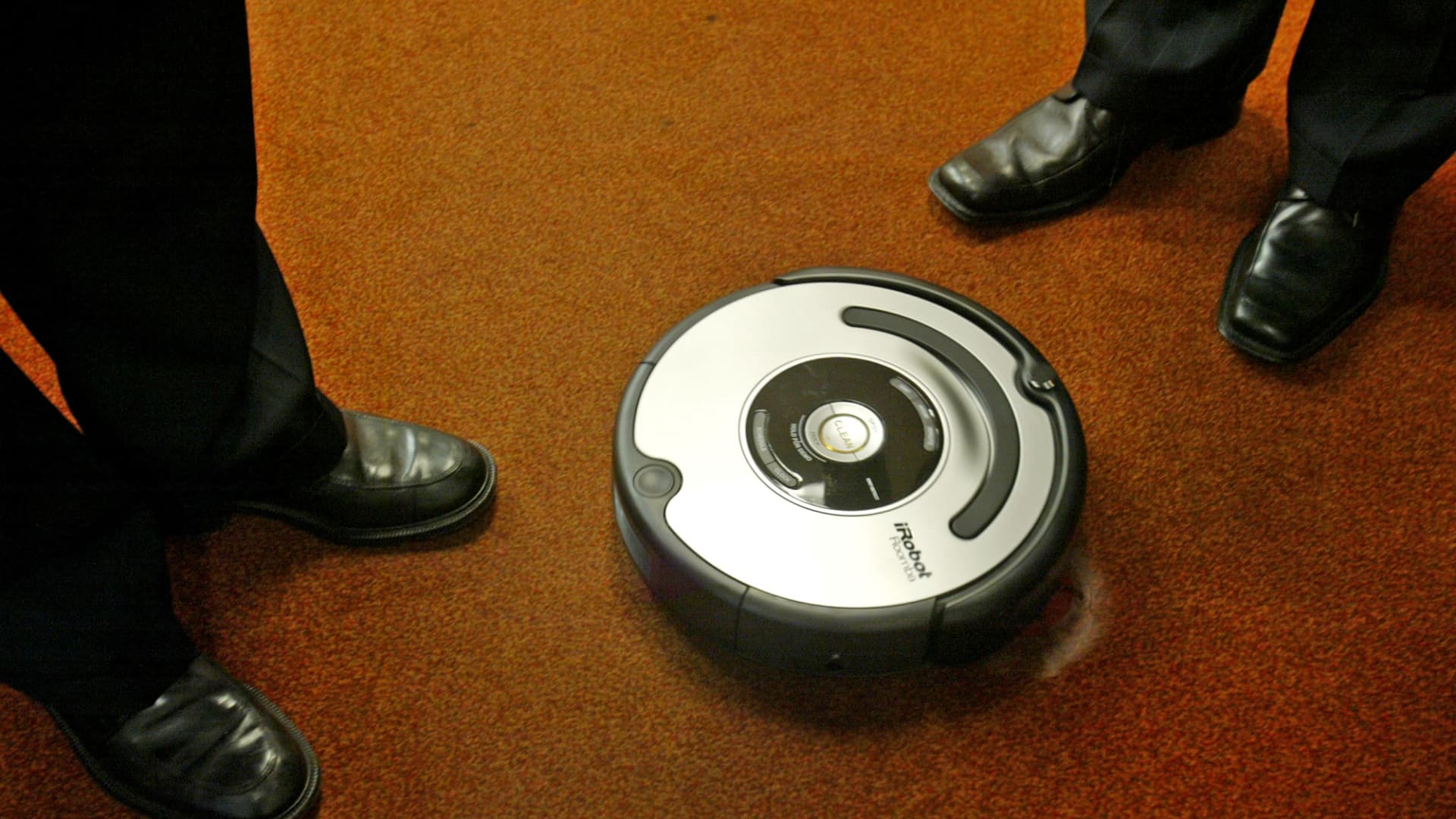
Medianews Group/boston Herald Via Getty Images | Medianews Group | Getty Images
Los Angeles resident Ruth Horne, 76, enticed by a bargain, bought what she thought was a Roomba to vacuum her house, but the experience ended in frustration.
“It kept getting stuck somewhere and would then just go around in circles,” Horne said. She realized it was a cheaper knock-off.
Meanwhile, Marcy Lewis, 75, of Madeira, Ohio, had been wanting a robot vacuum cleaner and deliberately chose a knock-off.
“I’m pretty low tech, but it just seemed like a good idea — cleaner house, less work,” Lewis said.
She was watching Prime Day sales and got a good deal on a Eufy robot vacuum cleaner. “I really liked it and it did a good job, but didn’t last long,” Lewis said.
Product quality was one of the advantages for the Roomba in a flood of less expensive knock-offs, but that didn’t save it from the corporate bankruptcy its maker iRobot announced earlier this week. And cheap Chinese competition was not the only factor in its failure. An attempted 2022 acquisition of iRobot by Amazon, thwarted by regulators, and the changing dynamics around mergers and acquisitions, represent an ongoing concern for struggling tech companies that in the past have turned to M&A as not just an exit ramp, but savior.
The company, which Amazon agreed to pay $1.7 billion to acquire in August 2022, reported in a court filing last Sunday that it had between $100 million-$500 million in assets and liabilities, and owed roughly $100 million to its largest creditor, Shenzhen Picea Robotics Co., the contract manufacturer, located in China and Vietnam, which now owns it. In all, Reuters reported the company has $190 million in debt.
“Today’s outcome is profoundly disappointing — and it was avoidable,” Colin Angle, co-founder and CEO of iRobot, told CNBC in a statement earlier this week. “This is nothing short of a tragedy for consumers, the robotics industry and America’s innovation economy.”
In early 2024, Amazon CEO Andy Jassy told CNBC that regulators’ efforts to block the deal were a “sad story” and said it would’ve given iRobot a competitive boost against rivals.
Some M&A experts agree with the view of both the would-be acquirer and bankrupt company.
“The iRobot case demonstrates that when regulators prioritize hypothetical future harms over present-day financial realities, they don’t protect competition; they destroy the target company,” said Kristina Minnick is a professor of finance at Bentley University. “The bankruptcy of iRobot serves as a definitive cautionary tale for the current M&A environment, underscoring fears that regulators are dismantling the traditional safety net for struggling companies,” she said.
Acquisitions are an integral part of recycling assets and growing the economy, but regulators in the U.S. and in Europe have taken a stance in recent years which Minnick says “distorts this natural cycle.”
She added that by blocking Amazon’s white knight acquisition of iRobot, regulators removed the only viable exit ramp for a struggling American robotics pioneer.
“The tragic irony is that instead of remaining an independent competitor, iRobot was forced into bankruptcy and is now being sold to one of its Chinese manufacturing partners. In their zeal to prevent Big
Tech expansion, regulators effectively handed valuable IP and market share to the very foreign competitors that were crushing the company in the first place,” Minnick said.

After Amazon abandoned the deal in early 2024 citing the likelihood that European regulators would block it, newer issues emerged for the already vulnerable company.
“Roomba didn’t just run out of battery, it got shoved into Chapter 11 after European regulators kicked out Amazon’s $1.4 billion escape hatch and left it bleeding cash on the living-room floor,” said Eric Schiffer, chairman at Reputation Management Consultants. “Amazon walked, tariffs hit, cheap rivals swarmed, and suddenly the king of robo-vacs is begging its own manufacturer to save its plastic rear end,” Schiffer said. “This is a cautionary tale that if your business model is to get bought by Big Tech, one hostile regulator in Europe can turn your dream exit into a Caligula-level catastrophic implosion.”
Jay Jung, managing partner at Embarc Advisors, a San Francisco-based corporate finance advisory firm, says that iRobot’s bankruptcy is ominous for future similar deals if regulators don’t learn the lessons of the past few years. “European regulators are within their rights to block these deals,” he said. But he added that “their stance is too tilted towards anti-big tech. When a Chinese company like this takes over, they will preserve the brand but everything moves to China — lost jobs, and any other economic benefit other than the brand is gone.”
At least publicly, the Trump administration’s Federal Trade Commission seems to be taking a more hands-off approach to M&A than its Biden era predecessors led by FTC Chair Lina Khan, who had a hawkish antitrust stance. It has vowed to take a dual approach on mergers: vigorously pursue ones deemed anti-competitive and stand out of the way one of ones that don’t meet that criteria. “If we’ve got a merger or conduct that violates the antitrust laws, and I think I can prove it in court, I’m going to take you to court. And if we don’t, I’m going to get the hell out of the way,” FTC Chair Andrew Ferguson told CNBC’s Squawk Box earlier this year.
But in Europe, the view towards tech M&A remains tilted to scrutiny. EU antitrust chief Teresa Ribera telegraphed that there could be more to come in comments earlier this month when announcing an anti-trust probe against Meta’s plans to block AI rivals from Whatsapp, which it owns. The action she said was to prevent dominant tech players from “abusing their power to crowd out innovative competitors”
That is cold comfort for a struggling tech company, and Minnick said big tech is already finding workarounds to avoid antitrust scrutiny. As a direct result of these blocked exit ramps, the tech giants are now attempting to circumvent regulators through asset purchases rather than full company acquisitions.
“In deals like Microsoft’s arrangement with Inflection AI or Amazon’s deal with Adept, the acquirer hires the target’s founders and key engineering talent while licensing their intellectual property, leaving the corporate shell behind,” Minnick said, adding that this “reverse acqui-hire” structure is designed specifically as a loophole to bypass antitrust review.
The FTC did in fact issue a report on these types of deals in the final days of Lina Khan’s tenure, after it had targeted the Amazon-Adept deal for scrutiny.
Minnick says even if the deal tweaks are successful, they remain imperfect solutions for a broader M&A problem. “While this allows the technology to survive, it is a sub-optimal outcome that often leaves regular shareholders and non-essential employees stranded in a hollowed-out zombie company, proving that regulatory friction is forcing the market into increasingly complex and inefficient contortions to survive,” she said.
The iRobot headquarters in Bedford, Massachusetts, US, on Friday, June 16, 2023.
Bloomberg | Bloomberg | Getty Images
Minnick believes that if things don’t change, we are likely to see more of these zombie scenarios, where struggling tech and media companies find their exit ramps blocked by regulators overseas or at home. “The refusal to allow organic consolidation means that instead of orderly acquisitions that preserve jobs and innovation, we may see more disorderly bankruptcies,” Minnick said. “If potential acquirers are genuinely concerned about overpaying or regulatory hurdles, they will choose not to engage. But when regulators preemptively block these lifelines to make a philosophical point, they are not saving the market; instead, they are breaking the machinery that allows the economy to heal and grow,” she added.
Roomba did face more than just M&A headwinds, including financial problems accelerated by the Trump administration’s trade policy.
Ragini Bhalla, head of brand at Creditsafe, has been watching iRobot’s deteriorating finances for a while. The company began paying vendors three to four weeks late beginning in May, Bhalla said, and that volatility in paying vendors and suppliers is usually an early warning sign of emerging liquidity pressure. She also said that iRobot’s credit score steadily dropped over a period of five months until it was rated “Very High Risk” in June 2025, where it stayed until the bankruptcy filing.
Bhalla also noted that revenue declined amid intensifying competition from lower-priced Chinese rivals and that tariffs emerged as a direct and material accelerant. Trade policy was the final blow. “Most Roombas are manufactured in Vietnam, exposing iRobot to new U.S. import levies that added millions in costs and disrupted forward planning,” Bhalla said.
Ultimately, the combination of elevated debt, eroding demand, and tariff-driven cost pressure pushed iRobot into a manufacturer-led buyout through bankruptcy. “This illustrates how trade policy shocks can quickly turn underlying operational stress into a solvency event for hardware-dependent businesses,” Bhalla said.
There is no going back from an antitrust regime that has gone global, according to Schiffer, and Roomba may merely be the most high-profile casualty of 2025.
“Your suitor can live in Seattle, your stock on Nasdaq, and some wacky commission in Brussels holds the shotgun to your wedding,” Schiffer said, adding that for founders, “Roomba is the billboard warning that if you rely on one mega-deal to save you, you’re not running a strategy, you’re rehearsing for disaster.”
Meanwhile, Lewis in Ohio just wants a working Roomba.
“I am surprised about the bankruptcy, but I don’t feel that it affects me. I’m also disappointed that a Chinese company is buying Roomba — sadly that seems to be the way things go now. It’s nice to buy American, but it gets harder and harder.”
