


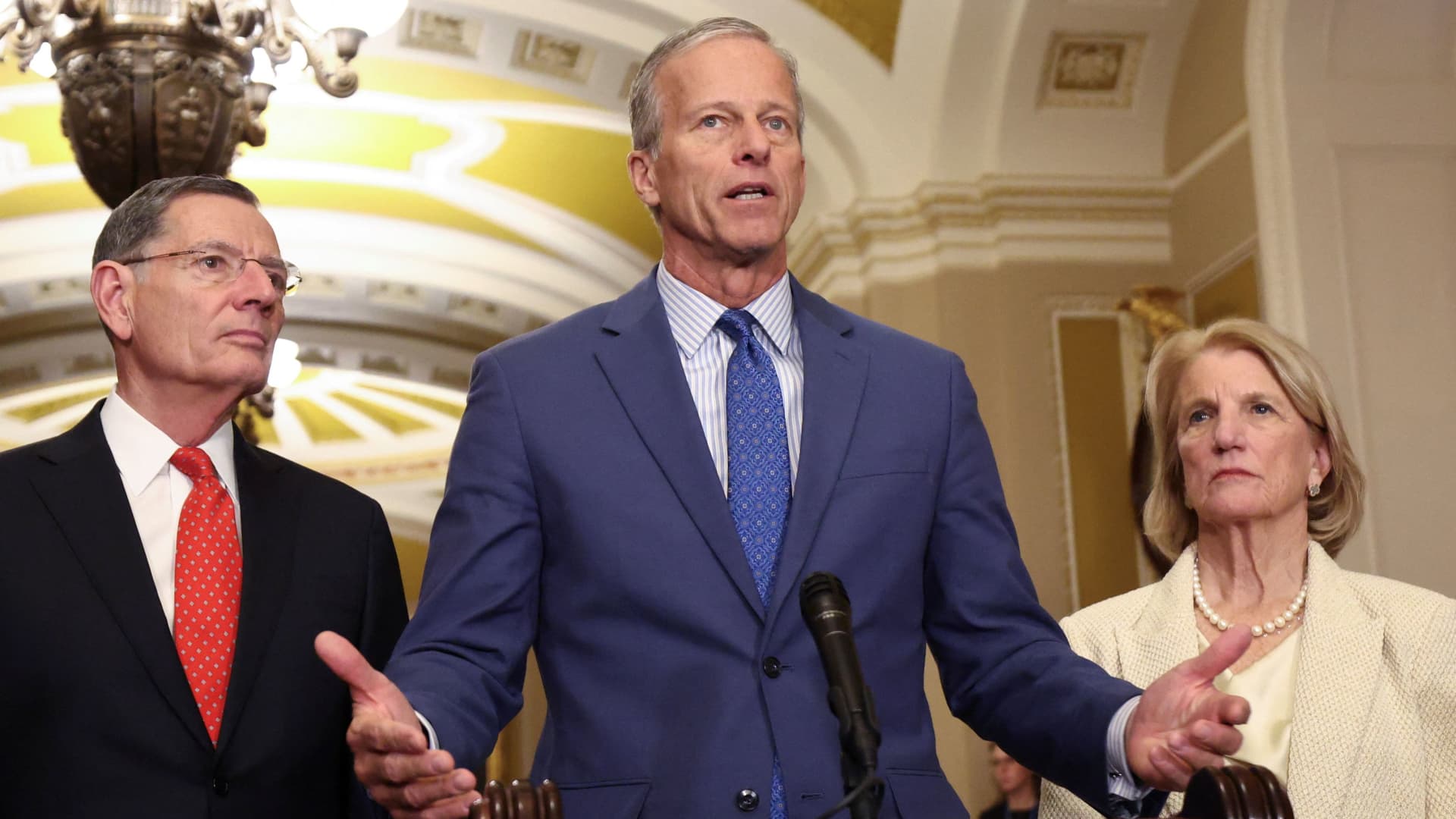
U.S. Senate Majority Leader John Thune (R-SD) speaks to reporters after the weekly Senate Republican caucus policy luncheon at the U.S. Capitol in Washington, D.C., U.S., U.S., January 13, 2026.
Kevin Lamarque | Reuters
The rapper Nicki Minaj supports it. Elon Musk says it’s critical to sustain American democracy. The SAVE America Act voter identification bill emerged this week as a hot topic in hard-line Republican circles and now may advance in Congress next week.
The legislation, backed by President Donald Trump, is scheduled for a vote in the House of Representatives next week amid a pressure campaign from right-wing commentators and many in the congressional GOP. It sets up a showdown with Democrats and voting-rights advocates, who say such a proposal could disenfranchise millions of Americans, and with Senate Republican leaders, who are fielding calls to change the filibuster and clear a path to passage.
“America’s Elections are Rigged, Stolen, and a Laughingstock all over the World. We are either going to fix them, or we won’t have a Country any longer,” Trump posted to Truth Social on Thursday. The president urged passage of a bill dubbed the SAVE America Act, which would require government-issued photo ID to cast a ballot and proof of citizenship to register to vote.
Democrats are among those who have bristled at the proposals, which are rooted in Trump’s unfounded claims that elections are rife with fraud and come in the context of the president’s recent comments about nationalizing elections and the FBI raid of a Georgia election office last week where Director of National Intelligence Tulsi Gabbard was present.
Senate Minority Leader Chuck Schumer, D-N.Y., said this week that the voter ID proposal would be “dead on arrival” in the Senate and likened the bill, — introduced by Rep. Chip Roy, R-Texas, in the House and Sen. Mike Lee, R-Utah, in the Senate — to “Jim Crow 2.0.”
According to the Brennan Center for Justice and the University of Maryland’s Center for Democracy and Civic Engagement, 21 million Americans do not have documents proving their citizenship readily available and 2.6 million Americans lack government-issued photo ID of any kind. Low-income and minority voters are more likely to lack the types of documents that would be required by a national voter-ID law, leading to less voting participation by those groups.
“The documentary proof of citizenship provisions would be extremely burdensome for a lot of Americans. Most Americans don’t have a driver’s license or ID that indicates that they’re a U.S. citizen,” Nicole Hansen, policy counsel at the Campaign Legal Center, said in an interview.
“We really view the bill as part of a broader effort by the president and his allies in Congress to sow the seeds to question election results in 2026 that they don’t like,” Hansen said.
The general concept of voter-ID requirements has broad public support, with voting-rights advocates cautioning the devil is in the details. According to an August 2025 Pew Poll, 95% of Republicans and 71% of Democrats favor voter ID. A 2024 Gallup poll found that 84 percent of Americans support voter ID and 83 percent support proof of citizenship to register to vote. It is already illegal for noncitizens to vote in federal elections and documented cases are rare.
“The American people are clear: they support Voter ID and agree that only U.S. citizens should vote in our elections,” Roy said in a statement Thursday.
But with Democrats vowing to block the bill, Senate passage is unlikely. Because of Senate procedural rules and the balance of the power in that chamber, Democratic votes are needed for legislation to advance there.
A separate proposal, also introduced by Roy and similarly called the SAVE Act, would have barred noncitizen voting but did not have a voter ID component. Federal law already bars noncitizens from voting in federal elections, but there are provisions for them to vote in some lower-level elections. The House voted 220-208 in favor of the bill in April, with four Democrats in support, but it has not yet gotten a vote in the Senate.
That has caused some members to call for eliminating the filibuster as it has been practiced since the 1970s and revert back to a “standing filibuster” — made famous by the movie “Mr. Smith Goes to Washington” — which requires dissenting members to actively hold the floor in order to block legislation.
“The modern-day filibuster is a perversion of how the Senate was supposed to function. Instead of arguing positions and attempting to pass legislation, it has become a way to avoid doing the work and to block the President’s agenda in the name of institutional supremacy, even though most of the senators got elected with help from POTUS,” Rep. Anna Paulina Luna, R-Fla., one of the most vocal in the House group calling for the passage of a voter ID law, posted to X this week.
Luna, during an appearance on Punchbowl News’ “Fly Out Day” podcast, floated the idea of tacking the SAVE America Act onto larger, must-pass legislation down the line.
“We should nuke what’s called the zombie filibuster, which is the ability for Democrats to filibuster it without lifting a finger and that we should require an old-fashioned talking filibuster,” Sen. Ted Cruz, R-Texas, told Newsmax this week.
But Senate Majority Leader John Thune, R-S.D., who has promised a vote on a version of the Republican election bill, expressed skepticism about filibuster reform.
“We will get a vote on the SAVE Act at some point,” Thune said at a press conference earlier this week. “With respect to the filibuster, I think we all know where the votes are on that.”
