


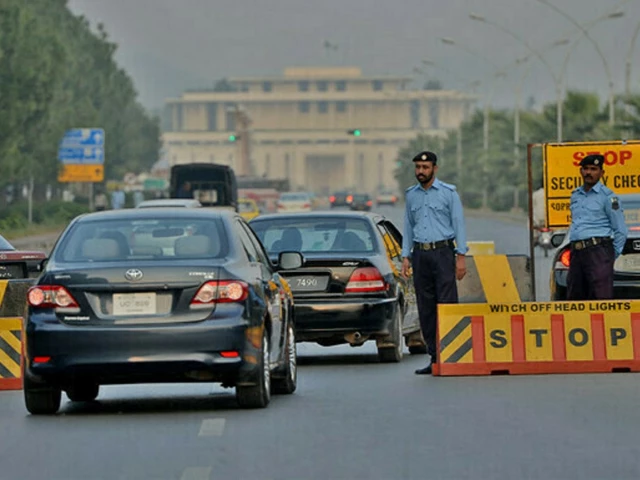
Islamabad administration imposes Section 144, banning all gatherings and declaring them unlawful across the capital
ISLAMABAD:
Protests erupted in Islamabad’s Red Zone on Sunday following killing of Iran’s Supreme Leader Ayatollah Khamenei in strikes launched by Israel and the United States a day earlier, as demonstrators marched towards the Diplomatic Enclave before being dispersed by police after heavy tear gas shelling.
According to details, Millat-e-Jafaria Pakistan had announced a protest in the federal capital after news of Ayatollah Khamenei’s killing. Thousands of protesters gathered at Aabpara Chowk on the call of Shia religious leaders and declared their intention to march towards the US Embassy to register their protest. Participants then began moving towards the Red Zone.
In response, police sealed all entry points to the Red Zone by placing containers and deploying heavy contingents. Additional personnel were stationed along Embassy Road to prevent the marchers from advancing. When protesters were stopped on Embassy Road, they began pelting stones at police, who responded with intense tear gas shelling. Despite these measures, the advancing crowd initially continued to push forward.
Read: At least 10 killed in Karachi clashes during march towards US Consulate after Khamenei strike
Chanting slogans and continuing stone-pelting, demonstrators moved through Serena Chowk and reached the gate of the Diplomatic Enclave. Protesters reportedly entered parts of the Red Zone and intensified their sloganeering. Police resorted to further tear gas shelling and aerial firing, and later used armoured vehicles to push the crowd back towards Aabpara Chowk.
Reports indicated that several protesters were injured due to the shelling. During the unrest, a police checkpoint at Serena Chowk was set on fire and the windows of multiple vehicles were smashed.
Among those participating in the protest were Majlis Wahdatul Muslimeen (MWM) chief and Leader of the Opposition in the Senate Allama Raja Nasir Abbas, along with several leaders of the Shia community.
An MWM spokesperson claimed that three protesters were killed and dozens injured during the demonstration due to police shelling and firing. The deceased were identified as Ali Raza, Razi Haider and Mohammad Basir.
However, an Islamabad police spokesperson denied the claim regarding the reported fatalities.
Also Read: Iran says it targeted US aircraft carrier, state media reports
Meanwhile, Interior Minister Mohsin Naqvi visited the Red Zone amid the situation. Speaking on the occasion, he described it as a day of mourning for the Muslim Ummah, Iran and the people of Pakistan. He said that following the reported martyrdom of Ayatollah Khamenei, Pakistanis were grieving alongside the people of Iran.
“We stand with you,” he said, urging citizens not to take the law into their own hands and to record their protest in a peaceful manner.
Later, police dispersed protesters at Serena Chowk and traffic flow in the area was restored.
Section 144 imposed in Islamabad
The district administration of Islamabad on Sunday imposed Section 144 in the federal capital, declaring all types of gatherings unlawful in the wake of protests following the killing of Iranian Supreme Leader..
District Commissioner Islamabad Irfan Nawaz Memon announced the measure on X, urging citizens not to take part in any gathering, protest, demonstration, or assembly, and warning that strict legal action would be taken against violators.
وفاقی دارالحکومت اسلام آباد میں دفعہ 144 کا نفاذ ہے جس کے تحت تمام قسم کے اجتماعات کو غیر قانونی تصور کیا جائے گا، شہریوں سے گزارش ہے کسی بھی اجتماع یا اکٹھ کا حصہ مت بنیں، کسی بھی احتجاج، مظاہرے یا اجتماع کی صورت میں سخت قانونی کاروائی کی جائے گی
— DC Islamabad (@dcislamabad) March 1, 2026
Protests have been reported across Karachi and Lahore following the assassination of 86-year-old Khamenei, whose death was confirmed by Iranian state media on Sunday.
Read More: Pakistan condemns ‘unwarranted attacks’ on Iran, urges diplomacy at UNSC
Iran launched hundreds of missiles and drones in retaliation, targeting US troops in the region and cities in Israel and Arab countries allied with Washington, leading to widespread flight cancellations across the region.
US President Donald Trump said the air strikes were aimed at ending a decades-long threat from Iran and ensuring it could not develop a nuclear weapon, as he sought to justify a move that appeared to go against his professed opposition to American involvement in complex overseas conflicts.
