


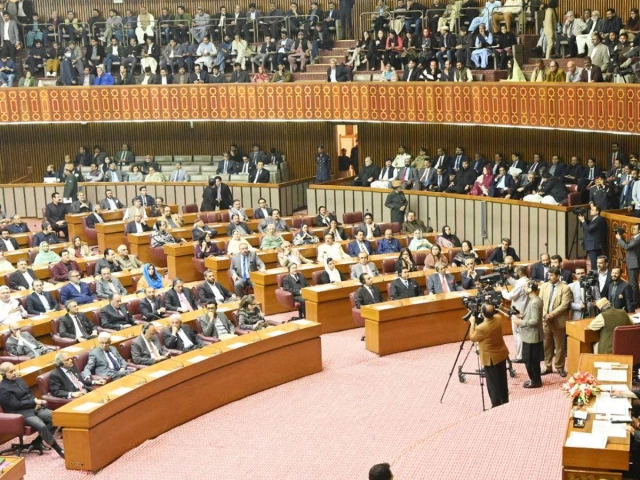
NA passes resolution condemning attack, calls it assault on Constitution, national security and inter-sect harmony
The Senate on Monday unanimously adopted a condolence and condemnation resolution over a suicide attack at an imambargah in Islamabad’s Tarlai area, calling for a judicial inquiry to identify those responsible and bring them to justice.
“This House demands the government and the relevant institutions to immediately establish a judicial commission for a transparent, comprehensive and timely investigation into this incident. The members of the judicial commission should include retired senior judges from the Supreme Court, intelligence agencies, as well as representatives from the Ministry of Interior, the National Assembly and the Senate,” the resolution said.
At least 33 people were killed and around 169 others injured when a suicide bomber struck Imambargah Khadijah al-Kubra during Friday prayers last week. The blast occurred as worshippers gathered for Jumma prayers and was accompanied by explosions and gunfire.
The attack was the deadliest in Islamabad in more than a decade and the deadliest nationwide since the Peshawar mosque bombing in January 2023.
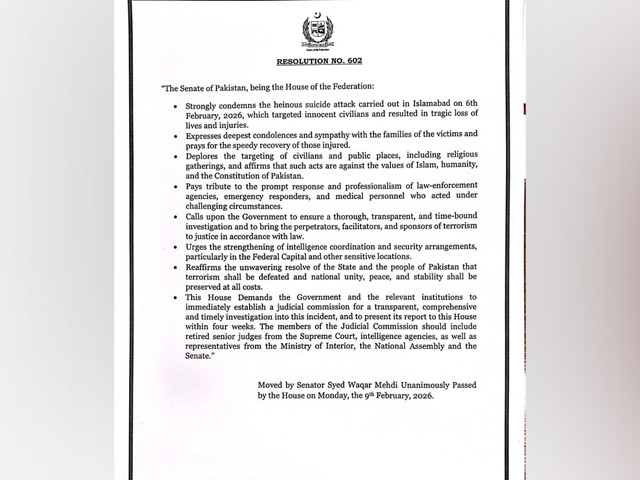
The resolution was tabled by Senator Waqar Mehdi during today’s session, while Leader of the Opposition in the Senate Allama Raja Nasir Abbas proposed that it include a demand for a judicial commission to investigate the incident.
The resolution condemned the attack, expresseed condolences to the victims’ families and called for those responsible — including alleged facilitators and sponsors — to be brought to justice under the law.
It said the House “pays tribute to the prompt response and professionalism of law-enforcement agencies, emergency responders, and medical personnel who acted under challenging circumstances”.
It further “calls upon the government to ensure a thorough, transparent, and time-bound investigation and to bring the perpetrators, facilitators, and sponsors of terrorism to justice in accordance with law.”
The resolution also urged stronger intelligence coordination and security arrangements, particularly in the federal capital and other sensitive locations, while reaffirming the state’s resolve to defeat terrorism and preserve national unity, peace and stability.
Earlier, routine business was suspended in parliament as both Houses held prayers for those killed in the suicide attack, with lawmakers moved to take up the incident for debate.
Law Minister Azam Nazeer Tarar addressed the upper house, saying private members’ bills on Monday’s agenda were being moved to Wednesday.
Tarar said the security forces had come under criticism and asked why they were being blamed. He said the forces were sacrificing their lives and questioned what fault could be attributed to them.
He said Pakistan had developed a habit of avoiding discussion of past mistakes, and he also targeted those criticising the “establishment”, saying they had previously relied on it themselves.
Tarar urged lawmakers to think as a nation, stand behind the security forces and become their voice, adding that improvement would only come if the House offered constructive suggestions during the discussion.
Abbas delivered an emotional address, contrasting mourning with celebrations elsewhere.
“We were carrying coffins, and in one city drums and music were being played,” he said.
Also Read: Daesh claims responsibility for deadly bombing in Islamabad imambargah
Abbas said those spreading division and hatred were operating openly.
“Pakistan is not a sectarian Pakistan — it was made a Muslim Pakistan,” he said. “This is Muslim Pakistan. This is Pakistan for all of us.”
He said hate-mongers also existed within the country and questioned why security operations had not prevented attacks.
“First there was the TTP and the BLA — now ISIS has also arrived,” he added.
Abbas said terrorism was increasing and blamed gaps in planning and security.
“Our priorities are something else. Giving the country peace and law and order should be our priority. At this time in Pakistan, our life and property are not safe,” he said. “Innocent people are being killed every day.”
NA unanimously passes resolution condemning attack
The National Assembly (NA) session began under Speaker Sardar Ayaz Sadiq. A motion to suspend the day’s agenda was tabled by the federal minister for parliamentary affairs and approved by the lawmakers. Maulana Abdul Ghafoor Haideri led a prayer for the victims.
Later, the session unanimously adopted a condemnation resolution against the suicide attack, calling it a direct assault on the Constitution, religious freedom, national security and inter-sect harmony.
The resolution was tabled by Senator Engineer Hamid Hussain.
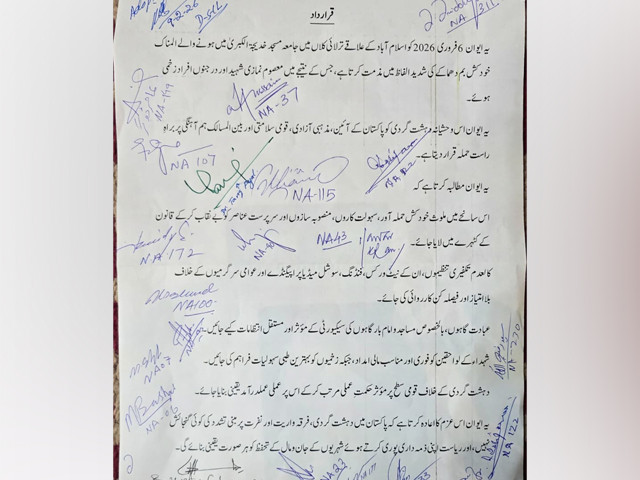
It said innocent worshippers were killed and dozens more injured in the blast. The resolution demanded that the suicide planners and “patronising elements” behind the attack be exposed and brought before the law.
It called for “indiscriminate and decisive action” against banned organisations, their networks, funding, social media propaganda and public activity.
The resolution urged “effective and permanent” security arrangements for places of worship, particularly mosques and imambargahs. It called for immediate and appropriate financial assistance for the families of those killed, and the best possible medical facilities for the wounded.
The NA also urged the government to develop an effective national strategy against terrorism and ensure its implementation.
The resolution reaffirmed that there was “no space” in Pakistan for terrorism, sectarianism or hate-based violence, and said the state must ensure protection of citizens’ lives and property.
Read More: Daesh-linked Afghan mastermind of Islamabad imambargah attack in custody
During the session, Parliamentary Affairs Minister Tariq Fazal Chaudhry told the NA the attack took place at an imambargah, where an assailant opened fire on security guards, entered the mosque area and detonated explosives.
He said 33 worshippers had been killed so far and more than 150 people were injured. He added that most of those killed were young people, saying the presence of educational institutions in the area meant more students were among the congregation.
Chaudhry said a cousin of Islamabad’s police chief had been killed and his uncle injured.
He told lawmakers the attacker had been identified as “Yasir Khan”, and said authorities had also learned that another terrorist linked to the incident was a suicide attacker.
He said the Counter-Terrorism Department in Nowshera had arrested four suspected terrorists.
Chaudhry said the attacker received training in Afghanistan, and claimed India trained suicide attackers in Afghanistan and was behind the operation.
He said intelligence agencies had foiled similar plots in the past and that places of worship had security procedures, but added that guards were unable to stop the attacker.
Defence Minister Khawaja Asif called for an honest reckoning with the country’s past role in wars linked to Afghanistan, saying Pakistan could not move forward on security unless it admitted “past mistakes”.
Asif said he largely agreed with remarks made by the opposition leader and by former prime minister Raja Pervaiz Ashraf.
Aslo Read: Eyewitnesses describe imambargah blast tragedy
The defence minister recalled that travel between Pakistan and Afghanistan had once been less restrictive.
“There used to be no visa between Pakistan and Afghanistan. People travelled on permits,” he said. “I also went to Afghanistan myself without a visa.”
He said Pakistan became a party to two wars fought on Afghan soil and challenged long-standing narratives about those conflicts.
He said Soviet forces entered Afghanistan at the invitation of the Afghan government and rejected the description of the anti-Soviet conflict as a religious war.
“The war against Russia was not any jihad,” he said, adding that Pakistan had still not been able to reverse parts of what he described as an altered national curriculum and history.
Asif said Pakistan had failed to learn after being abandoned by the United States.
“The Americans left us, but we still did not learn,” he said.
He also said that Afghanistan was not responsible for the September 11 attacks in the US.
“To this day it is not known who carried out 9/11, there was no Afghan Pashtun or Hazara in 9/11. But for two decades, we were available for rent. If we do not admit past mistakes, we cannot move forward. One person, to win America’s favour, made the country America’s frontline state,” he said.
He said he had apologised in Parliament for his own family’s political role, and criticised others for not doing the same.
Read This: Khawaja Asif calls for written Afghan assurance backed by friendly nations
Asif said Afghanistan’s government had told Pakistan it would move the banned Tehreek-e-Taliban Pakistan (TTP) militant group away, but demanded Rs10 billion in return, adding that Kabul was still not ready to offer a guarantee even after seeking the money.
“What we did is on record in history,” he said, urging that Pakistan’s role — including hosting “five million people” — should at least be acknowledged.
Asif said those loyal to the US were “still here”, accused India of using Afghanistan to attack Pakistan indirectly and stressed that while Pakistan may have assisted superpowers, it did not launch attacks. “I say again: those two wars were not ours,” he added.
NA opposition leader Mahmood Khan Achakzai said terrorism began “the day an American plane took off from Badaber”, referring to the former air base near Peshawar.
He said the Soviets had claimed they were being spied on from Peshawar and argued that the US wanted to confront Russia, adding that global powers wanted to break Pakistan into “different pieces”.
Achakzai said that, according to their “map”, Pakistan was meant to be limited to Sindh and Punjab.
He said it would be “madness” to claim Pakistan should not have a large military, but added the armed forces should live like other armies in the world.
A day after blast, Interior Minister Mohsin Naqvi announced that the mastermind of the attack on an Islamabad imambargah had been taken into custody.
Addressing a press conference in Islamabad after a high-level security meeting, interior minister confirmed the arrests and said one police officer was martyred and three were injured.
Naqvi described Friday as a “black day” for the country and gave an update on the investigation into the Islamabad blast.
He said agencies launched operations immediately after the explosion and continued them through the night, adding that the Counter-Terrorism Department (CTD) and Khyber-Pakhtunkhwa (K-P) police had arrested almost all those linked to the attack, including the masterminds behind it.
He congratulated the CTD and K-P police teams for their work.
Naqvi said raids were carried out in Nowshera and Peshawar, where four facilitators were arrested. He added that the ISIS mastermind, whom he identified as an Afghan national, was captured during the operation, and that an assistant sub-inspector from the K-P police was martyred in the raid.
He said the network behind the blast was trained in Afghanistan and that authorities had gathered intelligence on the suspects before the attack. He added that the planning took place in Afghanistan, and said agencies had not expected arrests to happen so quickly.
Naqvi said the Islamic State network in Pakistan had been dismantled and alleged that external actors had financed the group.
