


ISLAMABAD:
The Senate on Thursday banned speeches and statements against the state, its institutions, and national heroes amid protest by the opposition, which said it would not accept such “silencing”.
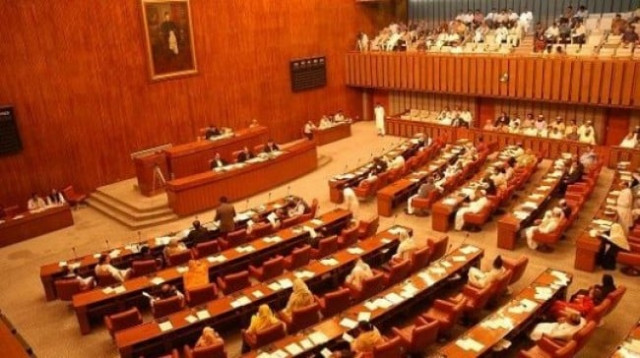
The upper house met on Thursday with Deputy Chairman Syedal Khan presiding.
After routine proceedings, Khan issued a ruling stating that derogatory remarks against the state and national heroes will not be allowed and any criticism of state institutions or national heroes would lead to suspension of membership and strict disciplinary action.
He clarified that certain opposition members were consistently disrupting proceedings and insulting state institutions and national heroes–a practice that would no longer be tolerated.
ANP leader Aimal Wali Khan asked him to define who qualifies as national heroes.
Syedal Khan replied: “Zulfikar Ali Bhutto, Benazir Bhutto, Nawaz Sharif, Dr Abdul Qadeer Khan, and all those who signed the 1973 Constitution are national heroes. No one will be allowed to speak against them.”
He added that those who fought and won wars for the country also fall under the category of national heroes, and any derogatory remarks against them will not be tolerated.
“Protecting the sanctity of the house is our collective responsibility. A handful of people cannot hold the House hostage. I have full authority to suspend anyone who violates its dignity.”
The opposition strongly protested his remarks. Harsh words were exchanged between PTI leaders and Syedal Khan , with PTI members accusing him of “oppression and gagging of speech,” saying they would never accept such restrictions.
Amid the shouting and intense protest from the opposition benches, the chair repeated his ruling in even firmer tone: “From now on, not a single word against the state or its institutions will be tolerated. My ruling will stand, and the house will run accordingly.”
During the ongoing protest, the Senate session was adjourned until Friday at 10:30 am.
NCHR bill
The Senate on Thursday passed the National Commission for Human Rights (Amendment) Bill, 2025, introducing structural and administrative changes to the 2012 law to bring it in line with the Supreme Court’s PLD 2016 SC 808 judgment.
Moved by Law Minister Senator Azam Nazeer Tarar, the bill replaces broad references to the “Federal Government” with designated divisions responsible for executing functions under the act. A new definition of “division concerned” has been inserted to clarify which administrative unit will oversee implementation of specific provisions.
Under the amendments, general administrative matters will fall to the division to which the business of the Act stands allocated, while functions relating to legal or defence matters will now explicitly be handled by the Law and Justice Division and the Defence Division, respectively.
Outdated references to the erstwhile Federally Administered Tribal Areas have been removed, and a key new clauseSection 4Ahas been added to allow the NCHR chairperson to continue for up to 120 days after expiry of the term or until a new chairperson is appointed, whichever occurs earlier.
Changes have also been made to several provisions to align administrative authority with specific divisions, including amendments to sections 14, 21, 22, 28 and 29 of the original Act.
