


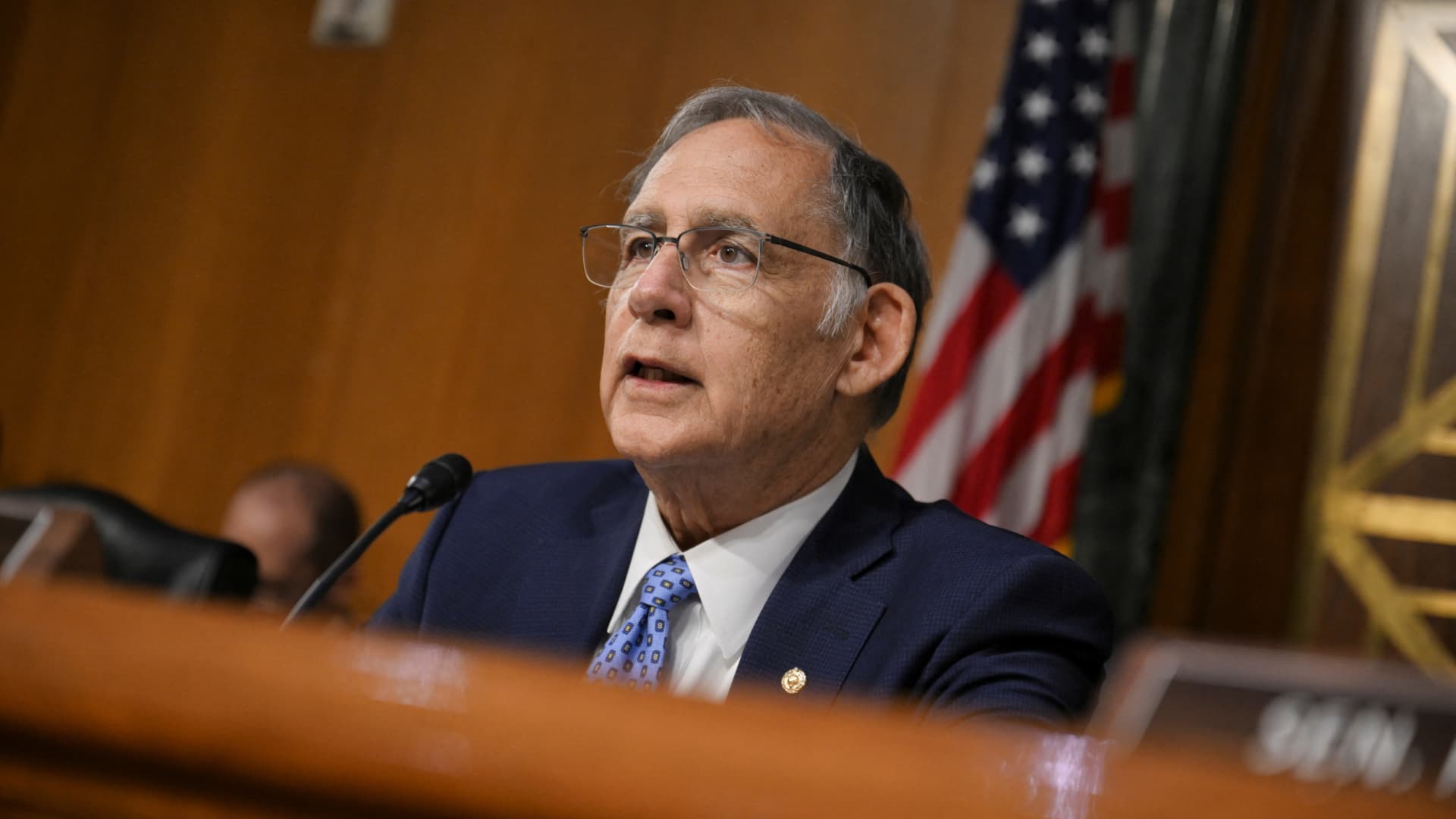
U.S. Senator John Boozman (R-AR) speaks on the day Brian Quintenz, U.S. President Donald Trump’s nominee to lead the Commodity Futures Trading Commission (CFTC) testifies before a Senate Agriculture, Nutrition and Forestry Committee confirmation hearing on Capitol Hill in Washington, D.C., U.S., June 10, 2025.
Annabelle Gordon | Reuters
The U.S. Senate Agriculture Committee voted along party lines Thursday to advance its version of a cryptocurrency market structure bill to create CFTC regulatory authority over digital commodities, a major development for digital asset regulation.
The Digital Commodity Intermediaries Act advanced on a party line-vote with 12 Republicans voting “yes” and 11 Democrats voting “no.” The vote is notable because it marks the first time a crypto market structure bill has advanced beyond a Senate committee. The Senate Banking Committee would also need to approve its version of a crypto market structure bill before the two measures could combine and advance to the full Senate.
Senate Agriculture Committee Chairman John Boozman, R-Ark., proceeded with the bill after losing bipartisan support for an earlier version. Boozman had worked with Sen. Cory Booker, D-N.J., on a draft bill last year, but Booker walked away from the version the committee voted on Thursday. However, Sen. Kirsten Gillibrand, D-N.Y., said in an interview with CNBC last week that she was “very optimistic” the Agriculture Committee would advance its measure.

The Senate Banking Committee’s consideration of its version of the bill was postponed from Jan. 15 at the last minute after opposition from the crypto industry, including Coinbase. A new Banking date has not yet been set. Boozman said Thursday he looks forward to working with the Banking Committee on issues discussed in his committee. Those points include scams linked to crypto ATMs.
Boozman in a statement Thursday called the vote “a critical step toward creating clear rules for digital asset markets.” He said “there’s still more work ahead,” adding that he is “hopeful” the development “will build momentum in the Senate to advance this legislation.”
He said the measure would establish a clear legal definition of digital commodities and would create a spot market digital commodity intermediary regulatory regime with the CFTC. He said the bill also would create consumer protections, including conflict of interest safeguards and customer disclosure requirements.
Boozman released the present version Jan. 21 to give the Commodity Futures Trading Commission new authority to regulate digital assets. The legislation builds on the bipartisan CLARITY Act, the crypto market structure bill the House of Representatives passed last summer, and incorporates provisions negotiated with Senate Democrats as well as input received during bipartisan meetings with stakeholders, according to Boozman.
During Thursday’s hearing, Booker noted that a bipartisan discussion draft was released in November and said that when he came back to Washington in January, he learned his “Republican colleagues were walking away from the bipartisan process that produced the draft” and were also “walking away” from a lot of the points “that held our agreement together.”
Booker said “the product put before us today is not the bipartisan draft that we have been working on.”
“It was negotiated with two parties at the table, but it isn’t in accord with the principles we laid out in November in a bipartisan way,” he said. “However, despite this, I still deeply believe in the work that we’ve done. We’ve come so long.”
Booker said Democratic concerns with the bill include the fact that President Donald Trump “is grifting on crypto himself,” which he called “ridiculous.”
He said “the president of the United States and his family have made billions of dollars off of this industry and are still trying to create a framework here without the kind of ethics that would prevent this kind of gross corruption in our country that would undermine our nation’s democracy.”
CNBC reached out to the White House for comment related to the concerns from Democrats tied to the president’s crypto ventures, but did not immediately hear back. However, in past statements, a White House spokesperson told CNBC that “there are no conflicts of interest.”
On Thursday, Democrats offered amendments that would have included banning public officials –including the president – from engaging in the crypto industry and addressing involvement in digital commodities from foreign adversaries. None were approved, with Boozman saying the issues are outside the Agriculture Committee’s jurisdiction.

