


Anna Moneymaker/Getty Images
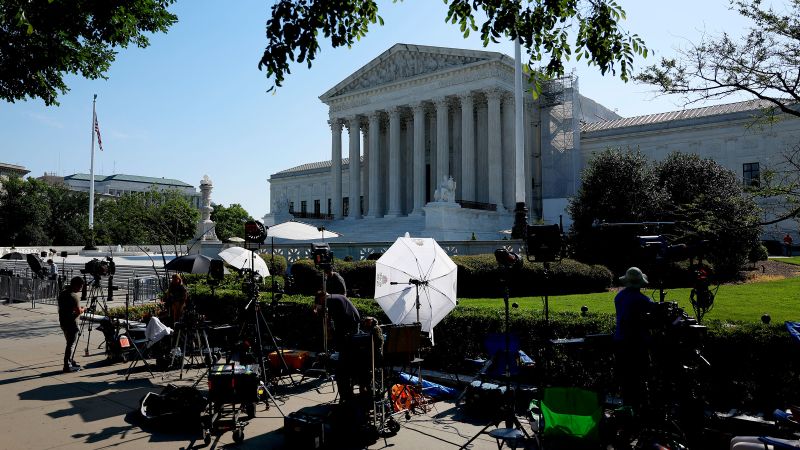
Television journalists work outside the US Supreme Court in Washington, DC on June 14.
CNN
—
The Supreme Court announced that it would not hear a case challenging Georgia’s system for selecting its public utility commissioners, a defeat for Black voters who had argued that the so-called “statewide” election system diluted their votes.
The Supreme Court’s refusal to intervene could make it much harder for the three Southern states to move forward with challenges to their statewide voting systems, which the plaintiffs call a “vestige of Jim Crow laws.”
The five members of the Georgia Civil Service Commission are elected in a statewide vote, a system that a federal judge said violated the Voting Rights Act. The decision was later overturned by the 11th Circuit Court of Appeals, and black voters appealed to the Supreme Court.
By not hearing the case on Monday, the Supreme Court said nothing about the merits of the arguments, but the move sets a precedent for the 11th Circuit and could affect other Voting Rights Act cases filed in the three states that the 11th Circuit covers: Florida, Georgia and Alabama.
The Eleventh Circuit Court of Appeals concluded that the black voters’ challenges failed because they had not offered a remedy to eliminate the dilution of their voting rights, such as preserving the statewide district system the state had chosen for the commission.
In their petition, the voters noted that if the ruling stands, the 11th Circuit’s precedent would make other Voting Rights Act challenges to city-wide election systems difficult, if not impossible, including challenges to school boards and other local entities that use the method.
Georgia Attorney General Chris Carr, in a legal argument, said the Supreme Court should not take up the case, highlighting the “unique” nature of the Georgia commission, which regulates investor-owned utilities such as power plants and telecommunications. His arguments suggested the appeals court had not barred challenges to other government agencies that use statewide election methods.
“Outcomes may have been different in other governmental entities and there is no reason to intervene here in particular,” the Georgia report said.
Earlier in the litigation, the Supreme Court sided with Black voters by reinstating a lower court order postponing the 2022 election for two commission seats so the Legislature could create a new system for selecting commissioners.
