


Pakistan’s fire safety laws exist; the tragedy lies in systemic failure to enforce them
KARACHI:
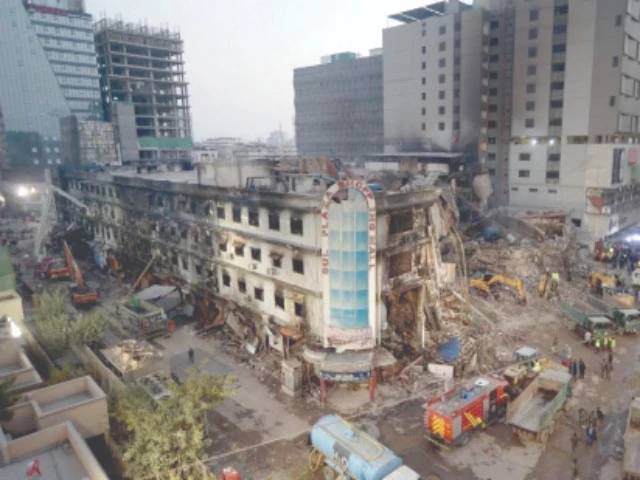
It was one of Karachi’s busiest commercial centres, especially for wedding garments and wholesale goods. No more. Gul Plaza burned to the ground in a few short hours on the night of January 17, 2026. It took with it the lives of at least 73 people. This is a tragedy that has shaken not just the people of Karachi but all of Pakistan. What makes the catastrophe especially heart-rending is that it was entirely avoidable.
Gul Plaza has brought into sharp focus the issue of building codes in Pakistan, especially as they relate to fire safety. The fact is, contrary to what most people may think, that Pakistan does have a robust fire safety code.
The core document is entitled Building Code of Pakistan – Fire Safety Provisions 2016 (FSP2016). This is Pakistan’s national fire safety code, issued by the Pakistan Engineering Council (PEC). It is legally binding and applies to all new buildings, all existing buildings (with phased compliance), and all public and private construction.
FSP2016 is closely aligned with the international fire standard known as NFPA 1. This is the Fire Code published by the National Fire Protection Association (NFPA) in the United States. It is a comprehensive, globally adopted, integrated fire safety code that brings together requirements from more than 130 other NFPA standards to create a single, enforceable framework for fire prevention, building safety, and hazard management.
Let us look at some of the core requirements covered by Pakistan’s FSP2016. It mandates fire protection systems such as automatic sprinklers, fire hydrants, hose reels, fire extinguishers, fire pumps and water storage, as well as fire alarm and detection systems. It requires that a means of exiting the building quickly in a fire emergency must be assured. This includes the number and width of exits, travel distances to the nearest exit, fire-rated staircases, emergency lighting and signage.
It requires standards for building construction such as fire-resistant walls, floors and doors, compartmentation, and fire barriers around ducts and cables to prevent the spread of fire. It mandates special measures for smoke control, which is how most people died in the Gul Plaza tragedy. These measures include smoke extraction, stairwell pressurisation to prevent the ingress of smoke into these vital escape routes, and automatic shutdown of air conditioning to prevent the system from spreading smoke to other parts of the building.
In the case of Gul Plaza, several overlapping failures turned the fire into one of the deadliest building fires in Pakistan’s recent history. When you look at the pattern, it is not one single cause – it is a cascade of structural, regulatory and operational breakdowns that left people with almost no chance of escape. Let us look at some of the main causes. The building was a multi-storey vertical trap. It had narrow internal corridors, congested shop layouts, limited ventilation and heavy combustible stock such as clothing, plastics and packaging. Once the fire started, smoke quickly filled the upper floors. Most victims died from smoke inhalation, not burns.
Exits were blocked, locked or insufficient. Multiple reports in the press mentioned locked exits and blocked staircases that obstructed escape routes. This was compounded by the absence of functional emergency fire exits. Blocked exits turn a building into a sealed container. People on upper floors had no viable escape path.
There was no sprinkler system. A functioning sprinkler system would have controlled the fire early, prevented flashover, kept smoke at survivable levels and given people time to escape. But Gul Plaza, despite being a high-risk commercial building, had no automatic sprinklers. This single factor dramatically increased the death toll. No working fire alarm or early warning system was in place. Survivors reported that there was no audible fire alarm, no evacuation announcement and no coordinated response. People on upper floors only realised there was a fire when smoke reached them, by which time their fates had already been sealed.
There was a clear violation of the requirement for compartmentation. Gul Plaza had open vertical shafts, unsealed service ducts and no smoke barriers. This allowed smoke to rise rapidly through the building. Occupants were trapped before they even knew that their lives were in peril. This combination of no alarms, no sprinklers, no smoke control and blocked exits meant the fire reached flashover conditions quickly. People on the upper floors were overcome by smoke within minutes. It should be clear by now that the Gul Plaza tragedy was not because of shortcomings in Pakistan’s fire code. Rather, it had to do with serious, and possibly criminal, lapses in the enforcement of the code.
So who enforces the code? The law states that enforcement “shall vest with the Authority Having Jurisdiction (AHJ)” within its respective area. In Karachi, this authority is vested with the Sindh Building Control Authority (SBCA), an agency of the Sindh government. Hence, it is the SBCA that bears the brunt of explaining why it failed to enforce the code, leading to this tragedy.
But it is useful to understand that the ecosystem of corruption in Pakistan means that the SBCA is perhaps not solely to blame. Consider that a poorly paid SBCA fire inspector shows up at a property such as Gul Plaza and insists that it comply or face closure. The seths who own and occupy the property realise that compliance will come at a substantial cost. So the poorly paid inspector is handed a sealed envelope. He overlooks the violations. He is happy. And the seths are happy. Until one day their shortsightedness catches up with them in a catastrophic manner.
“Systemic” is a much hackneyed term these days. Yet in the context of Gul Plaza, it captures precisely the failures that led to this disaster. Everyone is responsible to a degree – the SBCA, the Sindh government, the owners of Gul Plaza and even the hapless tenants of its shops, who failed to insist that the building comply with the fire code and who paid with their lives and wealth for this entirely avoidable tragedy.
The lesson here is that fire safety is not an extravagant indulgence. It is a matter of life and death. There must never be another Gul Plaza.
The writer is an MIT-trained civil engineer and chairman of Mustaqbil Pakistan. He holds an MBA from Harvard Business School.
