


PUBLISHED
December 28, 2025
For an average young adult battling growing feelings of inadequacy, distracting activities like sports or a heart-to-heart conversation with a trusted loved one can help resolve some of their inner turmoil. Yet when no positive outlet is available to channelise these negative emotions, the deadly powder trail becomes the only route of escape.
For Bilal, an ice addict, arrested multiple times for firing at his parents, wife and close relatives, this escape came at the cost of his family ties. Kamal Khan, his brother, was still in disbelief over the gruesome incident. “Eleven members of the family, including our parents, were forced to leave their home and live in a rented house out of fear. Bilal has targeted us many times before and since he is out of jail again he can shoot at us again,” feared Khan.
Dr Khalid Mufti, a psychiatrist who has been treating drug addicts in Peshawar since the last 20 years, confirmed that the number of patients suffering from ice addiction was increasing day by day. “Crystal meth is most commonly used among the youth. We receive four to five patients on a daily basis,” informed Dr Mufti. Similarly, Dr Qazi Shahbaz, medical superintendent at the Lady Reading Hospital Peshawar correlated the increase in ice usage with an uptick in crime rates.
“Ice is known to induce heightened alertness and energy, making it appealing to students aiming to enhance academic performance. Youth grappling with depression, anxiety, and academic pressure may resort to ice as a coping mechanism. The drug’s availability near educational institutions and through online platforms facilitates its widespread usage,” explained Dr Shahbaz.
Peshawar Police’s investigation department confirmed that from 2022 to 2025, about 55 percent of all crimes reported in Peshawar involved gangs of youth who were ice addicts. In order to maintain their drug supply and other lavish hobbies, a large majority were involved in mobile and car snatching and even house robberies.
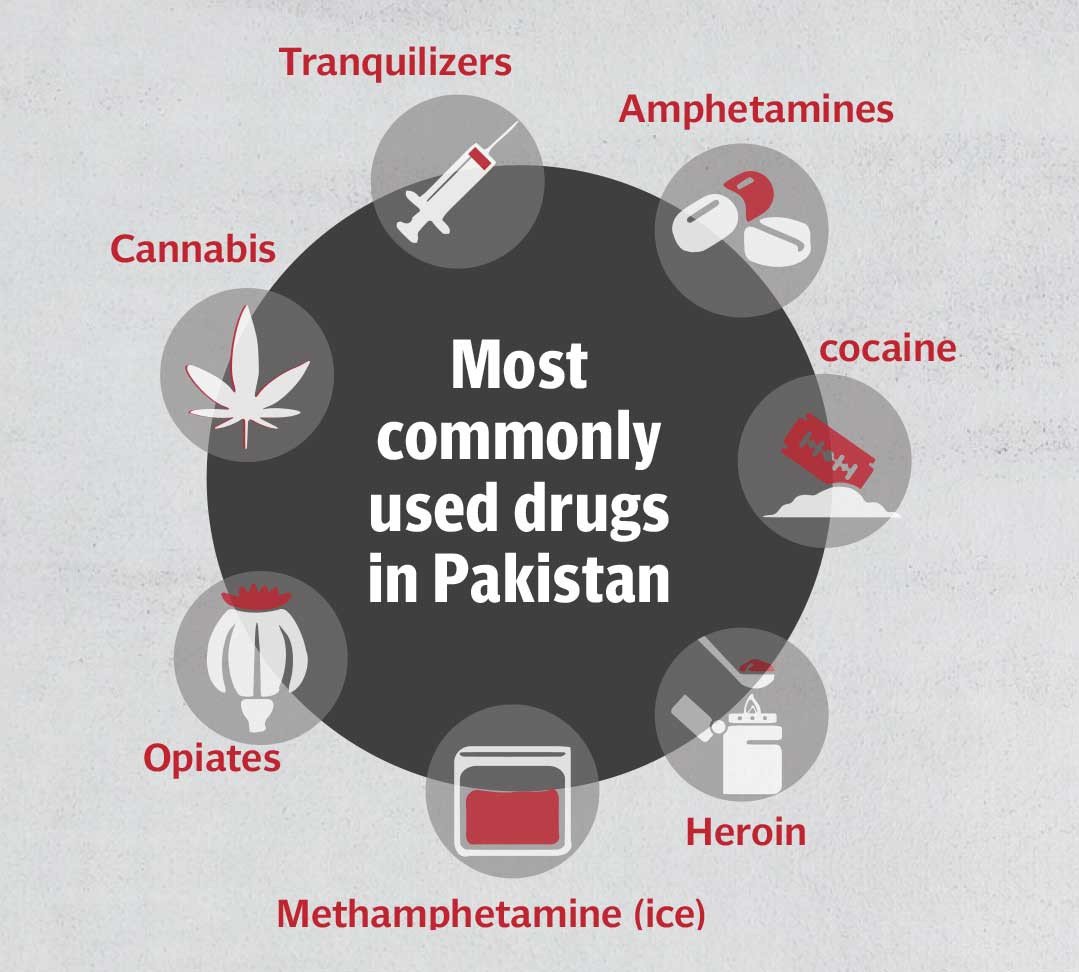
Unfortunately, however, the troubling epidemic is not limited to Khyber-Pakhtunkhwa (K-P) since the escalating use of crystal methamphetamine, commonly known as “ice,” has become a significant public health crisis across Pakistan. Apart from ice, other drugs like cocaine, heroin, marijuana, and LSD tablets are also popularly used among habitual addicts. In the country’s industrial hub, Karachi, drug networks are operating in areas like Old Golimar, Faqir Colony, Lyari, Machhar Colony, Sohrab Goth, Gujjar Nala and Nazimabad.
Similarly, in Punjab, at least three drug addicts’ bodies are recovered every day in densely populated areas of Lahore. “Drugs are supplied online in colleges of Punjab, and are also used in government offices. Parties arranged at farmhouses are also common spaces of drug exchange, where young boys and girls are exposed to various tablet substances,” informed Syed Zulfiqar Hussain, consultant expert at the Anti-Drug Narcotics Campaign.
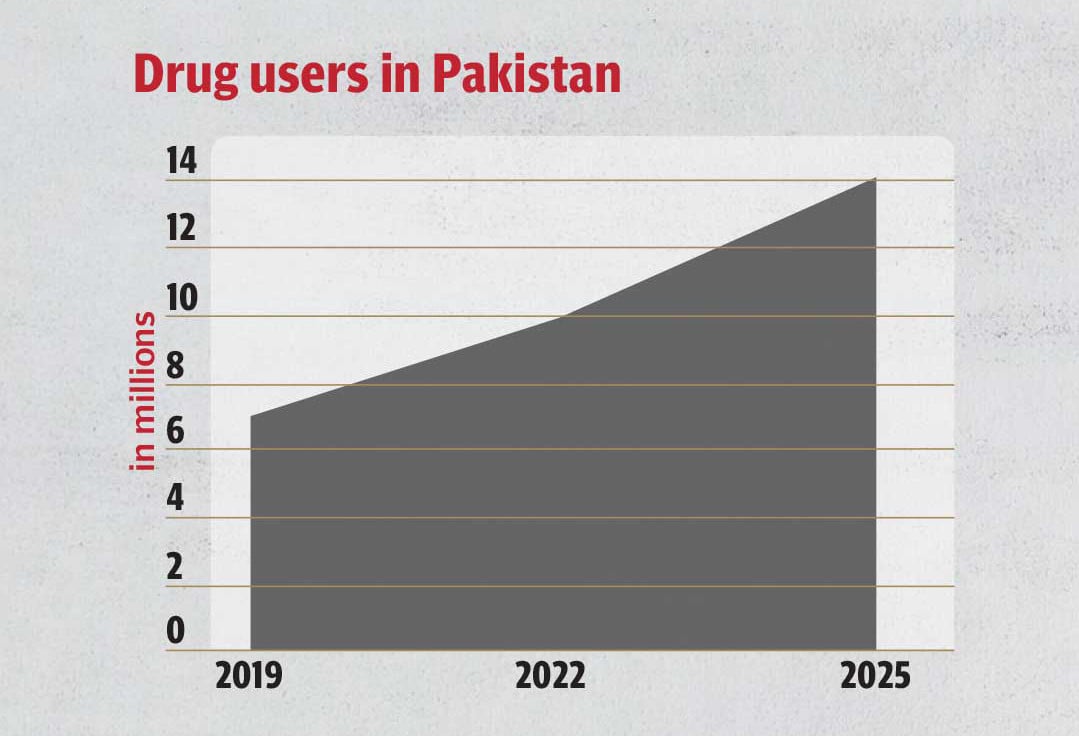
“In 2013, there were seven million different drug addicts in Pakistan,” informed Professor Dr Chooni Lal, head of the department of psychiatry at the Jinnah Hospital. The number has now increased to almost 10 to 14 million. “Ice addiction is more dangerous than marijuana since proper medicines and rehabilitation is needed for recovery. The majority of our young generation is suffering from ice addiction,” he added.
Routes of ruin
Fixing a leaky faucet is impossible without first identifying the root cause of the leakage. Similarly, any anti-narcotics campaign against drugs cannot be expected to curtail the vice unless it first identifies and apprehends the routes of ruin secretly smuggling addictive powders and pills to the youth of the country.
With the border of Afghanistan located just 40 to 45 km away from Peshawar, cities and tribal districts across K-P are often considered the hubs of drug trafficking, with many areas notoriously supplying illegal substances to other parts of the country. Reportedly, ice factories are secretly built in homes in Dara Adamkhel, from where the drug is supplied to Peshawar, Mardan, Swabi, Charsadda, other parts of the country and even abroad.
“Raw materials used in the production of ice usually come from tribal areas with the help of Afghan gangs, who are involved in transportation. People are making ice with the help of various chemicals by installing machinery in their homes. Goods coming from a factory were caught recently and the value of ice seized from just one place was more than four crores,” said Inspector Ahmedullah.
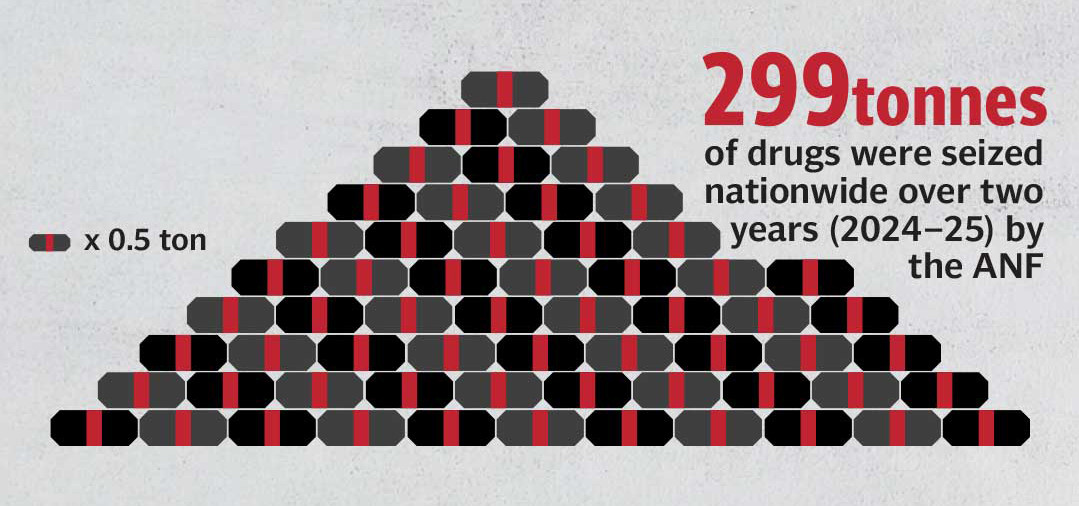
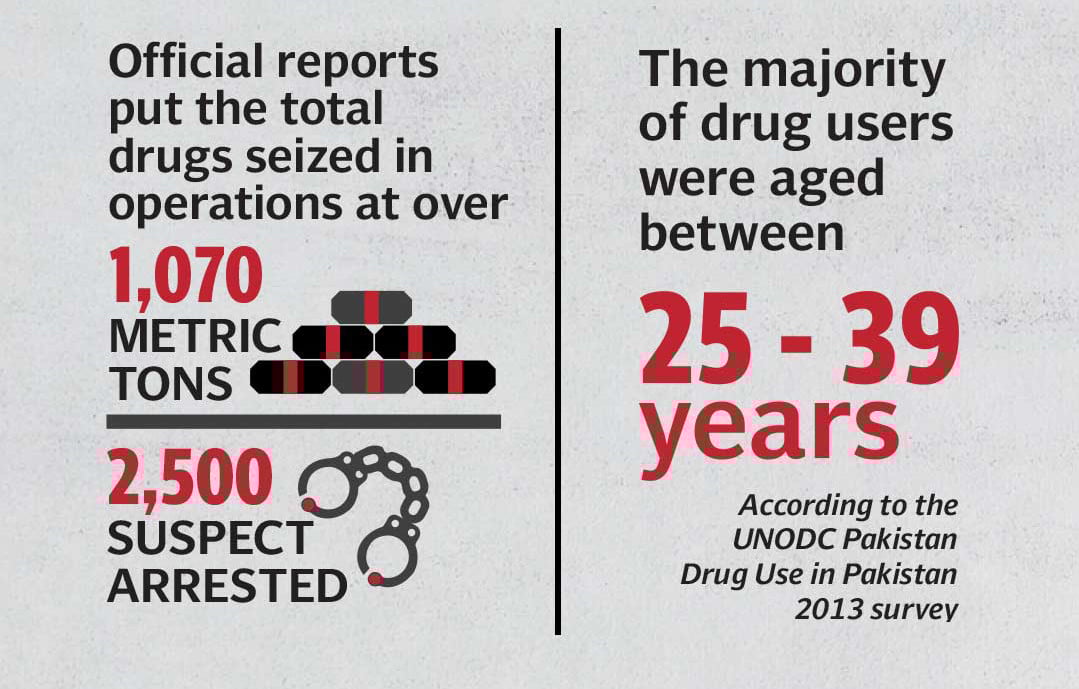
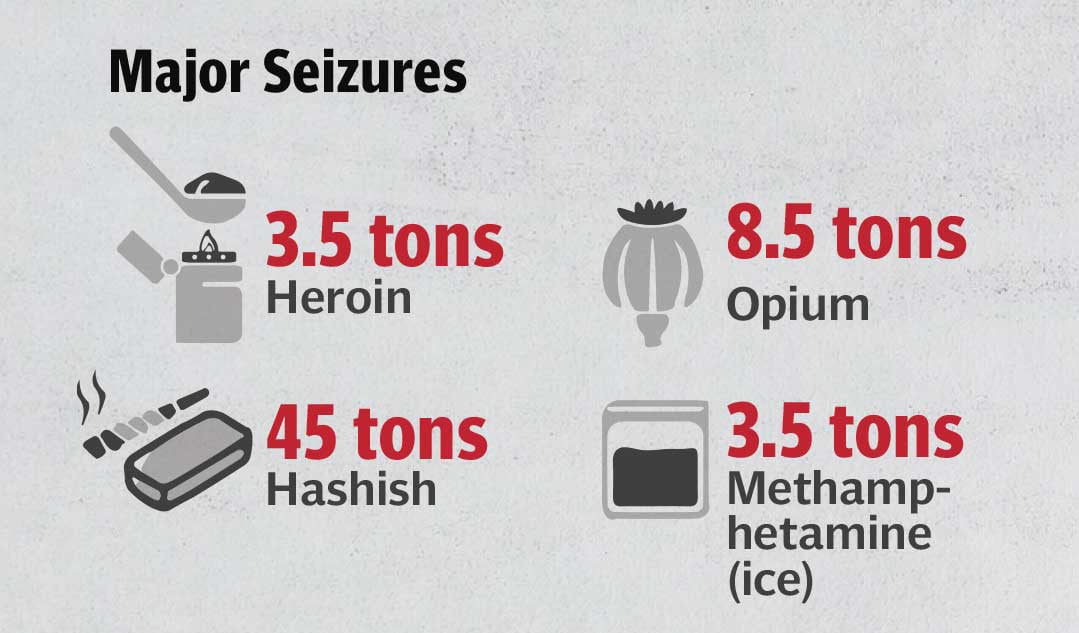
During the last six months of 2025 alone, 14,290 kg of hashish, 2,637 kg of ice, 426 kilograms of heroin and 294 kilograms of opium were seized across K-P, where 19,426 suspects were arrested. In Peshawar alone, around 4,000 drug addicts have been officially registered this year while unofficial information estimates that the number of drug addicts is close to 10,000.
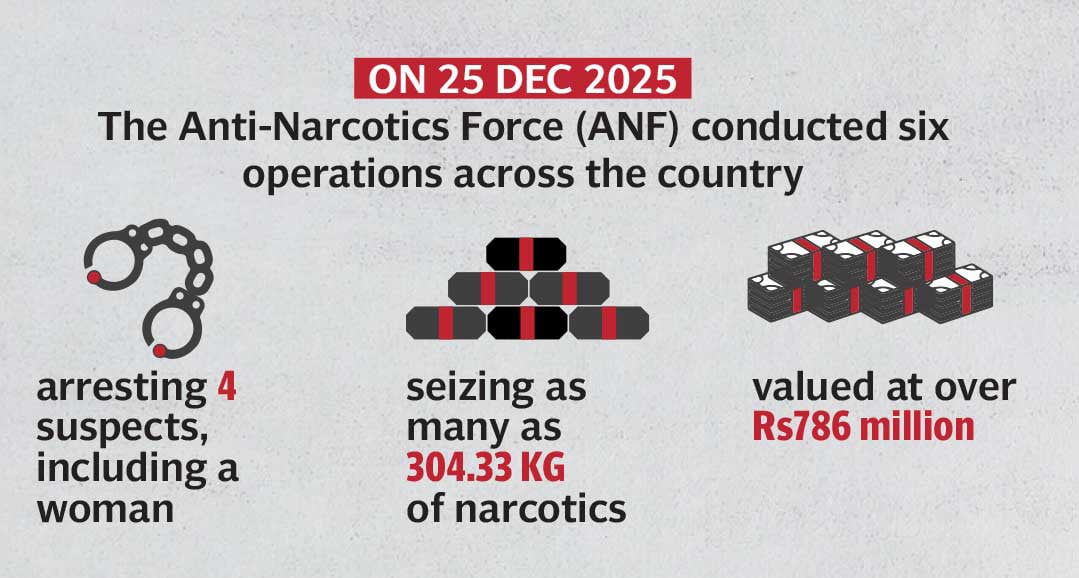
As expected, this colossal supply of drugs is circulated across the country. Sources from Lahore have verified that drugs sold in the city are smuggled from tribal areas and Afghanistan. Furthermore, a new trend has emerged in the city, where international sim cards are used for smuggling drugs. Parties organised in farmhouses regularly host international groups, whose representatives possess foreign SIMs and have a large number of clients.
A drug addict based in England disclosed that whenever he visited Pakistan, his friends gave him an international caller ID through which he ordered cocaine via WhatsApp. “In this dealing, I am responsible for any consequences. The dealer has a supply of all kinds of drugs. I simply share my demand and he arranges the stock,” shared the addict.
Down south in Karachi too, similar drug supply networks are covertly operating. The most recent gang made headlines after the brutal kidnapping and killing of 23-year-old Mustafa Amir unveiled a secret drug business involving multiple traffickers including the accused Armaghan and the son of actor Sajid Hasan, Sahir. During the inquiry it was revealed that the gang was supplying expensive drugs digitally to youth across posh areas of the city.
“Drug addiction is spreading alarmingly in our society and our young generation is suffering the most. Reportedly, 77 per cent of drug addicts are younger than 30 years, while five per cent are between the ages of 30-65 years. Marijuana is being used like an herb in Pakistan, and is seriously affecting the youth. In 2019, about 42 metric tons of hashish was used in Karachi,” said Dr Lal.
“The Afghanistan border via Torkham is a popular entry point for drug smugglers. As a result, drugs continue to be sold openly. Until the border’s porosity is controlled and strict measures are taken against drugs, the vice will continue to haunt the youth,” warned Dr Shahbaz.
No way home
Parents learning of their child’s drug addiction try their very best to save the youth from drowning in their worst nightmare. Yet when meagre rehab facilities and crippling addictions build a wall of resistance in the way of recovery, many caregivers have to live with the haunting reality that their lost child has no way home.
A father from Larkana revealed that his young, unmarried son had become addicted to ice. However, he could not do anything to help him since there was not a single official drug rehabilitation centre in his city.
Abid Lashari, head of a charity that runs a rehabilitation centre for psychologically-ill children in Larkana, confirmed this. “Unfortunately, there is no official treatment facility available for drug addicts. In Pakistan, 3.6 per cent of the adult population uses cannabis, one per cent uses opiates while 23.41 per cent of the population uses tobacco and other intoxicants. Recent research has shown that there is a very strong relationship between drug use and mental health problems including depression, personality disorders, and psychological disorders,” said Professor Dr Iqbal Afridi, former head of the department of psychology at the Jinnah Hospital Karachi.
Dr Aatir Rajput, a Hyderabad-based psychiatrist confirmed that his patients mostly sought treatment for mental health illnesses since their drug addiction was unaddressed. “The majority of drug addicts visiting me are young people between the ages of 15 and 30 years, who are addicted to various drugs, mostly ice. Older people are usually addicted to alcohol, heroin and cocaine,” said Dr Rajput.
“Drug addicts often lose their ability to differentiate between good and bad, and are seen adopting an aggressive and provocative behaviour in their social circles. Public treatment facilities for drug addicts are quite limited while private treatment is very expensive. Just 40 beds have been allocated in the psychology ward of the Jinnah Hospital for addicts. Ice addiction is prevalent in every province, but is alarmingly common in K-P,” noted Dr Lal.
Despite the rise in popularity of ice in K-P, Dr Shahbaz revealed that the Drug Rehabilitation Centre in Peshawar was equipped with only 100 beds, which is insufficient for the entire province. “Every district should have a well-equipped drug rehab centre. Many people have started drug rehabilitation as a private business but they neither follow any standards of patient care nor do they have qualified staff available. As the government and Health Care Commission turn a blind eye, these private clinics continue to mint money off families,” said Dr Shahbaz.
A similar situation is prevalent in the country’s most populated province, Punjab. “At the government level, there is only one drug rehab centre located in a public psychiatric hospital, which used to have 100 beds earlier, but now only has 10. Apart from this, only five beds are allocated for rehab in the Gangaram Hospital, five in Services Hospital, five in General Hospital, five in Jinnah Hospital and 10 beds in the Mayo Hospital,” shared Hussain, an anti-narcotics consultant.
High on impunity
As the country’s pitiful rehab network struggles to treat and rehabilitate the burgeoning influx of drug addicted youth, traffickers persistently escaping law enforcement remain high on impunity.
According to Nauman Mohib Kakakhel, an advocate at the Peshawar High Court, while most of the drivers trafficking drugs are arrested, the main suppliers roam around freely. “The accused in drug cases are easily acquitted since the FIR filed by the police is weak, the investigation is faulty and there is a general lack of interest. Furthermore, a lack of video evidence often benefits the accused in drug cases. Hence, even when huge quantities of drugs are recovered, the accused are easily released in some time,” said Kakakhel.
Abdullah Malik, a Lahore-based lawyer, confirmed that in most parks in the inner city, drug users can be seen injecting substances and are often lying in an intoxicated state. “When the police or Anti-Narcotics Force [ANF] try to catch them, they harm themselves. Through parties, drugs worth billions of rupees are circulated annually, but no effective action has been taken against these people, including foreigners, who are smuggling drugs in Faisal Town,” said Malik.
Reportedly, raids were conducted across 72 universities in Punjab. Recently, the Jordan gang, which was reportedly supplying drugs in chocolate boxes through an online business was also detained by the police. However, despite the collective measures undertaken by customs, anti-narcotics and the police, drug trafficking continues in cities across Punjab.
Similarly, various provincial and federal agencies are working to curtail drugs in Sindh, through special campaigns however, they remain easily available everywhere from big cities to small villages and are openly accessible to the youth. For instance, Garello, a village in Larkana district, is also among the rural areas where drugs are readily available. Locals have claimed that marijuana, cannabis and heroin have been common here for a long time, but now ice too has become increasingly popular among the youth.
Likewise, sources from the K-P police have revealed that 34 educational institutions in the province have been identified where ice is delivered. Drug dealers first receive online payments after which they coordinate with the student, who is instructed to pick up their package from a particular spot outside the educational institution.
Surprisingly, however, Commissioner Peshawar Riaz Mehsud denied all claims that ice was circulating among college and university students. “A few cases that emerged were treated in rehab centres. The fourth phase of “Drug Free Peshawar “is in full swing and the district administration and Social Welfare Department are facilitating the rehab of drug users. For the first and second phases, 1.8 million rupees were allocated while for the third and fourth phases 3.2 million rupees have been released,” said Mehsud.
