


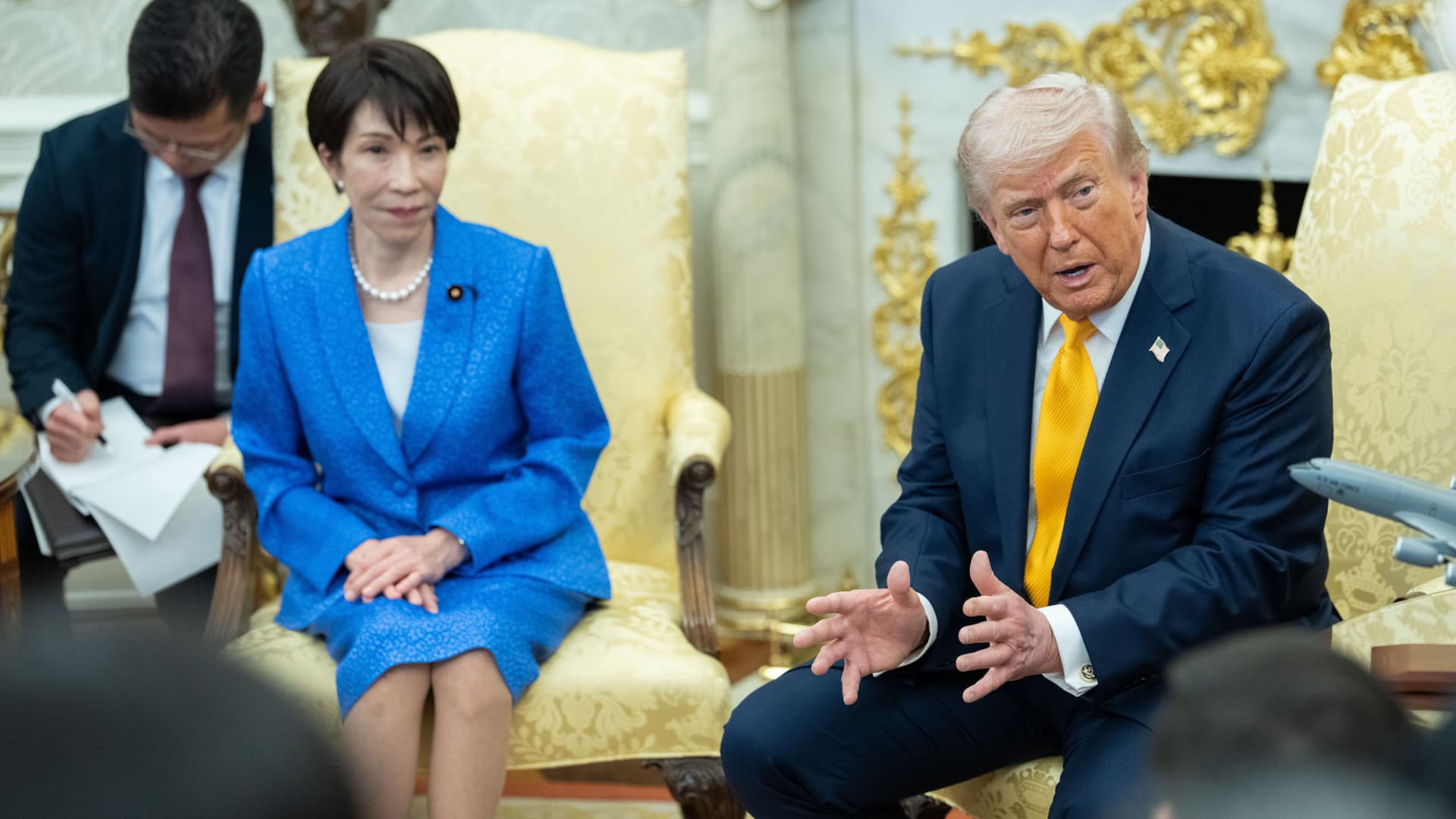
US President Donald Trump and Sanae Takaichi, Japan’s prime minister, during a meeting in the Oval Office of the White House in Washington, DC, US, on Thursday, March 19, 2026.
Aaron Schwartz | CNP | Bloomberg | Getty Images
Japanese Prime Minister Sanae Takaichi embraced President Donald Trump on Thursday, and not just on policy grounds. The newly elected Japanese leader threw herself into the arms of the U.S. president when he greeted her at the White House.
“It is only you, Donald, who can achieve peace across the world,” Takaichi said later as the two met in front of reporters in the Oval Office.
Beneath the flattery is an important truth. Trump is singlehandedly shaping the course of global events to a degree that far outstrips even the power he wielded in his first presidency. With his presidency unshackled, his military and other policy decisions are reshaping the economy in real time — and clouding the economic outlook.
Trump’s predecessors weren’t willing to make the choice he did in Iran. President Barack Obama’s response to the risk that Iran could develop a nuclear weapon was to negotiate a multilateral arms deal. Trump scrapped it in his first term. President Joe Biden attempted to revive it, opting for negotiations and sanctions pressure even after Iran-backed Hamas massacred Israelis on Oct. 7, 2023.
Trump’s decision to use his authority as the military’s commander-in-chief has essentially made him the lever that moves global energy prices up or down. Iran’s forces have attacked cargo ships and assailed its neighbors’ energy facilities.
Traffic has stalled through the vital Strait of Hormuz. In normal times it carries 20% of the world’s crude oil.
Gas prices in the U.S. have spiked by nearly a dollar, or 33%, over the past month, according to AAA. More economic turmoil is brewing. The strait is also a channel for fertilizer components that are rapidly becoming scarce. The possibility of fertilizer shortages has put U.S agriculture “in uncharted territory,” a Michigan farmer told CNBC this week.
Trump says he predicted gas prices would rise when he went to war, and sees it as a necessary price for neutering the threat of further Iranian aggression, nuclear and otherwise. The White House says prices will fall sharply when hostilities end. At the war’s outset, Trump said it would last days. Then weeks. On Friday, he said he is not interested in a ceasefire.
Prices may indeed fall after the war ends, but for now markets are pricing in a costly war. Futures markets show traders expecting the price of oil to stay above $80 a barrel through July 2027, according to FactSet data.
The markets’ worry reflects the risk that for all his individual power Trump may no longer be able to quickly end the war. Iran can use cheap drones, boats and mines to threaten shipping in the Strait of Hormuz. It may take a ground invasion to stamp out that threat. Trump on Thursday said he wasn’t considering ground forces, but the U.S. military is moving more personnel and ships to the region.
A bloody ground battle would add weeks or months to the time frame for oil prices to return to normal, while escalating conflict could further damage energy production facilities in the region. Whether that kind of operation goes ahead is largely up to Trump. Together with Israeli Prime Minister Benjamin Netanyahu, Trump gets to judge whether the potential national-security benefits of a defanged Iran are worth the hit to Americans’ wallets.
Congress could insert itself in Iran war
Congress, in theory, has a role in these decisions, just as it does over tariffs. The Senate voted Wednesday not to take action to determine the limit of the president’s war powers after Democrats pressed the issue.
Similar legislation focused on restraining the president’s power on tariffs has won modestly more support in Congress, but no such measures have become law. The Supreme Court in February struck down many of the president’s tariffs, but he immediately responded by implementing new ones.
It is the domain of the Federal Reserve to help ensure inflation stays in check and workers remain employed despite other shifts in policy. Both Iran and the tariffs risk creating the inflation problems that the Federal Reserve was designed to solve.
Trump’s accumulation of authority is complicating those efforts.
No new Fed chair is likely soon
A federal court on March 13 quashed subpoenas issued by a Department of Justice prosecutor for allegations Trump and his allies have made that the Fed misused public funds in an ongoing building renovation project. Sen. Thom Tillis, R-N.C., has said he won’t vote to advance Kevin Warsh, Trump’s nominee to lead the Fed, until the investigation is resolved. The Fed’s current chair, Jerome Powell, has said he will stay on in some form indefinitely while the investigation persists.
The judge’s ruling about the subpoenas might have been the moment Powell could have transitioned out and let Warsh come in. But the Department of Justice decided to appeal. And Trump appears to be backing that plan, saying Thursday he still believed there was “criminality” involved in the renovation’s cost overruns.
The White House has said the Department of Justice’s investigation is independent of Trump’s judgment. Regardless, the investigation is proceeding, putting the conflict between the president and the Fed at the center of markets indefinitely, at a time when Trump’s other policies are making the economic outlook as difficult to forecast as ever.
The only way to know how many of the biggest policy decisions facing the U.S. will break is to get into Trump’s head.
Presidents love to brag about the great influence they have on the economy, especially when it’s doing well. Often it’s overstated. But this economy, warts and all, owes much to Trump. Everyone from Japan’s prime minister on down is along for the ride.
