


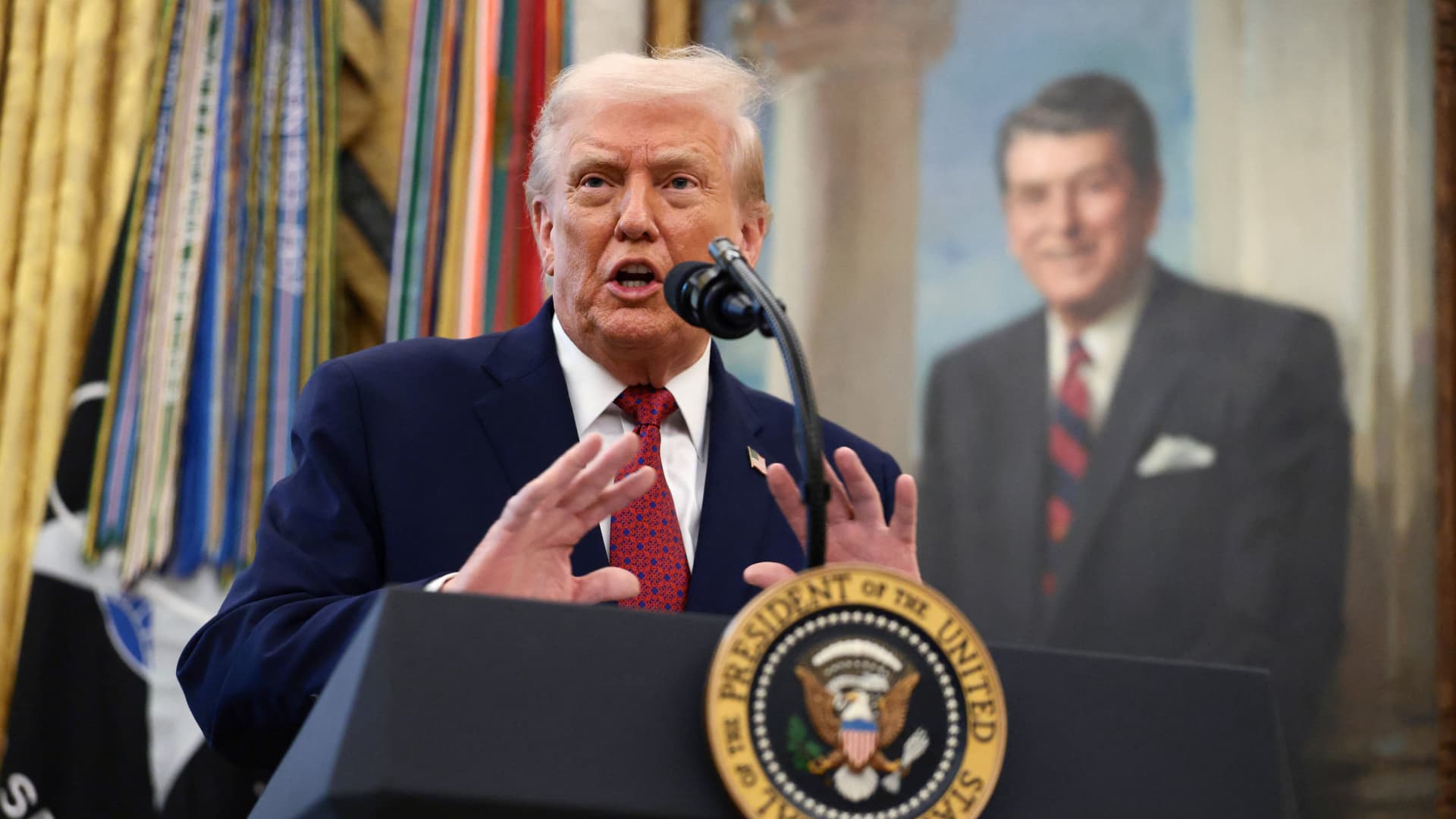
U.S. President Donald Trump speaks during a Mexican Border Defense Medal presentation in the Oval Office at the White House in Washington, D.C., U.S., Dec. 15, 2025.
Evelyn Hockstein | Reuters
U.S. President Donald Trump on Tuesday stateside ordered a “complete and total” blockade of sanctioned oil tankers moving in and out of Venezuela as tensions ramp up between Washington and the South American country.
In a post on Truth Social, Trump said “Venezuela is completely surrounded by the largest Armada ever assembled in the History of South America.”
He added, “It will only get bigger, and the shock to them will be like nothing they have ever seen before — Until such time as they return to the United States of America all of the Oil, Land, and other Assets that they previously stole from us.”
“For the theft of our Assets, and many other reasons, including Terrorism, Drug Smuggling, and Human Trafficking, the Venezuelan Regime has been designated a FOREIGN TERRORIST ORGANIZATION. Therefore, today, I am ordering A TOTAL AND COMPLETE BLOCKADE OF ALL SANCTIONED OIL TANKERS going into, and out of, Venezuela,” Trump said.
According to the U.S. State Department, the designation of a “Foreign Terrorist Organization” makes it illegal for any U.S. citizen to knowingly provide “material support or resources” to such an organization, among other measures.
Andy Lipow, President of Lipow Oil Associates, told CNBC that a full embargo of Venezuelan oil would affect 800,000 to 900,000 barrels of oil per day, which could increase prices by about $2-$3 per barrel.
Currently, prices of Brent crude are flat at $58.92, while West Texas Intermediate crude rose 1.05% to $55.85.

This would still leave the world “well supplied” as the there’s global oil surplus of about 2 million barrels per day, Lipow said.
However, Lipow also pointed out that “The oil market will be watching the Chinese reaction as they are the largest buyer of Venezuelan oil, benefiting from discounted prices and, they may be reluctant to observe USA sanctions, keeping Venezuelan oil flowing into the market.”
— CNBC’s Lee Ying Shan contributed to this report.
This is breaking news, please check back for updates.
