


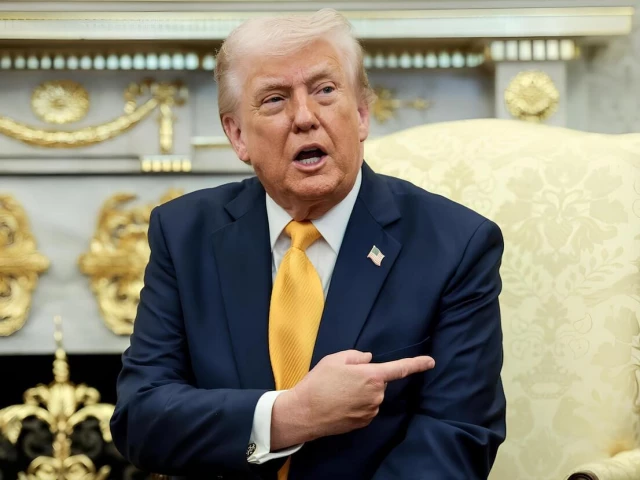
US President Donald Trump speaks during a meeting with Japanese Prime Minister Sanae Takaichi (not pictured) in the Oval Office at the White House in Washington, DC, US, March 19, 2026. PHOTO: Reuters
President Donald Trump said the United States was considering “winding down” its military operation against Iran, as the latter and Israel traded attacks on Saturday with Iranian media saying the nuclear enrichment facility in Natanz had been attacked.
In a social media post, Trump said the US was close to meeting its goals but insisted that other countries should take the lead in policing the vital shipping lane of the Strait of Hormuz, whose near-closure threatens a global energy shock.
Trump and his administration have sent mixed messages about US goals throughout the war, now entering its fourth week, leaving traditional US allies struggling to respond.
Trump has suggested the war could wind down as the Iranian threat was being eliminated, while at the same time, US Marines and heavy landing craft head to the region on a mission whose goals are not immediately clear.
“We are getting very close to meeting our objectives as we consider winding down our great military efforts in the Middle East with respect to the terrorist regime of Iran,” Trump said on Truth Social.
“The Hormuz Strait will have to be guarded and policed, as necessary, by other nations who use it — the United States does not!” he added.
“If asked, we will help these countries in their Hormuz efforts, but it shouldn’t be necessary once Iran’s threat is eradicated.”
More than 2,000 people have been killed in Iran since the US and Israel attacked on February 28, while American voters appear increasingly concerned at signs the war could expand further.
Vital energy infrastructure in Iran and neighbouring Gulf states has been attacked, sending oil prices up 50%.
Energy price shocks are also fuelling inflation, hitting consumers and businesses hard — a major political liability for Trump as he seeks to justify the war to the US public before the November elections in which he could lose control of Congress.
Trump had also accused NATO allies, which have not been consulted about the war, of cowardice over their reluctance to help open the strait.
Iranian gas supplies to Iraq reportedly resumed after flows were halted by an Israeli attack on Iran’s main gas field, South Pars, on Wednesday.
Iran reports attack on Natanz nuclear enrichment plant
As the fighting continued, Iranian media said US-Israeli forces had attacked the Shahid Ahmadi-Roshan Natanz enrichment complex on Saturday morning. Technical experts found that no radioactive leaks had occurred and nearby residents were not at risk.
Israel said it was unaware of such a strike, while the head of the International Atomic Energy Agency (IAEA) said it was investigating. Russia called it “a blatant violation of international law”.
Iranian media later reported strikes on a passenger terminal in the southern port of Bushehr and an empty passenger ship at nearby Kharg Island. The island, where Iran loads nearly all its oil exports, is seen as a potential target if Washington decides to hit Iranian energy or to use ground troops to seize it.
Iran said it fired drones at US bases in the UAE and Kuwait used to stage attacks on Iranian islands in the Gulf.
Read More: Trump calls NATO ‘cowards’ over lack of support in Iran war
Israel also attacked Beirut, saying it was targeting Hezbollah, in the deadliest spillover from the war on Iran since Hezbollah fired on Israel in support of Tehran on March 2.
Defence Minister Israel Katz said Israel was “determined to continue leading the attack against the Iranian terrorist regime, to behead its commanders and to thwart its strategic capabilities until any security threats to Israel and US interests in the region are removed”.
Israel also said it had attacked Tehran, Karaj, west of the capital, and the central city of Isfahan. Three members of a family were killed in a strike on a residential building in the city of Ramsar, Iranian media reported.
Air raid sirens in Israel warned of incoming missiles from early morning, sending millions to shelters as the blasts of interceptions rang out from above. There were no immediate reports of casualties.
Iran fired two ballistic missiles towards the US-British military airport on the island of Diego Garcia, 3,800 kilometres away in the Indian Ocean, but did not hit the base, the Wall Street Journal reported.
A source at Britain’s defence ministry said the attack had occurred before the government gave specific authorisation on Friday for the US to use British military bases to carry out strikes on Iranian missile sites.
European gas prices surge
Natural gas prices in Europe surged as much as 35% this week as Iran and Israel hit some of the region’s most important gas infrastructure. The European Union urged members to lower gas-storage targets and start refilling reserves gradually to curb demand, the Financial Times reported on Saturday.
The Strait of Hormuz, conduit for around a fifth of global oil and liquefied natural gas supplies, has been effectively closed to most shipping.
Leading allies of the US from Europe, as well as Japan and Canada, have pledged to join “appropriate efforts” to ensure safe passage through the strait, but Germany and France have spelt out that fighting must stop first.
Foreign Minister Abbas Araghchi told Kyodo news agency that Iran was ready to let Japan-related vessels pass through the strait, which carries around 90% of Japan’s oil imports.
India, suffering a severe shortage of cooking gas, has been one of the few countries so far to persuade Iran to let any of its ships through the strait, with two tankers carrying liquefied petroleum gas leaving last week and two more in position on Friday. Prime Minister Narendra Modi spoke to Iran’s President Masoud Pezeshkian today.
