


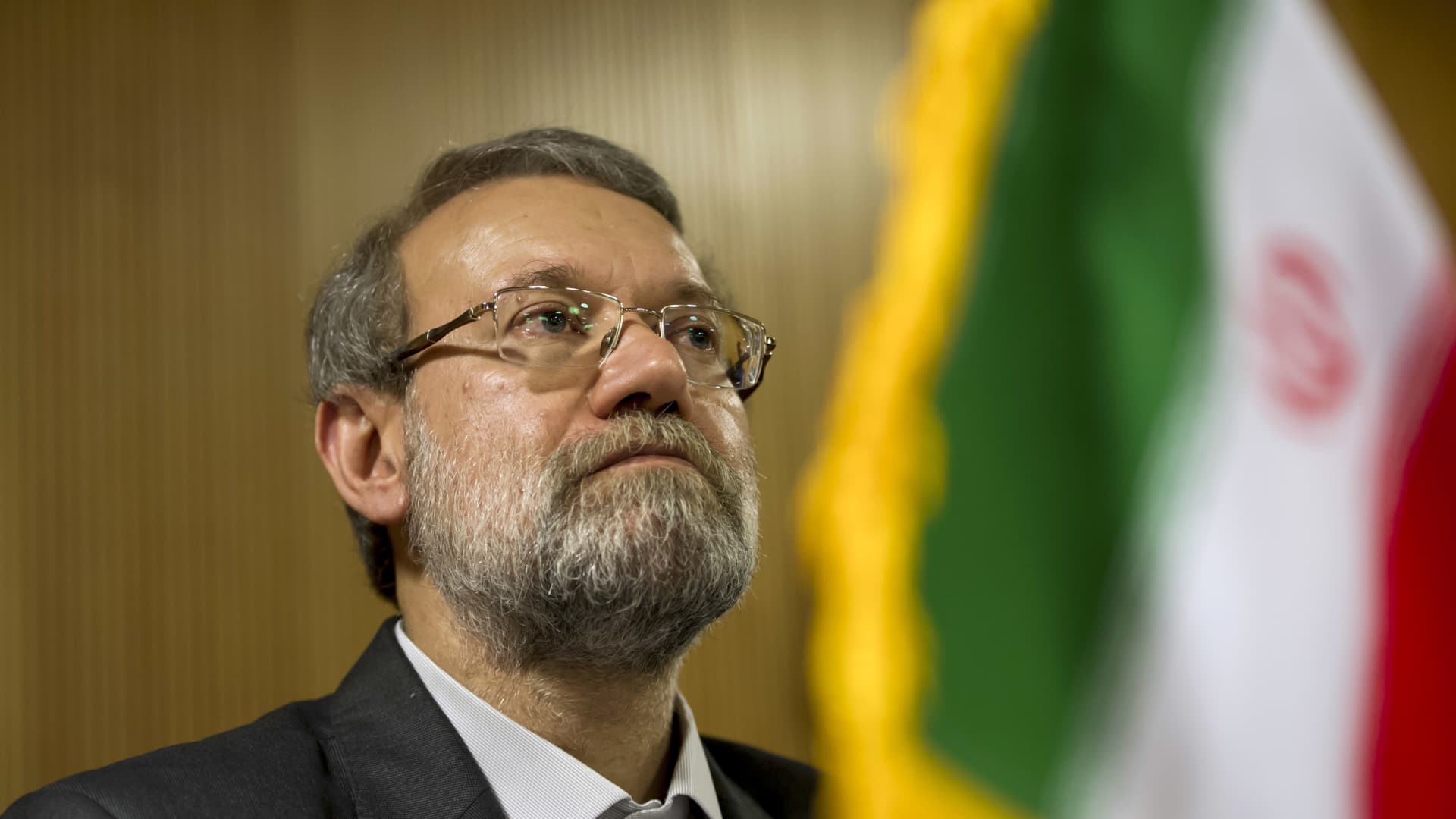
Iran security chief Ali Larijani rejects U.S. talks, blames Trump for chaos
Iran’s security chief Ali Larijani attends a ceremony by the Lebanese Shiite movement Hezbollah marking the first anniversary of Israel’s assassination of their longtime leader Hassan Nasrallah, in Beirut’s southern suburbs on September 27, 2025.
Anwar Amro | Afp | Getty Images
Iran’s security chief Ali Larijani said that Tehran has no plans to engage in negotiations with the United States.
“We will not negotiate with the United States,” the former adviser to the late supreme leader said in a post on X, dismissing reports that it is seeking to restart negotiations with Washington.
“Trump has plunged the region into chaos with his ‘false hopes’ and is now worried about further casualties of American troops,” he wrote in an earlier post.
— Lee Ying Shan
Kuwait reports drone interceptions as Iran continues retalitory strikes
An Iran-made unmanned aerial vehicle (UAV), the Shahed-136, is displayed in a rally commemorating the 47th anniversary of the Islamic Revolution’s victory in Azadi (Freedom) Square in western Tehran, Iran, on February 11, 2026.
Nurphoto | Nurphoto | Getty Images
Kuwait’s Director General of Civil Defense said Monday that the country’s Air Defense forces had successfully intercepted a majority of hostile Iranian drones approaching its borders through maritime routes.
The Kuwaiti official also confirmed that no injuries were reported from the interception operations, according to a report by state-backed media.
According to the Gulf Cooperation Council, Iran unleashed waves of drones and missiles on several Arab nations, including Kuwait, the United Arab Emirates, Bahrain, Saudi Arabia, Oman, and Qatar, over the weekend.
Since then, countries like Bahrain and the UAE have reported successful interceptions of hundreds of Iranian drones.
According to Bahrian officials, the attacks have included Iran’s Shahed-136 type drones, a cheap, locally made drone that can act like a guided missiles that travel to a predetermined target.
— Dylan Butts
U.S. and Gulf nations issue joint warning to Iran, vowing ‘self- defense’
A group of Middle Eastern countries and the U.S. issued a joint statement Sunday night stateside, condemning Iran’s missile and drone attacks and affirming their right to self-defense.
“The Islamic Republic’s actions represent a dangerous escalation that violates the sovereignty of multiple states and threatens regional stability. The targeting of civilians and of countries not engaged in hostilities is reckless and destabilizing behavior,” according to the statement.
“We stand united in defense of our citizens, sovereignty, and territory, and reaffirm our right to self-defense in the face of these attacks. We remain committed to regional security and commend the effective air and missile defense cooperation that has prevented far greater loss of life and destruction.”
— Anniek Bao
Marco Rubio to brief congressional leaders as Iran conflict escalates
U.S. Secretary of State Marco Rubio is scheduled to update top leaders of the Senate and House at 4 p.m. ET on Monday.
This comes on the back of coordinated strikes by the United States and Israel on Iran, and Tehran’s retaliation that has seen it target U.S. bases in the region, including those in the UAE and Saudi Arabia.
— Lee Ying Shan
Israeli forces retaliate against Lebanon-based militant group Hezbollah
Israel Defense Forces said they were retaliating against Lebanon-based militant group Hezbollah for targeting Israeli civilians.
“In response to projectile fire toward northern Israel, the IDF is striking Hezbollah targets across Lebanon,” the IDF said in statement posted on X.
“Hezbollah is operating on behalf of the Iranian regime, opening fire against the Israeli civilians, and bringing ruin to Lebanon. IDF troops have prepared for such a scenario as part of Operation ‘Roaring Lion’, and are prepared for an all-fronts scenario,” the statement read.
The IDF in 2024 killed Hezbollah’s leader Hassan Nasrallah, who had led the Iran-backed militant group for more than three decades.
— Vinay Dwivedi
U.K. lets U.S. use bases to target Iranian missiles after ‘scorched earth’ strategy
British Prime Minister Sir Keir Starmer speaks following the incident at Heaton Park Hebrew Congregation synagogue in Crumpsall, Manchester, at 10 Downing Street, London, Britain, Oct. 2, 2025.
James Manning | Via Reuters
The U.K. has granted permission for the U.S. to use its military bases in the Middle East in an effort to destroy Iranian missiles and missile launchers, Prime Minister Keir Starmer said in an address on Sunday posted to X.
Starmer framed his decision as one of self defense.
The move follows Iranian strikes across the region that have put British interests, citizens and allies in harm’s way, despite the U.K. not having been involved in the initial U.S. and Israeli attacks on Iran, the prime minister said.
“We all remember the mistakes of Iraq, and we have learned those lessons,” Starmer said. “We were not involved in the initial strikes on Iran, and we will not join offensive action now.”
“But Iran is pursuing a scorched earth strategy,” he added. “So we are supporting the collective self defense of our allies and our people in the region. Because that is our duty to the British people. It is the best way to eliminate the urgent threat and prevent the situation spiraling further.”
Against this backdrop, the U.K.’s decision to allow the U.S. to use its bases is consistent with international law, he said.
—Greg Iacurci
