


FM Dar likely to join high-stake Istanbul talks; US shoots down Iranian drone approaching aircraft carrier
ISLAMABAD:
Pakistan will join upcoming direct talks between Washington and Tehran aimed at seeking a deal to avert a potential United States-Iran conflict, officials confirmed on Tuesday.
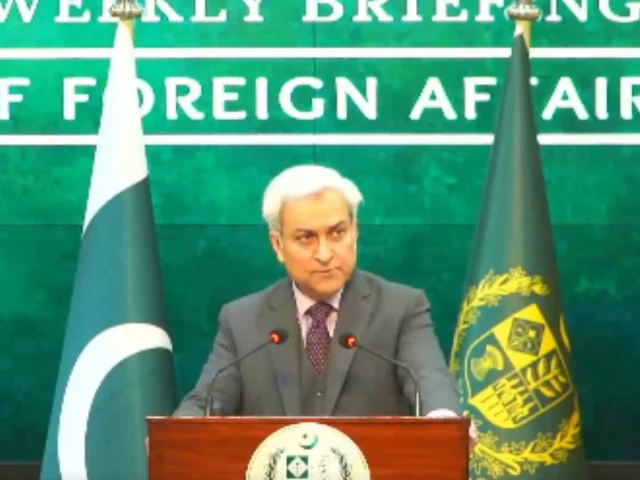
Foreign Office Spokesperson Tahir Andrabi told The Express Tribune that Pakistan was invited to join the negotiation process expected to take place in Istanbul on Friday.
This will be the first direct talks between Iran and the US since President Donald Trump returned to the White House in January last year.
Trump’s Middle East Adviser Steve Witkoff and his son-in-law Jared Kushner will lead the US side, while the Iranian foreign minister will represent Tehran.
Foreign ministers from Pakistan, Turkiye, Saudi Arabia, Qatar, the United Arab Emirates and Oman have been invited to the much-anticipated talks in Istanbul. The format of the process is yet to be finalised, but Pakistan’s participation in the high-stakes dialogue underscores its enhanced geostrategic role in the region.
However, Axios later reported, citing two sources with knowledge of the matter, that Iran has demanded that the talks be moved to Oman from Istanbul and be held in a bilateral format.
🚨The sources said the Iranians were walking back from understandings that were reached in recent days after several countries were already invited to participate in the talks
🚨The Iranians want to move the talks from Istanbul to Oman
🚨They also now want to hold them in a… https://t.co/jnMGI6PAYQ— Barak Ravid (@BarakRavid) February 3, 2026
The US military also shot down an Iranian drone that approached the Abraham Lincoln aircraft carrier in the Arabian Sea, a US official told Reuters today. The Iranian Shahed-139 drone was flying towards the carrier and was shot down by a F-35 US fighter jet.
However, the White House said the US is still planning talks with Iranian officials this week, even after the incident.
“I just spoke with special envoy [Steve] Witkoff, and these talks as of right now are still scheduled,” Press Secretary Karoline Leavitt told reporters, adding that they were due to happen “later this week”. “President Trump is always wanting to pursue diplomacy first, but obviously it takes two to tango,” Leavitt said outside the West Wing.
Sources said Pakistan, along with other regional countries, had been working actively behind the scenes to prevent potential US strikes on Iran. Prime Minister Shehbaz Sharif spoke to the Iranian president, while Deputy PM and Foreign Minister Ishaq Dar remained in contact with his Iranian counterpart amid renewed US threats.
Meanwhile, Pakistan also reached out to other key players, as well as Washington, as part of diplomatic efforts to avert renewed hostilities.
Sources said FM Dar is likely to represent Pakistan at the Istanbul talks.
Since President Trump issued renewed threats to attack Iran, Islamabad has been concerned that any escalation would have far-reaching consequences.
It is believed Pakistan advised the Trump administration against the use of force, while at the same time persuading the Iranian government to show flexibility and engage in meaningful negotiations.
Sources said that due to the efforts of Pakistan and other friendly countries, both sides agreed to sit across the table in an attempt to strike a deal.
Iran has tentatively agreed to resume nuclear talks with the US as it seeks to avert the threat of further military strikes, in what would be the first such negotiations since the Trump administration bombed three of Iran’s nuclear sites last summer.
“I have instructed my minister of foreign affairs, provided that a suitable environment exists — one free from threats and unreasonable expectations — to pursue fair and equitable negotiations, guided by the principles of dignity, prudence, and expediency,” wrote Iranian President Masoud Pezeshkian on X.
In light of requests from friendly governments in the region to respond to the proposal by the President of the United States for negotiations:
— Masoud Pezeshkian (@drpezeshkian) February 3, 2026
Pezeshkian said he gave the go-ahead for negotiations following “requests from friendly governments in the region”.
“These negotiations shall be conducted within the framework of our national interests,” he added.
These negotiations shall be conducted within the framework of our national interests.
— Masoud Pezeshkian (@drpezeshkian) February 3, 2026
Read: Iran’s president confirms order to begin nuclear talks with US
Tensions have surged in recent weeks, with Trump deploying a US “armada” to the region and renewing threats to strike Iran again if it does not agree to negotiate a new nuclear deal. Earlier in January, Trump had also warned of possible military action in response to nationwide protests in Iran, which triggered deadly crackdowns by security forces.
People familiar with the matter told CNN last week that Trump was considering options including airstrikes targeting Iran’s leadership, nuclear facilities and government institutions. A US carrier strike group is now in the region, where it could support potential operations against Iran.
Iran is believed to possess thousands of missiles and drones within range of US troops stationed across several Middle Eastern countries, and has threatened to strike them as well as Israel.
Also Read: Trump warns of ‘bad things’ if Iran talks fail
The past few days have witnessed a flurry of diplomatic activity as regional leaders rushed to find an off-ramp to avert conflict. Qatar, Turkiye and Egypt have led these efforts, with Turkiye offering to host in-person talks between the US and Iran.
Trump has expressed cautious optimism about negotiations, telling reporters on Sunday that Iran was “talking to us, seriously talking to us”.
Iran and the US held several rounds of indirect nuclear talks in April and May 2025 before a surprise mid-June Israeli strike on Iran led to the cancellation of further talks, followed days later by US strikes on Iran — effectively ending the process.
Iran had previously ruled out direct talks with the US.
————————
Additional input from Reuters and AFP.
