


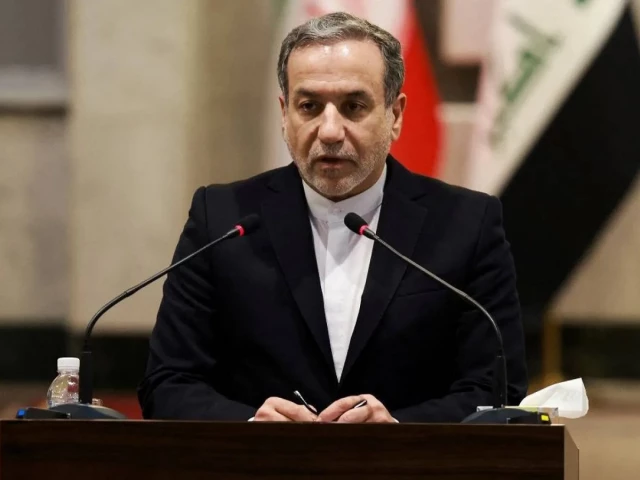
FM Araghchi says Iran seeking an end to the war and guarantees that such aggressions will not be repeated.
Iran’s Foreign Minister Abbas Araqchi speaks as he meets with his Iraqi counterpart Fuad Hussein, in Baghdad, Iraq October 13, 2024. PHOTO: REUTERS
Iran on Wednesday rubbished the claim from United States President Donald Trump that a new leader had just asked the United States for a ceasefire.
“Iran’s new regime president, much less radicalised and far more intelligent than his predecessors, has just asked the United States of America for a ceasefire,” Trump wrote on his social media platform Truth Social.
Washington would consider the request only when the strait was “open, free and clear”, he said, warning it would continue striking Iran “into oblivion or, as they say, back to the stone ages” in the meantime.
According to Iran’s IRIB news agency, Foreign Minister Abbas Araghchi said no ceasefire proposal was made.
He also said that a five-point plan allegedly proposed by Iran was “media speculation”, adding that the war would continue until “the aggressor is punished and full compensation is paid to Iran”.
Iranian Foreign Minister Araghchi:
🚨No ceasefire proposal has been made by Iran.
🚨The five-point plan allegedly proposed by Iran is media #speculation.
🚨The war will continue until the aggressor is punished and full compensation is paid to Iran.
— IRIB (Islamic Republic of Iran Broadcasting) (@iribnews_irib) April 1, 2026
Araghchi told Al Jazeera the same, saying that Iran was seeking an end to the war and guarantees that such aggressions would not be repeated.
Iranian Foreign Ministry spokesman Esmaeil Baqaei rejected Trump’s claim, saying that Tehran asking for a ceasefire did not reflect reality.
Axios, citing three US officials, reported that discussions were underway about a ceasefire in exchange for the reopening of the Strait of Hormuz.
Officials said Trump was actively discussing the possibility with figures inside and outside his administration, but cautioned that it remained unclear whether a deal could be reached. Sources did not specify whether the discussions were taking place directly with Iran or through mediators such as Pakistan.
Trump separately told Reuters today, hours before he was scheduled to make a primetime address to the nation, that the US would be “out of Iran pretty quickly” and could return for “spot hits” if needed.
Trump also said he would express his disgust with NATO for what he considered the alliance’s lack of support for US objectives in Iran. He said he was “absolutely” considering an attempt to withdraw the US from NATO.
UAE preparing to support US efforts to open Hormuz by force: report
Meanwhile, the United Arab Emirates is preparing to support US-led efforts to reopen the Strait of Hormuz by force, according to a Wall Street Journal report.
Citing Arab officials, the outlet reported that the UAE is lobbying for a UN Security Council resolution that would authorise military action and is urging the US and military powers in Europe and Asia to form a coalition to secure the strategic waterway.
The Gulf state is also reviewing potential military roles, including mine-clearing operations, as it weighs becoming a direct participant in the conflict for the first time, the report said.
In a statement cited by the Wall Street Journal, the UAE Foreign Ministry said there is “broad global consensus that freedom of navigation in the Strait of Hormuz must be preserved,” pointing to international condemnation of disruptions in the waterway.
US-Israeli strikes hit steel complexes in central, southwest Iran
According to Al Jazeera, US-Israeli strikes have hit steel complexes in central and southwest Iran, damaging production units, Iranian media is reporting.
“Initial assessments indicate massive attacks, with significant damage and destruction to production units” at the complex of the Mobarakeh Steel Company, one of Iran’s biggest, in the central province of Isfahan, Fars news agency reported, quoting a statement by the company.
According to Al Jazeera, Fars said one of the company’s subsidiaries, Sefid Dasht Steel, in the southwestern Chaharmahal and Bakhtiari province, had also “sustained damage and losses”.
The complex in Isfahan was attacked on Friday along with Khuzestan Steel factories in southwestern Iran.
Steel is an essential material for industrial and military production, including of missiles, drones and ships.
Trump “seriously considering” pulling US out of NATO
Speaking with the UK’s The Telegraph on Tuesday, President Trump has threatened to leave NATO.
“Oh yes, I would say [it’s] beyond reconsideration,” he said. “I was never swayed by NATO. I always knew they were a paper tiger, and Putin knows that too, by the way.”
According to Al Jazeera, Trump has recently called NATO “cowards” for refusing to send troops to the Strait of Hormuz.
He repeated those complaints to The Telegraph, claiming support “should be automatic” and appearing to draw a comparison between the war on Iran and Russia’s war on Ukraine.
“We’ve been there automatically, including Ukraine. Ukraine wasn’t our problem,” he said. “It was a test, and we were there for them, and we would always have been there for them. They weren’t there for us.”
Rubio says US can see ‘finish line’ on Iran war
US Secretary of State Marco Rubio said on Tuesday that Washington could see the “finish line” in the US-Israeli war on Iran, which is now in its fifth week, and the US will have to reexamine ties with NATO after the conflict.
“We can see the finish line. It’s not today, it’s not tomorrow, but it is coming,” Rubio told Fox News “Hannity” show.
In a recent statement, Donald Trump has been “seriously reconsidering” pulling out of NATO, according to Al Jazeera.
The war began on February 28 when the US and Israel attacked Iran. Tehran responded by launching its own attacks on Israel and Gulf states with US bases.
Joint US-Israeli strikes in Iran and Israeli attacks in Lebanon have killed thousands and displaced millions. The war has also raised oil prices and shaken global markets.
Rubio said messages were being exchanged between Iran and the US, and there is the potential to have a “direct meeting at some point” between the two sides.
“Messages are being exchanged, talks are going on. There is the potential for a direct meeting at some point,” Rubio said.
President Donald Trump – who has offered shifting timelines and objectives for the war, ranging from toppling Iran’s government to weakening its military and regional influence – said on Tuesday the US could end its military attacks on Iran within two to three weeks.
Rubio said, “there’s nothing any government is doing, or any country in the world is doing now to help Iran that is in any way impeding our mission.”
He added Washington will have to reexamine its relations with NATO after the Iran war.
“Ultimately, that’s a decision for the president to make, and he’ll have to make it,” Rubio said.
“But I do think, unfortunately, we are going to have to reexamine whether or not this alliance that has served this country well for a while is still serving that purpose, or has it now become a one-way street where America is simply in a position to defend Europe, but when we need the help of our allies, they’re going to deny us basing rights, and they’re going to deny us overflight,” he added in reference to use of military bases.
European leaders have refused to get directly involved in military attacks against Iran.
Iran focused on defending its territory
According to the Tasnim News Agency, Spokesperson for the Iranian Foreign Ministry Esmaeil Baqaei said that Tehran has received messages from mediators regarding the ongoing US-Israeli military aggression, but its stance remains “clear and defensive”.
In an interview with South Korea’s Yonhap News Agency, Baqaei said Iran had been attacked twice in the past nine months during ongoing diplomatic processes with the United States, describing the February 28 assault as a direct breach of diplomacy, despite Oman’s mediation.
He said that US claims of imminent Iranian threats or nuclear concerns are unfounded, as Iran’s nuclear program is peaceful, and said the war imposed on Iran is based on US ambitions rather than legitimate security concerns.
Baqaei reiterated that Iran did not initiate the conflict, which he described as an illegal and aggressive war by the United States, and emphasised that Washington must stop the hostilities while Iran continues to defend itself.
Additionally, around 1,262 Iranians living in Dubai have returned to Iran since the war started, Al Jazeera reports, citing Tasnim News Agency.
Since direct flights to Iran are closed, people have flown in via Afghanistan and Armenia. The Iranian government has submitted a request to the UAE to transfer more of its citizens via ship, as well as a dedicated flight route.
US wants a swift end to war despite continuing to bomb Iran
US President Donald Trump and his Secretary of State Marco Rubio said the end of the war with Iran could be near, with Washington signalling potential for both direct talks with Tehran’s leadership and a winding down of the conflict even without a deal.
The remarks underscored the shifting, often contradictory timelines and statements from Washington about how and when the war, now in its fifth week, might end.
“We’ll be leaving very soon,” Trump told reporters at the White House on Tuesday, saying the exit could take place “within two weeks, maybe two weeks, maybe three”.
Asked if successful diplomacy was a prerequisite for the US to end what it calls “Operation Epic Fury”, Trump said it was not.
“Iran doesn’t have to make a deal, no,” he said. “No, they don’t have to make a deal with me”.
Washington had previously threatened to intensify operations if Tehran did not accept a 15-point US ceasefire framework that had among its core demands that Iran commit not to pursue nuclear weapons, halt all uranium enrichment and fully reopen the Strait of Hormuz.
The White House said Trump would address the nation “to provide an important update on Iran”.
Rubio told Fox News’ “Hannity” programme there was potential for a meeting between both sides “at some point” and the United States could “see the finish line”.
“It’s not today, it’s not tomorrow, but it is coming,” Rubio added.
SECRETARY RUBIO: It’s illegal to bomb and sink commercial shipping. These are terroristic acts that Iran is undertaking in the Strait of Hormuz. Countries around the world should be stepping up and dealing with this. pic.twitter.com/BbiVHfogL5
— Department of State (@StateDept) April 1, 2026
Israel, Iran trade strikes
Drop Site News footage shows the aftermath of a US-Israeli strike on a major religious site in Zanjan.
📹 Aerial footage of U.S.-Israeli strike on major religious site in Zanjan
Footage shows the aftermath of an airstrike on the Grand Hosseiniyeh of Zanjan, a large Shia religious complex used for gatherings and ceremonies in northwestern Iran. pic.twitter.com/3XrZKaseYp
— Drop Site (@DropSiteNews) April 1, 2026
Drop Site News also reported on multiple impacts in central Israel after an Iranian missile strike. The impacts were reported in Tel Aviv, the Gush Dan area, and Bnei Brak following an Iranian ballistic missile launch, according to initial reports.
Some reports point to the missile carrying a cluster-type warhead, but this has not been independently confirmed.
Tanker hit off Qatar, blazes in Bahrain, Kuwait
Still, attacks were reported on both sides early on Wednesday, with drones hitting fuel tanks at Kuwait’s international airport, causing a big blaze and authorities in Bahrain reported a fire at an undisclosed company facility from an Iranian attack.
A tanker was hit by an unknown projectile near the Qatari capital Doha, causing damage to the hull at the waterline, the United Kingdom Maritime Trade Operations said, adding the crew was safe.
Explosions were heard in multiple areas of Tehran early Wednesday after US-Israeli air attacks, Iranian state media reported, adding that its air defences were activated.
Shahid Haghani Port, Iran’s largest passenger terminal located in Bandar Abbas port on the Gulf, was hit by an overnight air strike, but there were no casualties, the deputy governor Ahmad Nafisi told state media, calling it a “criminal” attack against civilian infrastructure.
Gulf countries, some home to US bases, have been repeatedly fired on by Tehran during the US-Israeli war, with concerns mounting about Iran’s closure of the Strait of Hormuz and ability to use the vital waterway, a conduit for a fifth of global oil and liquefied natural gas, as a bargaining chip.
While the United States has said talks with Iran were ongoing, Iranian Foreign Minister Abbas Araqchi said on Tuesday that he has been receiving direct messages from US special envoy Steve Witkoff, but those do not constitute “negotiations”, Qatar’s Al Jazeera TV cited him as saying.
The messages include threats or exchanged views delivered through “friends,” he added.
Iran’s Revolutionary Guards on Tuesday hit back with a new threat against US companies in the region starting on Wednesday.
It listed 18 businesses, including Microsoft, Google, Apple, Intel, IBM, Tesla, and Boeing, that would be targeted from 8:00pm.
Read: Iran’s Pezeshkian says US doesn’t believe in diplomacy as IRGC threatens to target US tech firms
When asked if he was concerned about threats to the companies, Trump said no.
Oil markets were subdued as trading resumed in Asia on Wednesday, but stocks and bonds rallied at the start of the session on hopes of a de-escalation. The MSCI’s broadest index of Asia-Pacific shares outside Japan was up 2.7% after a four-day losing streak as the Nikkei 225 jumped 3.9% at one point after Trump’s latest remarks.
Stocks on Wall Street soared on Tuesday as traders bet on the potential off-ramp, sending the S&P 500 2.9% higher.
US messaging is not negotiations, Iran says
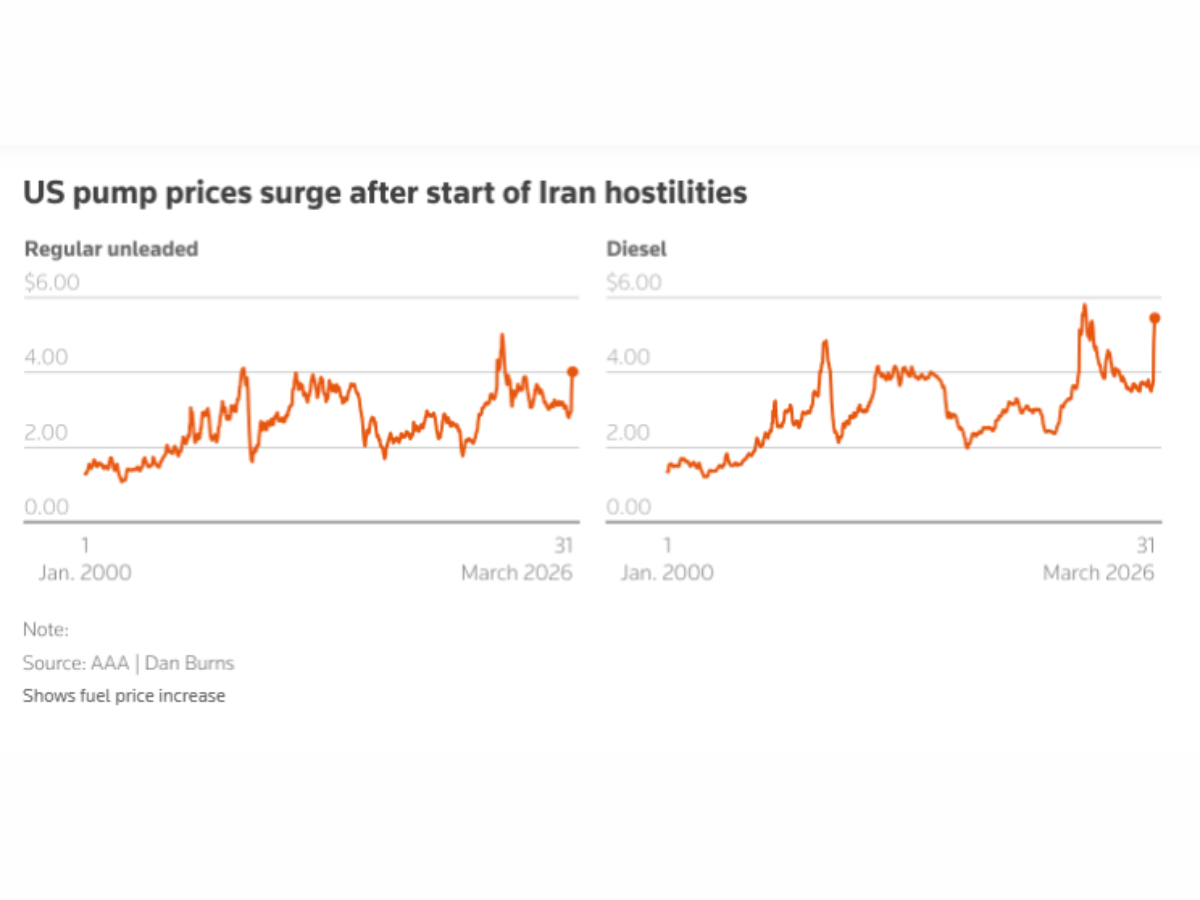
Higher oil and fuel prices have started to weigh on US household finances and are a political headache for Trump and his Republican Party before the November midterm elections.
Two-thirds of Americans believe the US should work to end its involvement in the Iran war quickly, even if that means not achieving the goals set out by the Trump administration, a Reuters/Ipsos poll found.
The United Arab Emirates is preparing to help the US and allies open the Strait of Hormuz by force, the Wall Street Journal reported late on Tuesday, in an effort to end its effective closure.
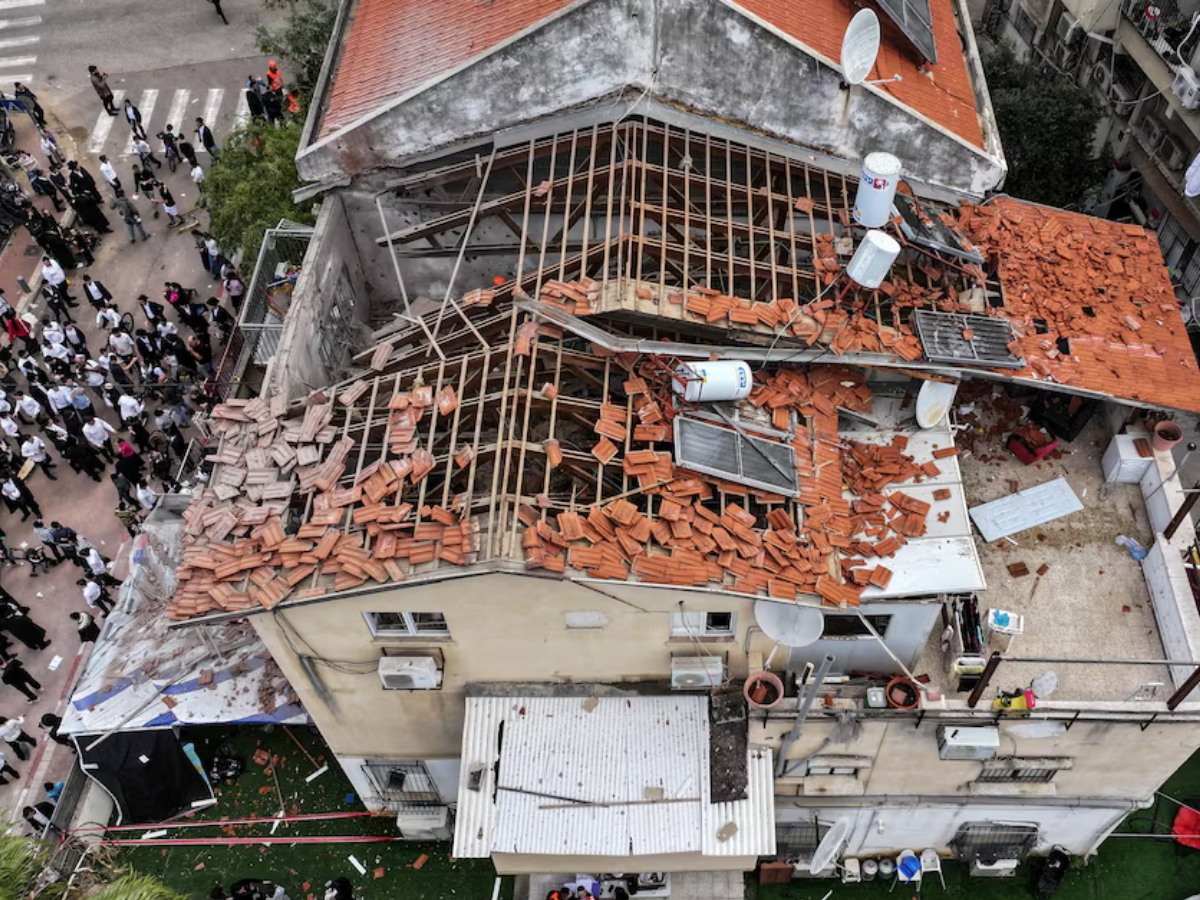
A drone view of people gathering at the site of damage in a residential neighbourhood following Iranian missile barrages in central Israel.
PHOTO: REUTERS
The UAE is seeking a UN Security Council resolution for the action and suggested the US occupy strategic islands, according to the report.
Trump earlier on Tuesday also criticised countries that have not helped the US war effort, such as NATO member Britain.
“NATO is a one-way street,” Secretary of State Rubio told the Fox News show, noting Europe was eager for the US to defend it but had not stepped up to provide the help the US sought.
“After this conflict is concluded, we are going to have to reexamine that relationship,” Rubio said.
 Houthis launch coordinated attack
Missile debris struck several areas in central Israel following an early morning rocket volley from Iran. There were no immediate reports of fatalities from Israeli authorities.
Many of Israel’s 19 deaths so far have been from falling rocket debris following interceptions.
Yemen’s Houthis, who joined the regional war in recent days, said they carried out a missile attack on Israel, describing it as a joint operation with Iran and the Tehran-backed Hezbollah in Lebanon, the first such collaboration between them during the war.
Current Supreme Leader of Iran Mojtaba Khamenei praises Hezbollah in a message to the Lebanese group chief, and vowed his continuous support in his telegram channel.
Israel’s military said air-defence systems were operating to intercept the threats.
The war has also revived conflict between Israel and Hezbollah. At least seven people were killed and 24 wounded in two Israeli strikes in the Beirut area, the Lebanese health ministry said. Israel said it was targeting two senior Hezbollah figures.
Israel says they killed Hezbollah’s Southern Front commander Youssef Ismail Hashem in the attack on Beirut.
Indonesia called for an inquiry into the deaths of three of its peacekeepers following Israeli air strikes in southern Lebanon which have also killed journalists and medics.
“We demand a direct investigation from the U.N., not just Israel’s excuses,” Indonesia’s U.N. representative Umar Hadi told an emergency Security Council meeting.
