


ISLAMABAD:
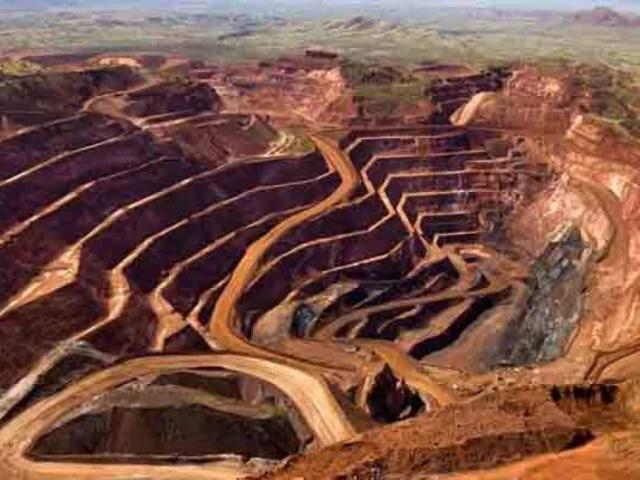
The United States has earmarked $1.3 billion for Reko Diq copper and gold mining project aimed at providing support for the extraction of mineral reserves in Balochistan.
Pakistan is currently working on the Reko Diq project in partnership with a Canadian firm. It requires capital injection of $3.2 billion, of which Washington has announced $1.3 billion.
Construction work has already commenced at the mining site and commercial production is expected to begin in 2028.
Despite its huge potential, Pakistan’s mineral sector currently contributes around 3.2% to the gross domestic product (GDP), with exports accounting for just 0.1% of the world’s total. However, with increasing exploration, foreign investment and infrastructure improvements, the industry is set to achieve significant expansion.
Pakistan’s mineral-rich landscape covers an outcrop area of 600,000 square kilometres. With 92 known minerals, 52 of which are commercially exploited, Pakistan produces an estimated 68.52 million metric tons of minerals annually. The sector supports over 5,000 operational mines and 50,000 small and medium-scale enterprises, providing direct employment to 300,000 workers.
According to the fact sheet related to the Critical Minerals Portfolio 2026, the US Exim Bank’s critical minerals portfolio of authorised transactions includes a $10 billion Project Vault for establishing strategic critical mineral reserves to support domestic manufacturers and strengthen supply-chain security.
It also includes $1.3 billion for copper and gold production at Reko Diq, $27.4 million for 6K Additive (Pennsylvania) to produce titanium, nickel and advanced metal powders and $23.5 million for Amaero Advanced Materials (Tennessee) to process advanced materials and critical metals.
The portfolio comprises $15.9 million for zinc mining and production by Empire State Mines (New York) and $11.1 million for titanium processing and manufacturing by IperionX (Virginia).
In a statement, the US embassy said that President Trump had announced Project Vault, a landmark initiative led by the chairman of the Export-Import Bank of the United States (Exim), which marks an unprecedented step in the US industrial policy by establishing a domestic strategic reserve for critical minerals.
Exim board of directors approved a direct loan of up to $10 billion for the Project Vault, more than double the largest financing in Exim’s history, designed to shield domestic manufacturers from supply shocks, expand production and processing of critical raw materials in the US and fundamentally strengthen America’s critical minerals sector.
More broadly, over the past year, Exim issued $14.8 billion Letters of Interest for critical mineral projects under the Trump administration, including, in recent months, $455 million for rare-earth development and processing in the US, $400 million for lithium extraction in Arkansas, $350 million for cobalt and nickel production in Australia, and $215 million for tin extraction across the United Kingdom and Australia.
Through its Loan Programmes Office, the Department of Energy has supported major private-sector projects to strengthen US critical mineral and battery supply chains.
These include a $2.3 billion loan for the Lithium Americas’ Thacker Pass project (lithium carbonate from clay), $996 million for the Ioneer’s Rhyolite Ridge project (lithium carbonate and boric acid), $475 million for Glencore battery recycling (lithium, nickel, cobalt and manganese extraction), $98 million for Syrah’s Vidalia facility (natural graphite processing), $1.4 billion conditional commitment for Energy Source Minerals’ project ATLiS (lithium hydroxide from geothermal brine), $754.8 million conditional commitment for Novonix’s project Kathari (synthetic graphite processing) and $1.26 billion conditional commitment for Michigan Potash (potash mining and processing).
