


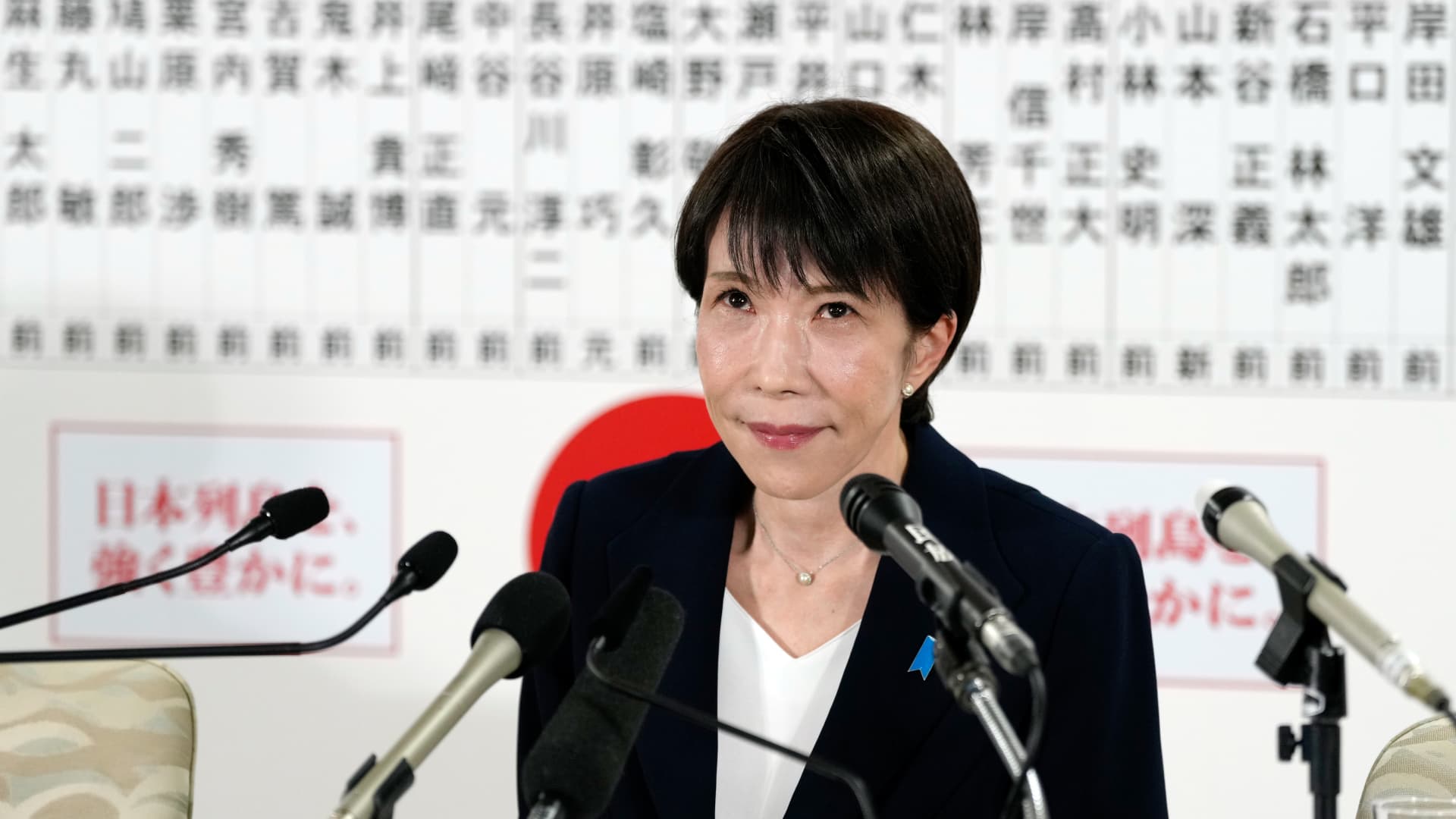
Sanae Takaichi, Japan’s prime minister and president of the Liberal Democratic Party (LDP), at the party’s headquarters in Tokyo, Japan, on Sunday, Feb. 8, 2026.
Toru Hanai | Bloomberg | Getty Images
Japan’s Sanae Takaichi and her ruling Liberal Democratic Party overwhelmingly found the support of voters in a Sunday election, sweeping a supermajority — which means the LDP holds two-thirds or more seats in the Lower House — and ushering her back as the country’s prime minister.
The outcome gives Takaichi broad latitude to pursue her agenda, which includes boosting defense spending and suspending some food-related taxes. Japanese stocks climbed to a record high Monday, while the yen strengthened to 156.88 per dollar, reflecting renewed investor confidence following the election results.
In Thailand, caretaker Prime Minister Anutin Charnvirakul declared victory after his Bhumjaithai Party performed strongly in national elections. Analysts attributed part of the support to surging nationalism and Anutin’s tough stance against Cambodia during recent border flare-ups.
U.S. markets look set to open higher on Monday, with futures tied to major indexes edging higher on Sunday evening stateside.
That optimism follows a sharp rebound on Friday, when tech stocks such as Nvidia, Broadcom, and Oracle led the charge.
“We’re in a gold rush right now with AI,” said Falcon Wealth Planning founder Gabriel Shahin. “There is money that will be deployed … It’s just the carousel [of money movement] sometimes scares people.”
The rally pushed major benchmarks higher. The Dow Jones Industrial Average popped 2.47% to close above 50,000 for the first time. The S&P 500 rallied 1.97% — putting it back in the green for 2026 after it dipped into negative territory after Thursday’s close — while the Nasdaq Composite climbed 2.18%.
Bitcoin also rode the wave of sentiment higher. It was trading at $70,312.88 as of 8 a.m. Singapore (7 a.m. ET). Remarkably, the cryptocurrency’s price jumped more than 11% within one day, suggesting investors haven’t lost confidence in the asset and are buying the dip — assuaging some fears of a renewed “crypto winter.”
What you need to know today
Big Tech has lost more than $1 trillion in valuation collectively over the past week, according to FactSet data. The declines hit Amazon, Microsoft, Nvidia, Meta, Google and Oracle. Amazon alone lost over $300 billion in market cap.
U.S. and India release framework of trade deal. However, the joint statement, released Friday, indicated that India is resistant to the U.S.’ push to open its agricultural market to imports. Separately, Trump removed a 25% tariff on India for buying Russian oil.
China’s Luckin Coffee opens first high-end store in Shenzhen on Sunday. It’s a departure from its original strategy of operating budget-priced coffee kiosks, and a move that takes direct aim at Starbucks. The company’s CEO last year hinted at plans to re-list in the U.S.
The Dow closes above 50,000 for the first time. Major U.S. indexes jumped on Friday as tech stocks rebounded. The pan-European Stoxx 600 rose 0.89%. Milan-listed shares in Stellantis plunged 24% after the firm said it would take a $26 billion hit from a business reset.
[PRO] Tech giants sold off in China last week. However, the reasons behind the moves differ from those in the U.S., analysts said.
And finally…
Elon Musk wants to be a trillionaire — here’s how SpaceX may get him there
Elon Musk’s journey to becoming the world’s first trillionaire will likely be powered by rockets rather than cars, as SpaceX now accounts for nearly two-thirds of the Tesla CEO’s wealth.
The tech magnate’s unprecedented wealth surged after SpaceX acquired his artificial intelligence company, xAI, this week in a deal that valued the merged entity at $1.25 trillion. With Musk’s ownership estimated at around 43% in the combined company, his stake would be valued at over $530 billion, marking a rapid shift in his fortunes.
— Robert Frank and Lora Kolodny
