


PUBLISHED
May 18, 2025
LAHORE:
The war entered through our ears. Lahore, as always, was calm. Too calm. That cursed tranquility — an affective anaesthetic — that made us feel like the war hadn’t come, when in fact it was already here.
I was at my desk, wrapping up a routine shift. By now, the escalations with India had faded into something ordinary. We were laughing. Fear had settled in us since April, like a second skin. That’s our thing: Comedy has never stood in opposition to trauma in Pakistan: it has walked alongside it as its twin.
Irony clawed at the moment: I was editing a report on the defence minister’s statement that war could break out any time. A sentence I had heard so often post-Pahalgam terror attack, it had calcified into a cliche. I knew, with the blunt certainty that sometimes precedes real catastrophe, that it wouldn’t be tonight.
But at 1:17 a.m., the moment betrayed me. Television tickers bled red: India had attacked Pakistan, targeting cities in Punjab. Not Kashmir. Not the expected theatre of conflict; it was home. Indian aggression had skipped its foreplay this time and arrived in our lungs.
Not our Baloch or Pashtun siblings in the peripheries. Not the battered, familiar terrain of the Line of Control. Punjab. This was our new cartography of fear. Moral nudity had reached Wagah.
My mother, in Sialkot, rang. Her voice: a storm on the other end of a wire. She had heard the blasts. She was stuck. And just like that, the abstraction dissolved. No longer rhetoric. It was real.
Having seen and lived a war before, a superstitious part of me started rehearsing loss, taking life in small doses. It felt as if my present, shaped by war, had already slipped into the past, while the future loomed like an anachronism.
What follows is no more than a scattered observation, a flimsy attempt to impose narrative on trauma. It’s all still too close, too raw, yet to be articulated. I indulge in what I have come to call ‘archaeology of memory’: an excavation of the wreckage still not ripe for interpretation.
War in our skins…
In Lahore, the days that followed the strikes were molasses. Stretched. Unreliable. At a remove.
The morning after the first strike, when the toll of the fallen, including children, women and worshippers, began to surface, there was disbelief. Stunned awakening of a city tasting war for the first time in decades.
It crept in sideways, like a rumour you’re not sure you believe. For this generation, it was a first. They asked questions. The answers came as instructions, handed down by grandparents, vessels of 1965 muscle memory: turn off the lights, cover the windows, stay low, wait.
But outside, the city still breathed like nothing had changed. The grocers opened as usual, children yelped through alleyways, chai dhabas regurgitated politics and paratha crumbs. Rickshaws argued. As if the entire city had been instructed to play a collective role: You will pretend. You will walk. You will buy lemons. You will not flinch.
One moment we were planning evacuations, the next moment arguing over keema or daal for dinner. A friend, who had just moved in from Islamabad, confessed, “I was afraid of birds, thinking they might be drones”.
We are atomic, we are told, but no one tells us what it means to live with that shadow. No drills, no shelters, only darkness and guesswork.
At a convenience store, I saw the cast assembled. A man muttering about petrol prices. A woman asking if ATMs would still function. A young boy, his hands balancing six eggs. I stood there with a bottle of milk, watching them. Or maybe witnessing them. Not a single face showed war.
It was the most grotesque part: that the sky could be split open and people still compared lentil prices.
The horror was not in the blasts, but in the kettle being boiled despite them. The psyche’s most radical act is sometimes to repeat the ordinary as an invocation.
If you keep making tea, perhaps the world will not disintegrate. If Lahoriites had to stop the war, they had to dine at their favourite eateries, go out and order their favourite burgers.
The city, said to be under attack, was performing peacetime louder than war could perform itself. After all, one is born in Lahore. And one who hasn’t seen it, they say, is not quite alive.
But is that not the worst violence a war can inflict – that it refuses to be named? A sword with dulled edges is not a mercy; it leaves it to the dying to discern the measure of blood, the register of pain, the depth of the wound. It is an undying death. But, as always, the mood would shift, anxiety cast aside in favour of the promises Lahore still held.
Years ago, I was in Tripoli during the Libyan civil war. That was a different kind of fear. I knew it was war. There, the violence was immediate — men on trucks, barricades, tracer rounds painting the sky. It was seen, smelled, known.
But it wasn’t this. Not this fog. Libya was chaotic, but honest. This was disorienting.
A war that flirted with you and only appeared intermittently.
I messaged a colleague:
“Tripoli was easier. I could tell where the bullets were coming from.”
She replied: “Let’s not call it a war yet.”
We had entered deferred meaning.
I saw two girls on MM Alam giggling on scooters as if we weren’t one false flag away from annihilation. Barbershops were full. Paaye joints opened past midnight.
Sonic violence
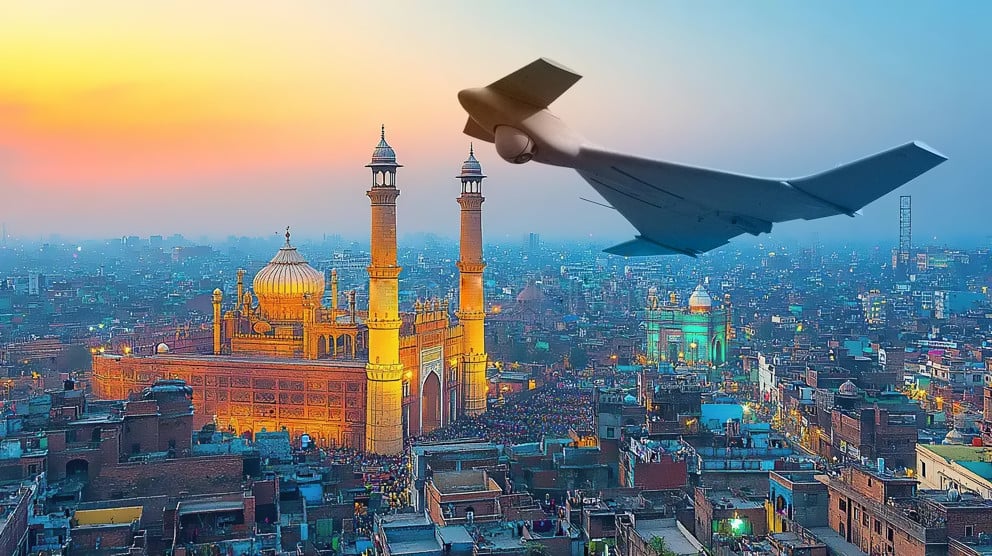
On May 8, parts of the city trembled under the thrum of Indian drone strikes. Explosions shook windows and fractured buildings. The slow percolation of dread began to crystallise into something more solid, more terrifying.
Officials were injured. Some were killed. Reports of strikes in multiple cities began to trickle in, forming a mosaic of violence. Even some homes were hit. Rooftops shattered.
The Indian government was escalating, and the dead had begun to acquire names. One night, we gathered near Ferozepur Road, behind a bakery. Strangers huddled in panic. No one knew where the explosion had struck. Some said Gulberg. Others, Indian Punjab. A few whispered it was just a transformer.
On social media, especially Facebook and X, the sensory onslaught was unrelenting. Footage of Israeli-manufactured drones hovering over Pakistani skies. Posts from terrified citizens. Disbelief turned, slowly and grimly, into acceptance.
Zionist expansionist ambitions reverberated through the speeches of Indian ministers, echoed by TV anchors who transformed warmongering into prime-time theatre.
A friend, also a journalist, told me of the night she first heard the Israeli-made Harop humming over Lahore’s Old Airport. She was there. For her, that was the war. “The scariest moment of my life so far.”
But what stayed with her wasn’t just the fear. A ‘random uncle’ broke into chants against Modi, others joining in with laughter that felt strangely necessary. Children played near the site, aestheticising war for her, rescuing her, rushing in to patch the hole torn open inside her.
She later told me it wasn’t conviction, but something else. Even those who’d normally flinch at jingoism’s empty theatre allowed themselves, for a fleeting second, to lean into its comfort.
The spontaneous return to nationalist libidinal rhythms was less political than symptomatic, a moment of shared jouissance, where the ‘Real’ of war slipped into farce, and farce into survival.
“As journalists, we literally run toward the places where something is happening,” she said. “Sometimes not for the facts … but because being near it makes us feel safer.”
Meanwhile, India faced heat from global powers. Its narrative started to fray. What Modi had dubbed the “new normal” wasn’t catching on. It was, in fact, backfiring.
Amid the chaos, a counterbalance to fear emerged: China. The public clung to a phrase repeated like prayer beads, “China won’t let anyone attack Pakistan. China is our brother.”
As diplomatic countermeasures gained momentum, it began to feel true.
Then came the night of May 9. A strike on DHA Phase 6. By the time the last drone fell on Lahore, no one was sure if it would be the last. Another night of blasts.
I sat again in the same chair, working through another shift. Another drone strike. Another explosion. I rushed out — as did many. For a moment, we didn’t know if the final act had finally arrived.
When I returned, the air had changed. The news had shifted — northward, to Rawalpindi, to Nur Khan base, to the looming possibility of full-blown escalation. At an emergency midnight press conference, the line was drawn. Indian aggression, we were told, had crossed the Rubicon. “Now you just wait for our response,” the DG ISPR said, warning the enemy, steadying us.
Minutes later, we saw the reprisal on our television screens — missiles targeting the enemy. A release. Tears.
After hours of uncertainty, the ceasefire was announced. The city erupted — Liberty Chowk lit up in fireworks. Yes, we had won. The deterrent had held. China affirmed. The Gulf approved. Even the West stopped parroting the usual lines.
But what had settled inside us would not exit with a UN statement.
Peace is a psychological terrain, not a treaty. Later that day, when the ceasefire was announced, fireworks went off somewhere near Liberty Chowk. The city, always a flirt with spectacle, did not pause.
But I did. The sound hit like a misfired memory. My chest tightened. I ducked, almost instinctively. Then I laughed. Fear, delayed, had turned into absurdity. The body was confused. But the surreal jubilation was our way of saying, “We are still here”.
The grocery list still sits on my kitchen counter: onions, tea, rice, batteries. I had written “batteries” in a different pen. Somehow, that felt like the most important detail.
