


PUBLISHED
February 15, 2026
As industrialisation enabled urbanisation, individuals, communities, and entire civilisations began to lose touch with what they regarded sacred — sacred rivers, holy springs and mountains, and sacred forests. This either led to a complete abandonment of the sacred attachment to nature, or a mere dogmatic adherence to it, without a deeper understanding of the intended purpose behind the stories and dogmas.
Sindh-based environmental anthropologist Dr Suneel Kumar who got his credentials from the University of Georgia, US, and teaches at the University of Sindh, Jamshoro, sheds light on the fundamentally intertwined relationship between river systems, biodiversity, and indigenous culture.
Over the century, due to industrialisation, and the attempt to tame the Indus river for the purpose of agricultural production at an industrial scale, people’s connection to the river began to reduce in a meaningful way, despite the river still holding symbolic and sacred value to the local population. “It is important to understand what riverine deltas are,” says Dr Kumar, adding that there is limited knowledge in urban areas about the nature of the river. “The river is always more than the flow of water. It’s also the flow of minerals and sediment, as well as small and big fish.” This may seem like a minor point but as the anthropologist goes on to explain, it has significant implications for biodiversity and culture.
Along its flow, the Indus creates different cultures for different kinds of biodiversity.
“The river tides not only erode the sediments but redistribute them,” he explains. “In its redistribution, it creates different deltaic environments, like salt marshes, lagoons.”
Often, the language spoken in a certain area changes with the changing ecology, for example, the languages spoken in the Kutch (marsh lands), Thar (desert), and the valley regions (around
the river) in Sindh are quite distinct from each other.
Pre-dam conditions
Dr Kumar shares the astounding statistics regarding the flow of the Indus river, “More than 100 million hectare feet of water flowed in the pre-dam condition, before 1932, when the Sukkur Barrage was built by the British Administration.” This helps explain why some early Vedic texts described the river as akin to a sea.
“Around 250 to 350 metric tonnes of sediments, through the Indus river would be transferred to the delta region,” he says. “Currently it’s only 10 to 20 metric tonnes per year.”
The sediments, he explains, are an essential part of the ecosystem. The sediments are what creates the land around the delta, and helps maintain it and, without that, the land is likely to sink, as is the case at the moment.
“The Indus river is not creating new lands, it is not rejuvenating the old lands, and this is causing salt water intrusion, which is eroding the land very quickly,” says Kumar. This phenomenon has been well documented in Sindh. Most notably, places such as Keti Bandar, Thatta, and other areas around the coast of Sindh are experiencing salt water intrusion. As a result, thousands of farmers have been impacted and are no longer able to farm, including a farmer who told the Express Tribune last year, that the conditions were so desperate that “they may as well drop the atomic bomb on us!”
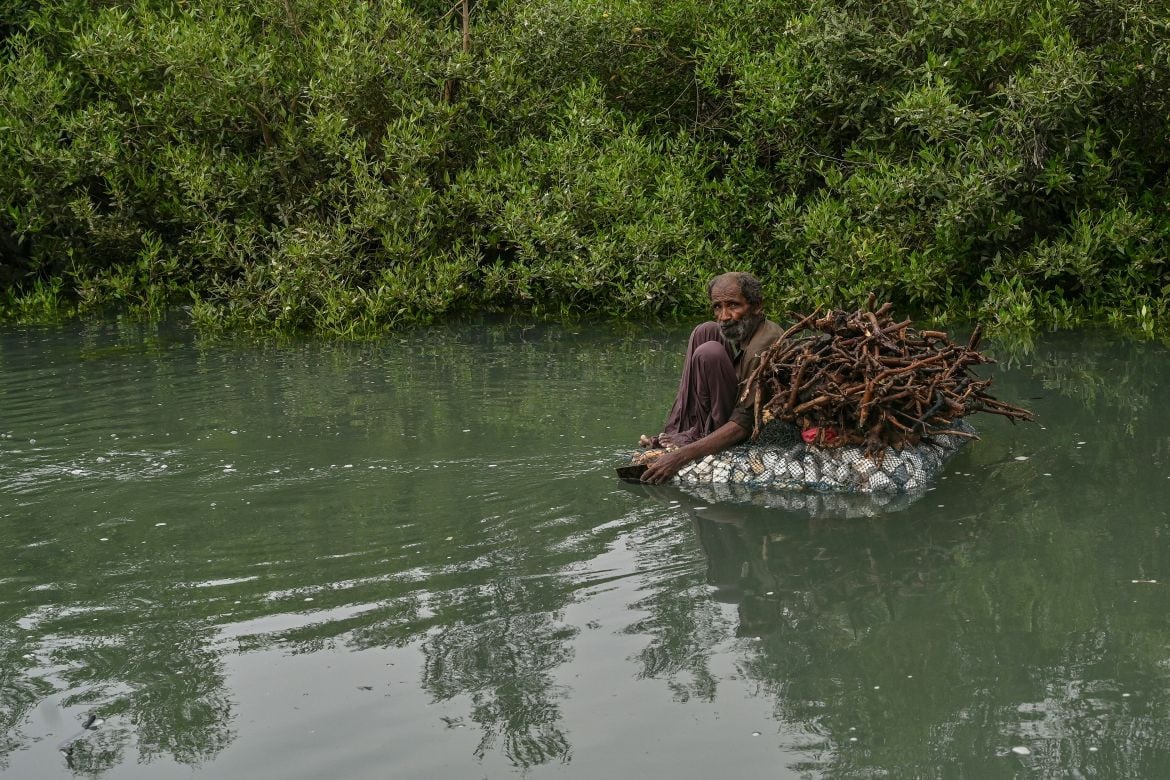
“By 1930-40, there were 17 active creeks between Karachi and Sir Creek. Today there is only one active creek. The rest have either been choked, or have been taken over by real estate…Most of the water now in those creeks is salt water.” An unfortunate fact about Sindh and Karachi in particular is that the tourism potential of creeks and the mangroves of the Indus Delta remains misunderstood. In many other countries in Southeast Asia, such as Malaysia, Indonesia, and the Philippines, tens of millions of dollars in profit are generated from mangrove-based tourism alone.
“When the Indus river used to flow, it used to meander, like a snake,” says Dr Kumar. “When it used to erode one area of land, it would create new ones by transferring sediment.” One would think that this would lead to a chaotic life and a disrupted economy, but Kumar explains why that is not the case. “Local people were used to that environment and never categorised this as a problem. They knew that if the river is eroding one land, it’s creating another.”
Kumar explains that the locals lived in bamboo houses, which could be easily dismantled during monsoon, and reassembled elsewhere, so that countless stories of areas of Sindh were swallowed up and others that were created, due to changing forms of the river and the sea.
“The most popular story I heard was that this Keti Bander is the third Keti Bander. They would just move the bamboo houses from one bank to another,” he says.
“What’s happening today is only erosion. The land that goes into the sea water never comes back,” says Kumar. “There’s a huge difference between what was happening in the past and those natural processes, and what’s happening today. While in the past, erosion of the land would go hand in hand with creation of new land, today, we only have erosion and no formation of new land. In places like Keti Bander, where previously people used to live in bamboo homes and could disassemble their homes as needed, today, in large part due to the engineering of the river and the creation of embankments, barrages, and dams, they began to live in permanent accommodations.”
As a result, displacement through flooding became a more significant event which would sometimes permanently displace the population – as opposed to a previous semi-nomadic lifestyle, which was resilient with respect to displacement.
The sacred
Dr Kumar recalls an anthropologically significant story about the palla (hilsa) fish in the Indus. The fish used to be abundant in the river system. The story of the palla perfectly encompasses the tragic nature of industrialisation. “It’s called a diadromous fish, which spends half of its time in the sea, and then travels into the river during spinning time,” he explains. “ In Sindh, you eat fish during the months that have the sound “r”, but not in the rest of the months.”
Local culture had a built-in sense of sustainability, and the wisdom to keep the fish population stable.
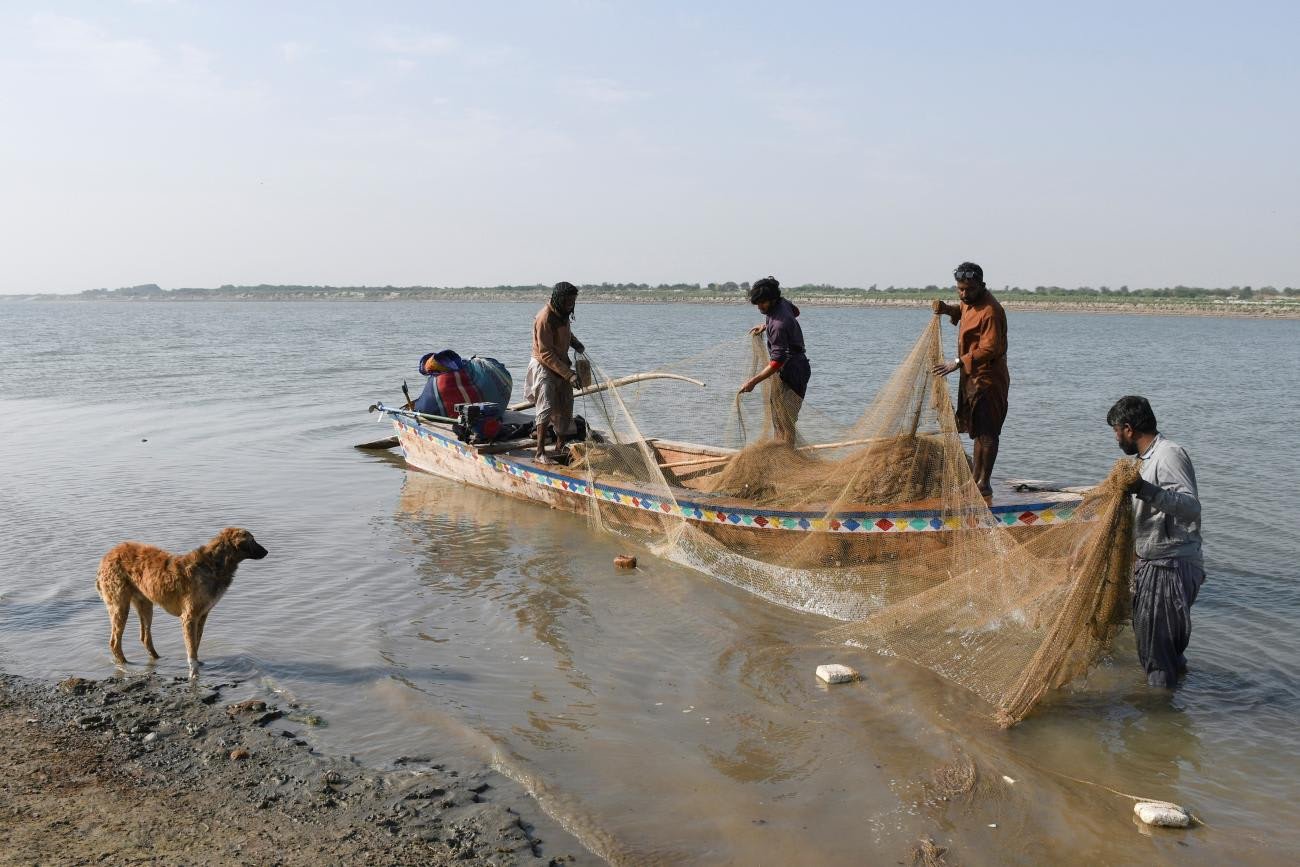
The history of the palla fish and the history of the Indus river are very much intertwined, for centuries. “In the past, the Indus river would start flowing in the delta around March and April, and that’s when people would notice that the palla fish were present in the creek, during their upward migration. During that period, the fisherfolk would catch the fish, but they had a very peculiar fishing net with such big holes that their hands could pass through.
This is, at least, according to the colonial records of the British Raj. “The 1907 gazette year tells us that they were using fishing nets that were two to four-inch wide, which is a big size. This was so that the small fish, like the palla, could easily pass through. And if they were to catch the small fish, they would take it out and throw it back into the water.” This would go on to change with industrialisation and the introduction of small nets that catch even small fish, and damage the ecosystem.
All of these cultural wisdoms are typically instilled through stories, since stories are easier to remember and pass on. “In their own metaphysics, they believe that the palla is a companion of the saint Khwaja Khizr,” explains Kumar. “They believe that when the fish migrates upstream, it is not merely for spawning, but it is a type of “ziarat” [a pilgrimage], to the shrine of the saint located in Sukkur. On their return migration, around October/September…the fisherfolk would be very careful to not catch the palla fish, and they had ways of identifying it through names. They would claim that they could tell when their faces were red that they had seen their Saint Khizr.”
This astounding fact is known by few in urban Sindh, where most individuals rarely visit the interior of the province out of curiosity and a willingness to learn.
“These stories are no more…there is no palla in the Indus delta,” shares Dr Kumar who believes that this is not merely a loss of palla but a whole culture that went along with it.
“Today, they are using a net, which is banned by the Sindh fisheries department,” he points out. “It is so small that even your finger cannot pass through it. As an anthropologist, I see the change in their care for these fish and the biodiversity because of the loss of these stories that inform the younger generations about conservation of nature.”
Migration
As a result of diminishing fish and the fishing community, people are migrating to places like Ibrahim Haideri. Most of these people go on to find better luck in deep-sea fishing instead, according to Kumar.
“I try not to use the word ‘migrants’ for these people, because they are not migrants, they are victims…they are dispossessed. And it’s not just the fisherfolk,” adds Dr Kumar. “There were agriculturalists in the Indus delta. There was the Jut community in the Indus delta, who were dependent on camels. Now due to the shrinking of the delta, they are now shifting from whatever they have been dependent upon, towards the fisheries.”
Has there been an attempt to restore these wisdoms? Unless the river returns to its original flow, it is very difficult to revive that knowledge and wisdom, believes Dr Kumar.
“When Muhammad Ali Shah was CEO of Pakistan Fisherfolk, being from the deltic community, he started to mobilise the people of the delta, to revive the culture,” shares Dr Kumar. “Due to industrialisation and easy communication between the rural areas and the city, the younger community is eager to move to the city. But the older people talk a lot about reviving their culture, their knowledge, and their old ways. It’s not just the fishing community, but also the Jut community, known for its camel herding, that is now selling its camels to survive.”
Without a sufficient restoration of water flow from the Indus river, the mangroves are unlikely to be sufficiently restored, and the most vulnerable communities like the Juts are leaving their nomadic life, to settle in places like Keti Bander. “Once all these camels are gone, how can we revive the Jut culture?” asks Kumar. “It’s a rare species of camel that can partially swim in the water.” Often, in academic spaces, it is believed that progress can be made simply through abstract discoveries, restorations, and findings, but as Dr Kumar points out, all of that is in vain unless accompanied with fundamental shifts in the status quo, with respect to the Indus river and its governance.
All facts and information are the sole responsibility of the writer
Zain Haq is a climate activist focusing on the mechanics of mobilisation and organisation
