


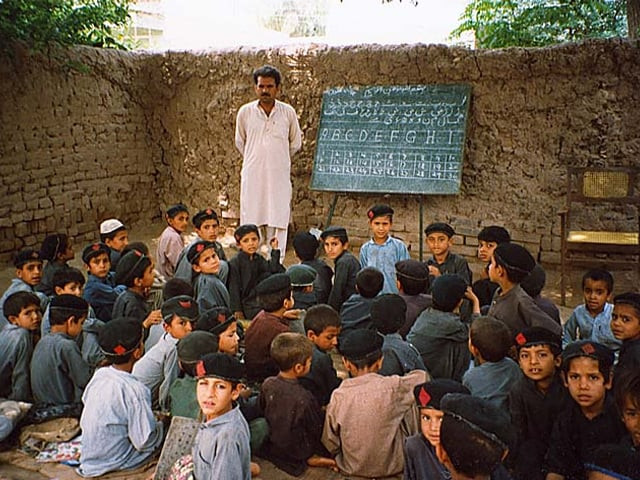
Unemployed young people pose challenges, can become positive force if governance system is fair and inclusive
ISLAMABAD:
What is a state? Why do people give up their rights to the state? How does it function? What are the responsibilities of a state? These are questions that have always been asked and debated throughout human history. A state aims to restrict, control, and eliminate injustice, external threats, and social injustice. But how?
The state establishes a fair governance system that upholds human equality, dignity, and liberty. Through this system, the state aims to provide basic needs, skills for growth, education to promote morality and values, and a peaceful living environment. It ensures that everyone – government, institutions, and individuals – is governed by the rule of law, which unites society.
In essence, a state’s strength depends on its governance system, which should focus on people, be anchored in the rule of law, be dedicated to justice and the fight against injustice, and hold officials accountable for ensuring a prosperous and safe life.
Now, the question is, how do we create such a state, who can undertake the job, and what qualities do those individuals possess? Islam outlined the characteristics of the state and its actors many centuries ago. Islam states that the system and its actors must be pious, transparent, accountable, selfless, and always serve as servants rather than rulers. Islam has provided a practical example of a welfare state, governed by the rule of law, with everyone submitting to it.
The state is always focused on people, giving priority to meeting the needs of its citizens and all creatures within its borders. The state must also provide social justice before seeking justice.
Pakistan was envisioned as a state with these characteristics. It was promised that the state would work to create a fairer social justice system, a welfare economy, respect human dignity, ensure sustainable peace, and operate through a people-centric governance system based on Islamic principles.
It will be ensured through inclusiveness and public participation, achieved by strengthening people’s democracy at the highest level. Quaid-e-Azam Muhammad Ali Jinnah emphasised that a fair and just system of governance would be crucial to achieving these objectives.
Regrettably, after Jinnah’s death, the idea began to fade. The ruling elite could not grasp the Quaid-e-Azam’s vision. Justice and social justice have become the last priorities of the ruling class. The state, which was meant to serve as the guarantor of justice, was unable to do much to protect the vulnerable.
The elite ruling class and its actors exploit the weak with impunity. Those who were brought into the system as servants have become the rulers. They enjoy enormous benefits at the expense of the common man. They have burdened citizens with various taxes and bestowed themselves with extraordinary privileges. The lure of power’s perks and benefits is so strong that no one wants to relinquish it.
As a result, elitism, exploitation, injustice, and social and economic exclusion have become the defining features of the Pakistani system. Rent-seeking and corruption are common practices. Fairness, social justice, and inclusivity, which were meant to be the core principles of the state, have become alien to Pakistanis.
In modern Pakistan, exclusion and injustice are so widespread that they affect all levels of society. The story of exclusion begins with the education system and extends to access to livelihood opportunities, social status, security without discrimination, and growth prospects.
The biggest victims of this unfair and exclusionary system are the youth. On one side, most young people lack access to quality education and skill development, and on the other side, retired individuals prevent them from getting jobs, as they take on post-retirement roles.
The elite class has replaced merit with nepotism and bribery. This forces the youth to remain unemployed. It is a concerning trend, as youth (aged 30 and below) make up 64% of the population. This creates serious challenges for the country, security, and economic growth.
It is well known that youth can be a destructive or constructive force. If the system is fair and inclusive, young people will be a positive force; otherwise, no one can stop them from becoming destructive. Recently, we have seen Gen Z bring down many governments.
Against this backdrop, there is a need to reform the system to ensure it is fair and inclusive. Serious reforms are necessary to safeguard the social and economic interests of ordinary people, protect the life and dignity of every citizen, and guarantee justice and social equity for all without discrimination.
In this context, we have some suggestions for consideration. First, merit should be the guiding principle, not nepotism or any form of discrimination. Merit must consist of two components: 1) field competence and 2) high moral values such as integrity, selflessness, truthfulness, transparency, accountability, and honesty.
Second, the constitution should prohibit post-retirement appointments that favour the elite and are a criminal act. Third, the ruling class must live among ordinary citizens; there should be no gated communities. Fourth, everyone must obey the law, regardless of their situation or status. The ruling class must understand that the rule of law is fundamental to keeping the country united.
It is high time to bring in changes, as Pakistan is undergoing a series of constitutional reforms. Moreover, the much-debated topic of creating new provinces is included in the proposed 28th amendment, making the timing more relevant for enacting and piloting the reforms.
In conclusion, state leaders must understand that selective justice and social injustice are a recipe for failure and go against the teachings of Islam. Fair and accessible justice, along with social justice, is increasingly necessary. Therefore, the government should neither be too soft nor too harsh; it must be just and equitable.
The foundation of the government relies on justice and social justice at all levels. Without these, the government cannot endure, as seen in the example of the USSR. Despite its power, the USSR’s inability to deliver justice and social justice ultimately led to its collapse.
The writer is a political economist and visiting research fellow at Hebei University, China
