


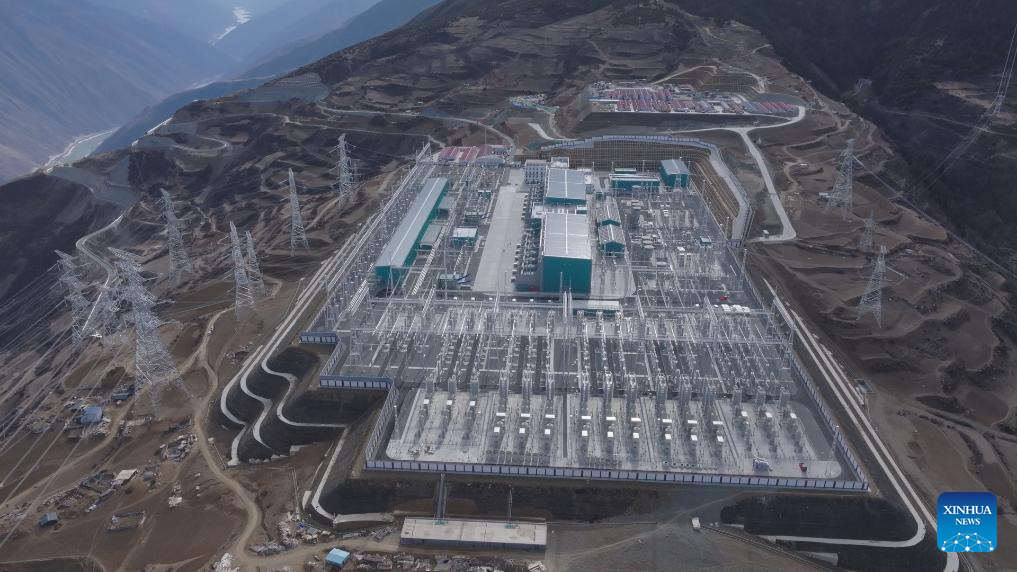
This undated file photo shows the Karmai station in Mangkam County of Qamdo City, southwest China’s Xizang Autonomous Region. (Xinhua)
LHASA, Dec. 18 (Xinhua) — A converter station at an altitude of 3,720 meters completed a 168-hour trial run on Thursday, marking the launch of the first ultra-high voltage (UHV) power transmission project in southwest China’s Xizang Autonomous Region.
The operation of the Karmai station, located in Mangkam County in Xizang’s Qamdo City, also signifies the full completion of a local direct current (DC) power transmission project, which has now officially begun delivering clean power to central China.
Below the converter station, a 750,000-kW hydropower station on the Jinsha River is roaring into operation. In just about 6 milliseconds, electricity generated here can travel 1,900 km from the converter station to Hubei Province.
The ±800 kV DC power transmission project, with an investment of 34.3 billion yuan (4.9 billion U.S. dollars), is designed to transmit 40 billion kWh of clean electricity annually. Powered primarily by hydropower with supplementary solar and other renewables, the project will replace over 12 million tonnes of coal and reduce carbon dioxide emissions by approximately 30 million tonnes annually.
Dong Ran, a deputy project manager from the Karmai converter station, said the sending end of the line was split into two parts: the Karmai station in Xizang and the other in neighboring Sichuan Province. “The two ±400 kV converter stations link together like two batteries, forming the sending end of the ±800 kV transmission line — the first one of its kind in high-altitude regions in the world,” Dong said.
As the high altitude and thin air constrain the insulation performance of UHV equipment, the converter station systematically increased ground and tower clearance during the design phase to ensure safe and reliable operation, he added.
UHV refers to power transmission technology with exceptionally high voltage levels, typically defined as alternating current (AC) projects at 1000 kV and above, and DC projects at ±800 kV and above.
Compared to conventional transmission lines, UHV DC power transmission offers the advantages of longer distances, higher capacity, and lower losses, enabling stable, large-scale transmission over thousands of km, akin to an “expressway” for electricity.
The Karmai station is equipped with cameras, track-based inspection robots and robotic dogs for round-the-clock automated inspection and monitoring, significantly reducing manual on-site work at such a high altitude, said Gu Pen, the station’s deputy head.
Xizang, one of China’s key energy bases, is rich in clean energy sources, including hydropower, wind power, and solar power.
Wang Bingqiang, a manager at State Grid Xizang Electric Power Company Limited, said that the full operation of the transmission line further integrates the plateau region into the national energy landscape, supporting the optimization of regional energy structures and the “dual carbon” goals, while demonstrating China’s capability and innovation in UHV core technologies in complex high-altitude environments.
China has been making efforts to meet its dual carbon goals of peaking carbon emissions by 2030 and achieving carbon neutrality by 2060.
Over the past years, China has invested heavily in the construction of UHV power transmission lines to deliver electricity from the country’s energy-rich west to its booming east and increase consumption of clean energy sources for green economic growth.
To date, the State Grid has put into operation a total of 42 UHV projects comprising 22 AC and 20 DC lines, achieving an inter-regional and inter-provincial power transmission capacity of 370 million kW. ■
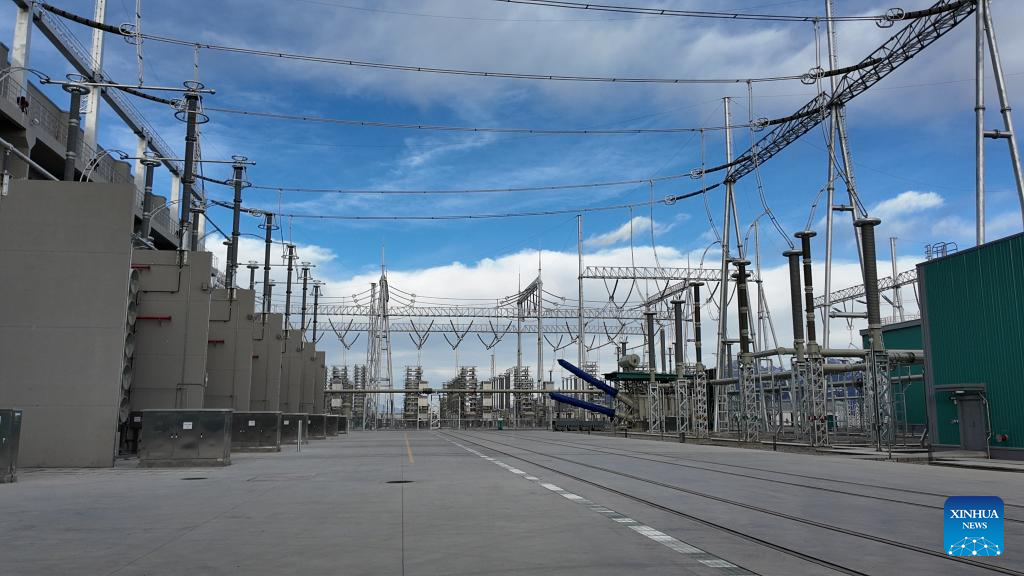
This photo taken on Dec. 16, 2025 shows a view of the Karmai station in Mangkam County of Qamdo City, southwest China’s Xizang Autonomous Region. (Xinhua/Pan Yijing)
