


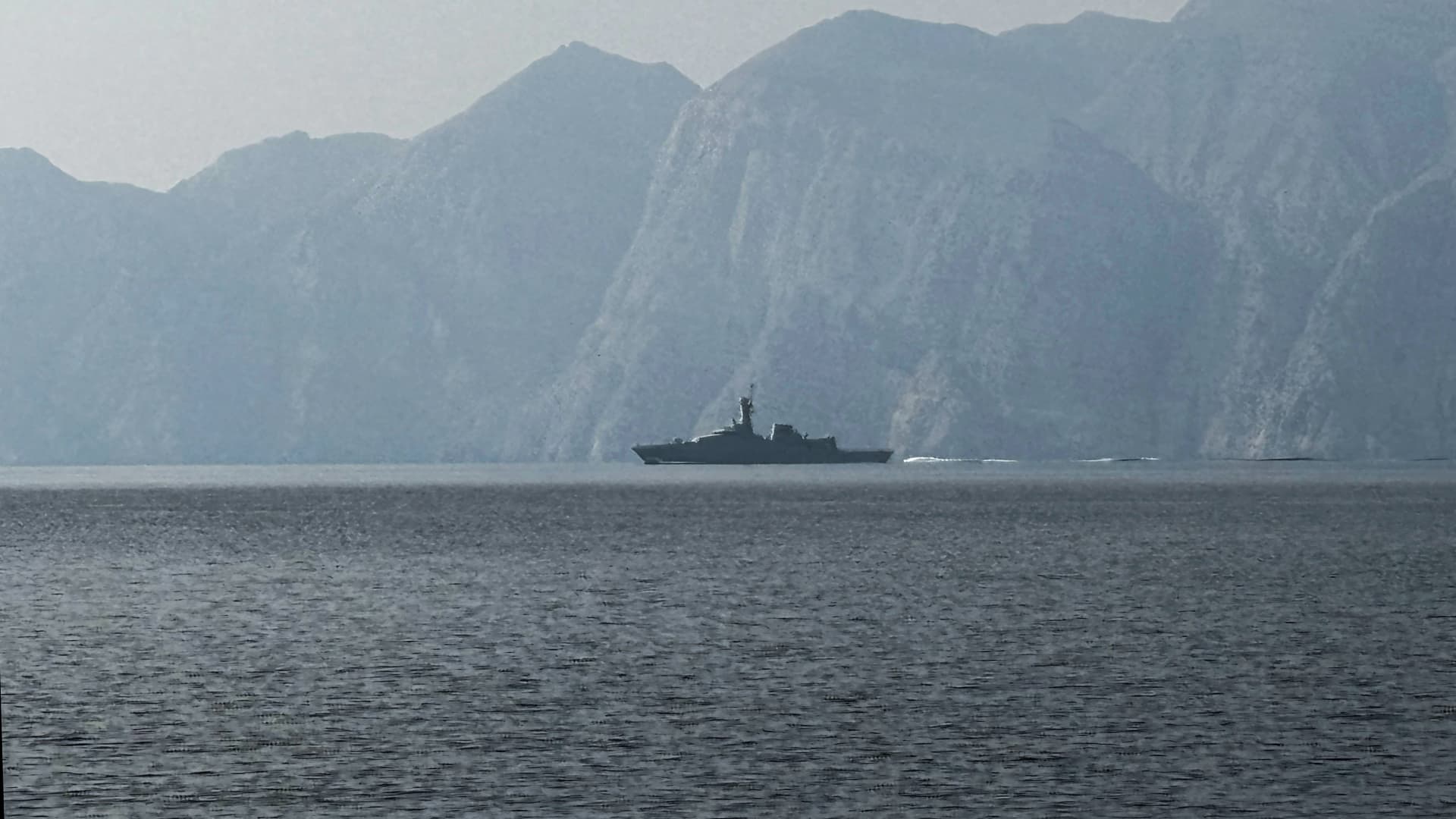
A navy vessel is seen sailing in the Strait of Hormuz, a vital waterway through which much of the world’s oil and gas passes on March 1, 2026.
Sahar Al Attar | Afp | Getty Images
President Donald Trump on Monday rolled out a “blockade” of access to Iranian ports in the Persian Gulf to great fanfare, announcing his intentions on social media and then proclaiming it in motion at his appointed deadline.
But what exactly does choking access to the region’s oil exports via the Strait of Hormuz mean and what does Trump want to accomplish?
A former Biden-era Pentagon official said the U.S. is trying to turn the tables on Iran, which has blockaded the strait for weeks during the U.S.-Israeli war with the country, creating a bottleneck that roiled global markets and strained the economy. Experts say the goal of the blockade is to convince Iran’s leaders to back down and acquiesce to U.S. demands to end the war and restore freedom of navigation to the strait.
“The administration seems to be pursuing what is called a close blockade, which is an attempt to prevent ships from going into those ports or leaving those ports,” said Michael Horowitz, senior fellow for technology and innovation at the Council on Foreign Relations and a former deputy assistant secretary of Defense. “The theory behind a close blockade of Iran’s ports is to make it impossible for Iran to financially benefit from oil sales via shipping in the strait while it is restricting others from doing so.”
Iran is a top-10 petrostate, accounting for about 4% of the world’s oil production — most of which is sold to China. Shutting down the ability of Iran to export its oil could cause a significant drain on the country’s economy.
Trump announced on Sunday that he would blockade the strait, a significant escalation after a two-week ceasefire and reports that Iran was planning to toll ships seeking passage through the waterway. U.S. Central Command later clarified it would be blockading “against vessels of all nations entering or departing Iranian ports and coastal areas, including all Iranian ports on the Arabian Gulf and Gulf of Oman.”
Ports in other Middle Eastern countries, including the United Arab Emirates and Saudi Arabia, are also accessed via the strait.
Mark Cancian, a retired Marine colonel who is now a senior advisor Center for Strategic and International Studies Defense and Security Department, said the U.S. is likely to carry out the blockade in a similar fashion to the one it imposed on Venezuela last year. The U.S. seized several vessels as part of that blockade.
“We’ll know a lot more when the first boarding takes place, because that will tell us where they’re boarding ships, how they’re doing it and what happens to the ship after they board,” Cancian said.
He said the U.S. is more likely to interdict vessels east of the strait in the Arabian Sea than in the strait itself or the Persian Gulf, where Iran has more agency to interfere. Though Cancian said the U.S. could seize vessels there if it wanted to.
The boardings themselves are likely to be carried out by landing a helicopter on a tanker, but could also happen by boat, he said.
Horowitz said the blockade is likely an attempt by the administration to resolve lingering problems with the Strait of Hormuz as it prepares to back away from the war in Iran.
“Even if the United States wanted to pick up and leave now, an obstacle to the success of that approach would be if Iran is charging any tolls of ships going through the strait,” he said. “Resolving freedom of access for entry and departure into the strait is now essential for how the Trump administration is now thinking about the conflict, and they view this blockade as a critical element for maximizing economic pain for Iran in the hopes that Iran will back down.”
Iran trolls Trump about blockade
Iran struck a defiant tone ahead of the blockade’s start.
Iran’s parliamentary speaker Mohammad Bagher Ghalibaf taunted Trump in an X post Sunday, saying “Enjoy the current pump figures. With the so-called ‘blockade’, Soon you’ll be nostalgic for $4–$5 gas.” The post included an image of a map with gas station locations near the White House listing per-gallon prices.
The U.S. military already has what it needs to implement a blockade in Iranian waters, thanks to a monthslong buildup of naval forces in the region.
“You have multiple carrier strike groups in the region already and the U.S. Fifth Fleet, which was already based in Bahrain,” Horowitz said, adding that the U.S. also has significant submarine and satellite capability. “The American military has the ability to effectively monitor whether ships are coming or going in a way that lets the U.S. vector to intercept those ships and prevent them from going to sell Iran’s oil.”
And Cancian said the blockade itself will be “cheap,” likely not adding additional expense to a war effort that has ballooned in costs — so long as it doesn’t restart open conflict between the two nations.
“You’re not firing million-dollar missiles at somebody. All the costs of the ship and the crew are basically in the budget already,” he said. “And you might even make money if you sell the oil, and of course that’s the sort of thing that would appeal to Trump.”
Effect on oil prices remains to be seen
What the blockade does to the price of oil and freedom of navigation in the Strait of Hormuz is less immediately clear. Oil prices shot up after the blockade was announced and are now hovering around $100 per barrel.
“The effects of the blockade are a little uncertain at the moment,” Horowitz said. “It is easy to imagine a world where a blockade, even if effective, doesn’t generate a lot more traffic in the strait in the short term, because ships are still nervous about the same Iranian missile and fast boat capabilities that have allowed Iran to place pressure on transit in the strait in the first place.”
Horowitz said Iran still has military capabilities that could threaten ships in the strait. It still has a missile arsenal, one-way attack drones and fast boats, small vessels that can maneuver and attack.
Trump acknowledged the threat from fast boats on Monday in a Truth Social post, saying the U.S. did not “consider them much of a threat.”
Even so, the president said if the boats “come anywhere close to our BLOCKADE, they will be immediately ELIMINATED, using the same system of kill that we use against the drug dealers on boats at Sea.”
The U.S. has carried out comprehensive strikes on boats the Trump administration claims are shepherding drugs across the Caribbean and into the U.S.
Cancian said Iran could launch “kinetic responses” like drones, “lay more mines in the strait,” or “depending on how crazy they wanted to get, they could blow up a tanker.”
Iran’s response options are limited
But he said their options are limited because “they don’t have a navy, they don’t have an air force, there’s really not much they can do to stop a boarding operation.” Iran may take more offense, however, to U.S. operations to clear mines in the Strait of Hormuz, which would put U.S. forces “under the noses of the Iranians, doing something they don’t like.”
How the blockade ends is less clear. Iran has said it will view the entry of military vessels near the Strait of Hormuz as a breach of the ceasefire and respond accordingly.
The U.S., on the other hand, may need more direct military action to stop Iran from being able to menace ships transiting the strait, Horowitz said, if the blockade doesn’t meet its goals.
“To effectively end the conflict, the U.S. needs to both communicate to Iran the conditions in which it would stop fighting, and the U.S. and Iran probably need to have at least some understanding of the conditions in which the U.S. might start a conflict with Iran again,” Horowitz said. “Because if Iran believes that no matter what they do the U.S. is going to go after them, then the incentive for their leaders will be to keep fighting and keep threatening the strait.”
“This makes it a really challenging negotiation,” he said.
Cancian said a blockade is one of Trump’s “three levers” he has left. The second is to open the strait by eliminating Iran’s stranglehold on it. And the third would be what Trump threatened to do earlier this month, when he came close to accelerating the U.S. bombing campaign to target civilian infrastructure.
“Other than that, I’m not sure what leverage he has,” he said.
